

We start by explaining what a mattress vacuum is and why people search for the best uv vacuum cleaner for mattress. These machines aim to remove dust mites, pet hair and fine debris from the sleeping surface. They often combine UV-C light, HEPA filtration and agitation to tackle hidden allergens.
In Singapore, humidity and constant air‑conditioning make soft furnishings act as a dust reservoir. Regular use of a mattress vacuum turns into a practical routine rather than a gimmick. This is especially true where indoor living is common.
We shortlisted four test-led models: the Jimmy BX5 Pro, UZK, JIGOO J300 and Dyson Car + Boat. We chose them because they blend UV‑C plus filtration and agitation, not just raw suction and attachments.
Our guide is for allergy‑prone sleepers, pet owners and families who want cleaner sleep. You will get a quick shortlist, detailed breakdowns and a buying guide that focuses on the features real mattresses need.
Note: This content is informational and not medical advice. Cleaning supports a healthier bedroom but does not replace professional care for allergies or asthma.
Why we recommend a dedicated mattress vacuum cleaner for Singapore homes
Warm, humid conditions in local flats speed up the build-up of fine dust and biological debris on bedding. Mattresses collect body oils, sweat and dead skin cells that quietly feed dust mites and trap dust deep in fabric layers.
Dust mites, pet hair and dead skin cells build up faster than most of us think
What lives inside a mattress goes beyond visible pet hair and tracked-in dust. Soft layers hold microscopic skin flakes and crumbs that mites use as food.
In Singapore, humidity and intermittent condensation can make those pockets more hospitable to mites and musty odours.
How regular bed vacuuming can reduce allergens and bacteria for cleaner sleep
Studies suggest routine use of a bed vacuum can lower allergens and bacteria in the sleep zone. A dedicated device is shaped for fabric contact and often adds agitation, filtration and light-based sterilisation to reach deeper than a floor unit.
We recommend weekly sessions as a baseline, and extra cleans during heavy shedding or haze. Regular cleaning reduces exposure but does not replace medical advice for ongoing symptoms.
Our testing approach and selection criteria for a mattress vacuum
We created repeatable dirt trials to assess how well each device cleared embedded debris from fabric surfaces. Testers scattered crumbs, hair and fine dust on a mattress surface, ran multiple passes, then inspected what remained and what collected in the dust cup.
Suction power explained: what kPa means in real-world cleaning
kPa is short for kilopascal and gives a snapshot of suction force. Higher kPa usually signals stronger suction, but head design and airflow matter as much.
We compare specs (typical range ~8–17 kPa) and then verify pick-up. A unit with mid kPa can beat a higher-rated model if the head makes close contact with the surface.
Build quality and durability at an accessible price point
We check plastic thickness, dust cup fit and clip strength. Parts that feel flimsy fail repeated runs.
Durability checkpoints include attachment fit, filter access and whether mechanisms seem made for regular use rather than occasional jobs.
Portability, ergonomics and cord length for platform beds and tight spaces
Our standards: light enough to lift onto a platform, compact for a wardrobe shelf and easy to manoeuvre along edges.
- Handle angle that reduces wrist strain
- Head that stays flush on fabric
- Cord length and sturdiness (Jimmy has a 5‑metre cord in tests)
| Criterion | What we test | Why it matters |
|---|---|---|
| Suction (kPa) | Spec value and debris pick-up | Shows raw pull and real-world effectiveness |
| Build | Plastics, clips, filter fit | Predicts longevity under regular use |
| Portability | Weight, size, cord length | Determines ease of use in Singapore flats |
Best uv vacuum cleaner for mattress: our quick shortlist
For shoppers who need a short, practical guide, we list four machines that cover most bedroom and upholstery tasks in Singapore homes.
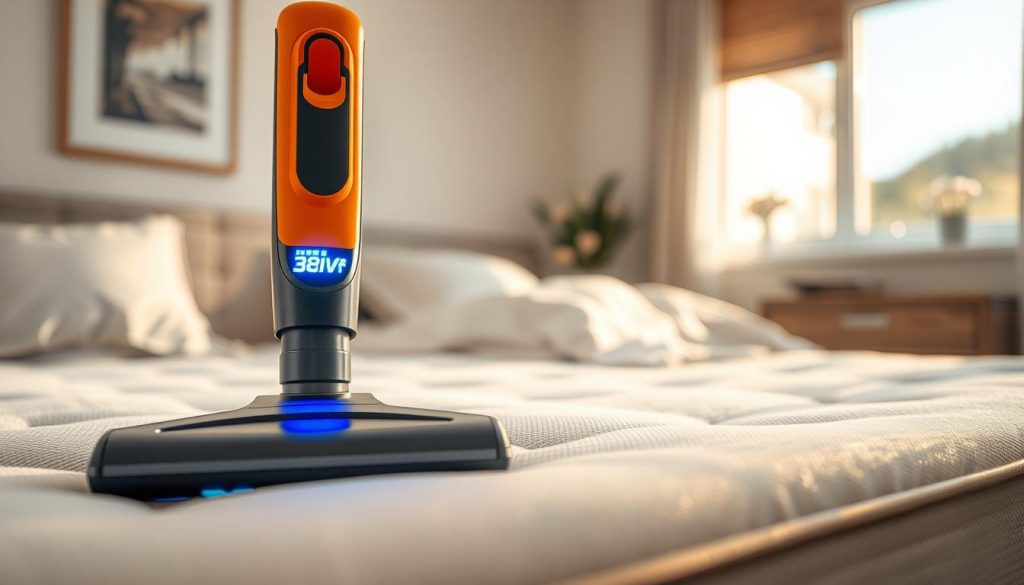
Best overall: Jimmy BX5 Pro — corded, uv-c light and hepa filter
Why choose it: The Jimmy BX5 Pro pairs a tapping brush with uv-c light and a hepa filter to target embedded dust and allergens. Its 5‑metre cord helps reach beds and wardrobes without moving sockets.
Considerations: It is heavier than handheld options and the cord does not retract.
Best multi-use: UZK — for mattresses, sofas and pet beds
Why choose it: UZK offers 16 kPa suction plus uv-c, hepa filtration and hot air mode. That mix makes it useful across upholstery and pet areas.
Considerations: Real-world pick‑up can vary depending on head contact and fabric.
Best affordable: JIGOO J300 — corded with hot air and uv
Why choose it: JIGOO J300 gives uv, hot air and hepa basics at a lower price point. It suits those who run routine sessions near a power outlet.
Considerations: You trade some edge and crevice performance for cost savings.
Best cordless: Dyson Car + Boat — powerful handheld vacuum
Why choose it: Dyson focuses on raw suction, ergonomic design and useful attachments. It excels at quick spot cleans and tight places between wash days.
Considerations: It lacks uv‑C and heat modes, so it is chosen for suction and convenience rather than light-based sterilisation.
How to use this shortlist: Our deeper reviews follow and help you weigh allergies, humidity control, storage space and budget. The right pick depends on which of those matters most to you.
Top pick in depth: Jimmy BX5 Pro mattress vacuum cleaner
We rate the Jimmy BX5 Pro because it combines mechanical agitation with steady power to lift embedded dust and particles from the sleep surface.
Why its tapping brush and deep suction stand out on embedded dust
The high-frequency tapping brush vibrates the top comfort layers to loosen trapped debris. That action helps suction reach beyond a skim of the surface.
The head’s wider base covers more area per pass. In practice this speeds up routine sessions across the mattress, though it may need extra passes along deep seams and piping.
HEPA filtration and UV-C sterilisation for allergens, bacteria and fine particles
Multi-stage filtration uses a HEPA element that meets the 99.97% airborne particle capture standard. This reduces recirculation of fine dust and pet dander during cleaning.
“The built-in light system adds an extra sanitising step while we run routine passes on the sleep surface.”
Why it matters: HEPA plus the light system helps households worried about allergens and bacteria keep particles from returning to the air they breathe.
What to know about the wider head, weight and non-retractable cord
The 5-metre cord gives consistent power and reach across beds and wardrobes. That suits corded vs cordless shoppers who prefer steady suction over battery limits.
Trade-offs: The non-retractable cord increases storage friction in small flats. The wider head speeds cleaning but demands slower, repeat passes in tufted areas.
| Feature | Benefit | Practical note |
|---|---|---|
| Tapping brush | Loosens embedded dust | Improves pick-up on comfort layers |
| HEPA filter | Captures 99.97% of particles | Reduces allergen recirculation |
| Automatic light system | Surface sanitisation | Adds hygiene step during passes |
| 5‑metre cord | Extended reach | Cord not retractable; needs storage space |
Who should consider it: shoppers who will run weekly sessions, want strong suction and filtration, and accept a corded design to avoid battery management.
Best for versatility: UZK bed vacuum cleaner for mattresses and upholstery
Versatility matters when a single device must tackle beds, sofas and pet bedding in tight Singapore homes. The UZK aims to be that one tool by combining light, heat and filtration in a compact body.
UV-C light, HEPA filter and hot air mode to tackle dust mites and humidity
The UZK ships with a claimed 16 kPa rating, an integrated uv-c light, a HEPA filter and a hot air mode. The hot air helps reduce local dampness that encourages dust mites, while the filtration captures fine particles that can worsen allergies.
Portability and storage for smaller Singapore flats
It is lightweight and compact, which suits HDB bedrooms and tight storage. The unit is corded and must stay plugged in; the cord is non-retractable, so plan storage space or an extension lead.
Who should consider it despite mixed suction feedback
Some reviewers praise pick-up, but our testing noted underwhelming suction on heavy debris. Slower, overlapping passes work best. Focus on pillows, the mid sleep zone and sofa arms.
- Good fit: light-to-moderate debris households and multi-surface use
- Tip: use overlapping strokes and repeat high-contact areas
- Note: includes aromatherapy tablets and Amazon 30-day returns
| Feature | Benefit | Practical note |
|---|---|---|
| 16 kPa spec | Reasonable suction on paper | May need extra passes on crumbs |
| Hot air | Helps reduce humidity | Useful against dust mites in warm climates |
| Compact design | Easy to store | Corded use; plan power access |
Best value pick: JIGOO J300 mattress vacuum with UV-C light and hot air
A compact, budget-friendly unit can cover the daily hygiene needs of many households without a hefty price tag. The JIGOO J300 sits at an accessible price and bundles HEPA filtration, UV LED lights and hot air mode into a corded, lightweight design.

Multiple modes to target dust, mites and dehumidifying without overspending
We find the J300’s modes aim to loosen lint and dust, reduce mite-friendly humidity and trap fine particles in a HEPA filter. The hot air vents can assist local dehumidifying during routine passes.
Compact design and day-to-day usability near a power socket
The unit is light and easy to carry onto a bed. Its small footprint suits Singapore flats where storage is tight.
Note: it is corded, so best use is near a socket or with an extension lead to cover larger beds.
Trade-offs: mode clarity and cleaning along edges and crevices
Mode indicators can be unclear, making it harder to tell which function is active without testing. The wide head picks up surface dust well but can miss tight seams and piping.
We recommend finishing edges and buttoned areas with slower, targeted passes to get rid of trapped debris.
“The JIGOO J300 is a practical value play: core sanitising and filtration at a lower entry price.”
| Feature | Benefit | Practical note |
|---|---|---|
| HEPA filter | Captures fine dust and dander | Reduces airborne particles during use |
| UV LED lights | Surface sanitisation step | Useful as part of routine cleaning passes |
| Hot air mode | Local dehumidifying | May help reduce mite-friendly damp spots |
| Compact, corded design | Easy storage and steady power | Requires socket access; extension lead recommended |
Who we recommend it to: budget-conscious shoppers who want a reliable mattress cleaner that covers dust, mites and basic surface refresh without the premium price. Use targeted passes along seams to compensate for a wide head.
Best cordless option: Dyson Car + Boat handheld vacuum for mattress cleaning
For many households, the most used cleaning tool is the one that is easy to grab. The Dyson Car + Boat is a high‑performance handheld vacuum designed for quick spot work across beds, sofas and car seats.
When raw suction and attachments beat UV-C features
Why suction matters: the motor spins at about 110,000 rpm and delivers strong pull that removes visible dust and pet hair fast. We find this makes a real difference when you want immediate results without a longer sanitising cycle.
“The Car + Boat is built to be used often; its power and tools make quick refreshes simple.”
Crevice access, ergonomics and quick clean-ups between wash days
Its slim profile and assortment of nozzles reach seams, tufts and piping where wider heads struggle. That access helps us get rid of trapped debris in buttoned or piped areas.
Practical note: this tool is cordless with optional docked power. The light weight and good balance reduce wrist strain during short sessions.
Price, warranty expectations and who gets the most value
The unit carries a two-year warranty. Expect sturdy build quality and better ergonomics than cheaper handhelds.
- Ideal for busy professionals and parents who need fast spot cleaning.
- Great when you want to protect a new mattress with frequent light cleans.
- Trade-off: no light‑based or heat sanitising, so pair it with regular bedding washes and protectors.
| Aspect | What it gives | Practical tip |
|---|---|---|
| Suction | High-speed motor; strong pull | Use slow passes along seams to extract debris |
| Attachments | Crevice tool, brush, mini motor head | Swap tools to reach tufts and upholstery gaps |
| Warranty & price | 2 years; varies by retailer | Good support if used as a daily handheld device |
Buying guide: features that actually matter in a UV-C mattress vacuum
Not all headline specs translate to better cleaning in real bedrooms — look at practical design choices first. We focus on safety, filtration and usable tools so you can compare models without being swayed by marketing claims.
UV-C light safety and activation on uneven surfaces
Safety first: many units use a contact interlock so the UV-C only lights when the head is pressed to the bed. That stops stray light but can fail on buttoned or indented surfaces unless you apply steady pressure.
HEPA filter performance for allergies
HEPA is designed to capture very fine particles. A good hepa filter traps dust and stops it blowing back into the air you breathe. Check filter replacements and seals.
Agitation, hot air and head design
Tapping or vibrating agitators often loosen trapped dust more than raw suction. Hot air vents can reach high temperatures and help dehumidify, but they are not a sole sterilisation method.
Power, noise and returns
Corded units usually give steadier power; cordless wins on convenience. Listen for pitch and volume if you clean early. Finally, check warranty and 30-day return policies and verify spare parts on listings like our top features checklist.
Conclusion
A steady routine is the single most effective way to keep sleeping surfaces fresher and less dusty. Choose the Jimmy BX5 Pro if you want a balanced, mattress-focused option; the UZK if you need multi-surface versatility; the JIGOO J300 for value; and the Dyson Car + Boat for cordless suction and attachments.
Use slow, overlapping passes and pay attention to seams, edges and the pillow zone. We recommend weekly use alongside regular bedding washes and a good protector. Vacuum underneath the protector from time to time.
Care tip: keep filters clean and empty the dust cup after each run so suction stays strong and odours do not build. A cleaner mattress can cut exposure to dust mites and fine particles, but persistent symptoms or a sagging, 5–10 year old mattress may mean replacement is the better option.

