
We set clear expectations for what a true wet-and-dry model can do in Singapore homes. Daily dust, hair and kitchen spills often end up on hard floors and at entryways. Our aim is practical results that suit HDB flats and condos.
By “wet and dry” we mean a unit that vacuums then uses a usable mopping system. This is not just a single water wipe. Combo machines are replacing separate devices for many households because they save time and storage space.
We focus on coverage, getting-stuck prevention, hands-free docks and mopping that removes grime rather than just spreading water. We prioritise real-world edge cleaning, carpet behaviour and obstacle avoidance over marketing figures.
Use our guide to shortlist models by budget, flooring mix and weekly upkeep. We want you to find a dependable robot that makes home cleaning simpler for busy families.
What we looked for in a wet and dry robot vacuum in Singapore homes</h2>
Our testing focuses on real-life runs: messy kitchens, pet hair and narrow corridors. We measure how machines combine suction with practical mop action to remove sticky spills, not just smear them.
Vacuuming versus carpets and hard floors
We test pickup on tiles and rugs separately. Brush design often matters as much as stated suction power. Carpet boost and roller brushes change real-world results more than numbers on a spec sheet.
Mopping systems that actually scrub
We compare dual spinning pads, vibrating flat pads and roller mop designs. Scrubbing performance is judged on dried stains and tacky messes. A genuine mopping system must control water, avoid over-wetting and rinse pads during long runs.
Navigation, obstacle avoidance and docks
We check obstacle avoidance for cables, slippers and pet messes to reduce getting stuck. LiDAR navigation gives stable maps; camera-based mapping adds AI detection that lowers the chance of a beached unit.
Hands-free docks should auto-empty, wash and dry mop pads, and refill clean water. We also note battery life, recharge-and-resume behaviour and noise for daytime use.
For a closer look at a model with a multifunction dock, see H12 Pro FlexReach.
Our top recommendations at a glance for 2026</h2>
Here is a compact shortlist to help you pick a model that fits daily life in Singapore flats. We highlight key trade-offs for mopping performance, mapping and dock automation so you can match a model to your routine.
Best premium option: Ecovacs Deebot X8 Pro Omni
Why it won: The ecovacs deebot combines a roller mop with an OMNI station for full washing and drying. Its 18,000Pa suction and hands-free dock reduce upkeep in larger flats.
Best for thresholds and mixed floors: Dreame X50 Ultra
Why it won: The dreame x50 ultra manages transitions with retractable LiDAR and strong 20,000Pa pull. Hot-air drying helps in humid climates.
Balanced features: Roborock Saros 10R
Why it won: The roborock saros blends reliable mapping and a multifunction dock. It suits homes that want solid mapping without flagship cost spikes.
| Model | Standout | Price (SGD) |
|---|---|---|
| Ecovacs Deebot X8 Pro Omni | Roller mop + OMNI station | Varies |
| Dreame X50 Ultra | Threshold handling, hot-air dry | Varies |
| Roborock Saros 10R | Multifunction dock | Varies |
Next we dive deeper into each pick, then give buyer advice for HDB and condo layouts so you can choose the right robot vacuum for your home.
Best wet and dry robotic vacuum cleaner for most Singapore households</h2>
For most Singapore flats we prioritise machines that handle mixed floors, thresholds and daily mess without fuss.
Why we rate the Dreame X50 Ultra for hard floors, carpets and home transitions
dreame x50 ultra suits tiles and vinyl. Its 20,000Pa suction power pulls grit from grout and dining areas. CNET lab runs show top coverage and near-perfect sand pickup on hardwood.
The unit reads rugs and lifts the mop away from carpet automatically. A tangle-free brush helps pet hair work well on low pile carpet. Thresholds up to about 6cm are crossed reliably by the lift system.
Standout features: 20,000Pa suction power, retractable LiDAR and mop handling on rugs
Retractable LiDAR helps under low furniture and improves mapping. Its lidar navigation and smart navigation limit getting stuck among cables and toys.
The dock auto-empty, washes mop pads and uses hot-air drying. Expect solid obstacle avoidance, but still clear bulky clutter for the smoothest runs.
| Spec | What it means | Notes (SGD) |
|---|---|---|
| Suction | 20,000Pa | Power for grout & carpet grooves |
| Navigation | Retractable LiDAR + SLAM | Better under-furniture access |
| Dock | Auto-empty + mop wash + hot-air | Requires space; refill tanks |
Best roller mop pick for deep mopping and spill control</h2>
We focus on a model built to remove sticky spills and dried-on sauces, not just leave a damp trace. The Ecovacs Deebot X8 Pro Omni pairs strong suction with a genuine roller mop system to tackle kitchen messes.
Ecovacs Deebot X8 Pro Omni with OZMO Roller Mop and OMNI station
ecovacs deebot X8 Pro Omni uses 18,000Pa and an OZMO roller to scrub, then the OMNI station handles auto-emptying and mop washing. This reduces manual rinsing and helps in Singapore’s humid climate.
Where it shines: dried-on stains, edge cleaning and self-cleaning mopping
The roller design beats simple spinning pads for streak-free coverage on thin spills like milk or juice. Its extending roller helps reach skirting boards and the crumb zone along cabinets for better edge cleaning.
- Strengths: excels on dried stains, wet spills and mop washing in the dock.
- Limitations: limited mop lift (~10mm), heavy chassis can struggle with some transitions and low-lying cables affect obstacle avoidance.
- Practical note: large OMNI station footprint and a premium price tag.
| Feature | Spec | Benefit |
|---|---|---|
| Suction | 18,000Pa | Strong pickup before mopping |
| Roller system | OZMO roller | Deep scrubbing, less streaking |
| Dock | OMNI station | Auto-empty, mop washing, dry cycle |
| Navigation | Precise SLAM | Good mapping; watch for cables |
Ownership checklist: top up clean water in the water tank every 2–3 runs, empty the dirty water after heavy mopping, and use floor-safe cleaning solution sparingly to protect finishes.
Best for low-maintenance cleaning with a self-cleaning dock</h2>
A set-and-forget cleaning routine is what many busy Singapore households actually want.
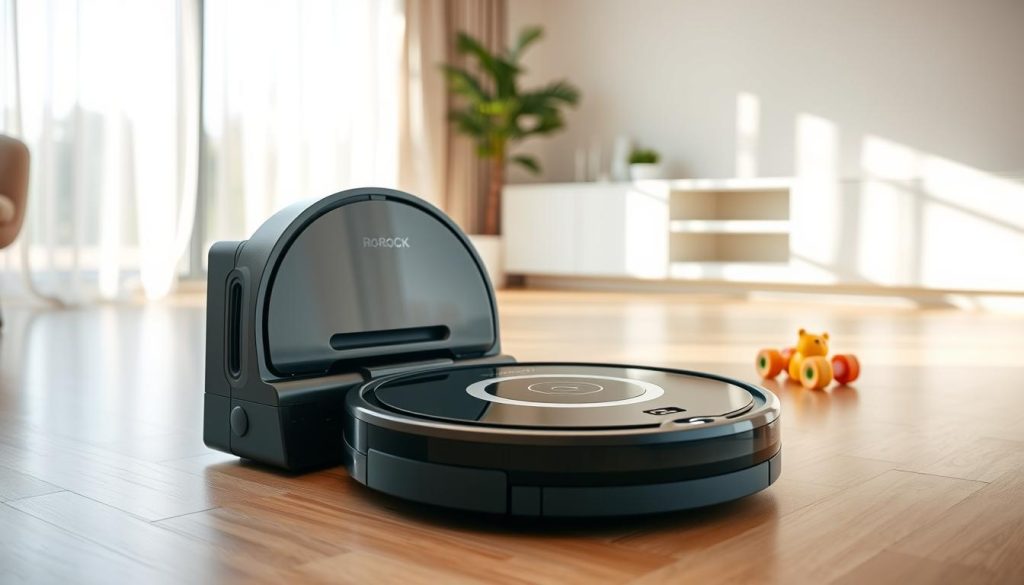
The Roborock Saros 10R centres on a multifunction dock that handles auto bin emptying and mop washing. It bundles strong mapping with reactive obstacle avoidance using 3D structured light.
How the dock helps day-to-day
Multifunction means the station empties dust, washes mop pads and stores clean water so the unit is ready for the next run. This reduces hands-on upkeep for households that prefer minimal fuss.
- Navigation: precise maps and carpet recognition to avoid wetting rugs.
- Obstacle avoidance: practical avoidance around chair legs, cables and toys.
- Voice control: a handy option for quick spot cleans after meals.
| Feature | Spec | Benefit |
|---|---|---|
| Dock | Auto-empty + mop washing | Less daily maintenance |
| Sensors | 3D structured light | Fewer stuck incidents |
| Floor rules | Carpet recognition | Prevents damp rugs |
Real downsides include dock noise during auto-empty, space needed near a power point, and ongoing consumable costs. Overall, we rate the Saros 10R as a strong set-and-forget option for mixed-floor Singapore flats.
Best value wet-and-dry robot vacuum we didn’t expect to impress</h2>
Among mid-tier options, one model stood out for offering a near-flagship feature set without the sting of a high price.
Mova P10 Pro Ultra: high suction, self-drying mop and voice control at a lower price
Mova P10 Pro Ultra surprised us by packing practical features that suit busy Singapore flats. CNET noted that newer brands have pushed flagship traits into lower tiers, and this unit follows that trend.
The self-drying mop is the standout for humid climates; it reduces odour and helps keep the station hygienic between runs.
Expect reliable suction for dust, hair and rice grains rather than headline suction power figures. Consistent pickup matters more than peaks for daily cleaning.
“Value does not mean cheapest — it means the right mix of automation, performance and upkeep.”
- Why consider it: strong cleaning, self-drying mop and helpful voice control for room routines.
- Practical note: this tier often hits the sweet spot if you want to cut daily sweeping and mopping time.
- Caveat: check app stability, firmware updates and spare-part availability before buying; these decide long-term satisfaction.
Best budget robot vacuum and mop combo with smart mapping</h2>
Affordable models can still deliver the features that matter most: reliable maps and bin automation. The TP-Link Tapo RV30 Max Plus gives those at a clear price point for small Singapore flats.
TP-Link Tapo RV30 Max Plus: LiDAR navigation and auto-empty dock for less
Why it stands out: 5,300Pa suction, LiDAR+IMU mapping and a 3L auto-empty dust bag that lasts about two months at typical use. Room-specific cleaning and carpet boost add real value for the price.
Trade-offs to know: basic obstacle detection and shorter battery life
LiDAR navigation gives straighter lines, more consistent coverage and easy no-go zones in the app. That improves day-to-day results versus non-mapping budget models.
- Mop expectations: surface cleaning for dust and light marks — not a deep scrub for dried stains.
- Practical limits: basic obstacle avoidance means cables and socks can still stop the unit, so some tidying is needed before runs.
- Battery life: shorter runtimes suit small flats; larger homes may need recharge-and-resume and longer total cleaning time.
- Carpet care: no mop lift means carpets should be set as no-mop zones to avoid damp rugs.
Bottom line: For first-time buyers who want automated dust management without flagship cost, the Tapo RV30 Max Plus is a sensible entry point — just expect occasional hands-on checks.
Other wet and dry robot vacuums we tested and considered in Singapore</h2>
Several other models earned close consideration during our rounds of testing and are worth a quick look. These were often near-misses or suited niche needs rather than being universal picks.
Xiaomi Robot Vacuum X20 Pro — dock automation for tiled floors
Who it suits: buyers wanting automatic mop washing and hot-air drying at a mid-range price point. It has 7,000Pa, LDS navigation and smart carpet detection with auto mop lift.
LG CordZero R5T-AUTO — brand support and app control
Why consider it: recognised appliance brand, maps your home, app control and a 2L auto-empty bag. It also boosts suction on carpets.
Midea MVC-I5C — simple 4-in-1 for tight budgets
At an entry-level price this model offers vacuum, sweep, mop and dry with a 450ml water tank. Navigation is basic, so it’s best where price matters more than advanced avoidance or mapping.
| Model | Standout | Price (SGD) |
|---|---|---|
| Samsung Jet Bot AI+ | 100+ obstacle ID; strong on hard floors | Varies |
| NARWAL Freo Z Ultra | Quiet operation; hot-water mop care | Varies by retailer |
| Xiaomi X20 Pro | Auto mop wash + hot air; smart mop lift | Varies |
Samsung Jet Bot AI+ and NARWAL Freo Z Ultra
Samsung impresses with LiDAR plus 3D sensors to avoid cables and pet waste, and it excels on hard floors. It is less effective at pet hair on deep carpets.
NARWAL appeals if you run daily cycles and want quieter runs plus hot-water care to keep mop hygiene high.
“Compare these alternatives by dock features, availability and local support before you decide.”
How to choose the right wet-and-dry robot vacuum for your flat</h2>
Choosing the right machine for your flat starts with mapping how you live and where dirt collects. We prioritise practical fit over headline specs so the unit actually reaches trouble spots.
HDB and condo layouts: room count, narrow passages and furniture clearance
Measure doorways and corridor turns. A small turning circle and low profile matter for narrow HDB halls.
Check furniture clearance so the device can reach skirting boards and under beds. If clearance is low, choose a model with slim height and precise navigation.
Hard floors first: tiles, vinyl and parquet realities
Assume hard floors are the daily norm in Singapore. Grout lines, parquet seams and kitchen grease all change how a unit vacuums then mops.
Look for good brush design and mop control to avoid streaks or over-wetting on delicate surfaces.
Carpets and rugs: mop lift, removal and carpet recognition
If you have many rugs, choose reliable mop lift or removable pads so carpets stay dry. Carpet recognition avoids accidental damp patches.
Homes with pets: brush design, anti-tangle systems and pet hair pickup
For pet households, anti-tangle brush systems and strong pickup for hair beat raw Pa figures. Consider brush types that resist matting and ease maintenance.
- Choose this if… lots of rugs = prioritise mop lift/removal.
- Choose this if… many chair legs = prioritise advanced navigation and obstacle avoidance.
- Dock planning: place the dock near a power point and out of main walkways.
- Routines: schedule short kitchen runs daily and bedrooms alternate days to cut noisy full-house cycles.
| Need | Key feature | Why it matters |
|---|---|---|
| Narrow corridors | Small turning circle, slim height | Reaches under furniture and into corners |
| Mixed floors | Adjustable mop control, good brush | Prevents streaks and protects parquet |
| Pets and hair | Anti-tangle brush, strong pickup | Less manual detangling and better hair removal |
Suction power vs real-world cleaning: what actually matters</h2>
Numbers on paper mean little unless the brush meets the floor. High Pa figures promise strong airflow, yet pickup depends on airflow sealing, brush contact and how the system holds up as bins fill.
Why brush design can beat raw Pa numbers for debris pickup
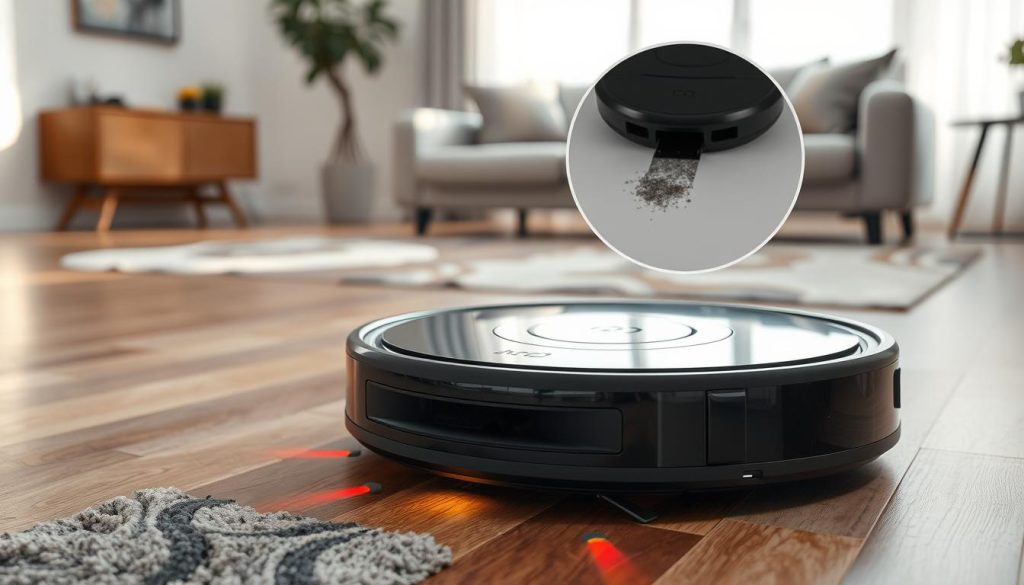
Large rubber rollers often outperform small bristle heads. The Verge highlights that rubber rollers pick up crumbs, hair and rice more reliably while tangling less.
Dual-brush layouts and flexible housings keep contact on uneven tiles. That means better cleaning without chasing peak suction claims.
Carpet boost and edge cleaning: where differences show up fast
Some models use carpet boost to raise airflow when rugs are detected. If the brush is shallow or poorly matched, that boost fails to lift embedded grit.
Edge cleaning separates contenders. Most visible dust piles along skirtings and under beds; a dedicated side brush or an extending roller matters here.
| Factor | Design element | Real-world benefit |
|---|---|---|
| Airflow | Sealed path, strong motor | Maintains pickup as bin fills |
| Brush type | Rubber roller vs bristle hybrid | Hair resistance, better crumbs pickup |
| Carpet handling | Carpet boost + lift | Deep rug cleaning without damp spots |
Obstacle avoidance and “getting stuck”: what separates premium robots from budget bots</h2>
Cameras, sensors and maps change whether a scheduled clean actually finishes. We test how different avoidance systems cope with the clutter of everyday life in Singapore flats.
AI camera detection often spots cables, socks and small toys before the unit tangles. The Verge notes this upgrade reduces rescues, but AI quality varies by brand and lighting.
Navigation approaches
SLAM is the mapping method that helps a unit learn a flat and follow repeatable routes. LiDAR navigation uses laser scans for stable maps; camera-based vSLAM can add object ID. Good maps enable room routines and reliable virtual boundaries.
Common failure points
Low-lying items, tight chair-leg clusters, sliding-door tracks and small thresholds still cause most getting stuck incidents. Even premium models can stall on thin cables.
How to reduce failures: manage loose cables, set no-go zones, clear toys before runs and use multi-floor maps if you move the dock.
| Approach | Strength | Typical weakness |
|---|---|---|
| AI camera + SLAM | Detects small obstacles | Needs light; privacy concerns |
| LiDAR + SLAM | Stable maps, reliable routing | Less object ID for cables |
| Sensor-only | Low cost; simple | More frequent tangles |
Mopping performance: choosing the right system for your floors</h2>
We judge mopping on three things: the mechanical action, water control and pad care. Each affects how well stains lift from tiles, vinyl or parquet.
Roller mop vs dual spinning pads vs flat pad vibration
Roller mop systems use a textured roller to scrub and absorb spills. They shine on sticky messes and give even water distribution with less streaking.
Spinning pads oscillate to scrub; they suit textured tiles and frequent spot stains. Vibrating flat pads deliver fast surface agitation for light marks and polished hard floors.
Water tank capacity, water control and avoiding over-wetting
Choose a sensible water tank size for your kitchen runs. Too little water leaves grimy streaks; too much risks over-wetting parquet and rugs.
Good models let you set flow per room. Auto carpet sensing prevents pad contact with rugs, which matters in mixed-floor Singapore flats.
Auto mop washing and hot air drying to prevent odours in humid weather
Mop washing stations that rinse and spin pads cut manual upkeep and reduce mildew. Hot-air drying further limits odour in humid climates.
We note Xiaomi X20 Pro, Dreame X50 Ultra and Deebot X8 Pro Omni for effective pad care. For practical routines, vacuum first to remove grit, then run the mop pass to avoid smearing.
“Match the action to the stain, control the water and keep pads dry between runs.”
For extra tips on unusual uses and maintenance, see our guide on clever session ideas.
Dock features and ongoing maintenance costs to factor in</h2>
Docks shape ownership costs as much as the machine itself. Choose a station level to match your routine and flat size. We break docks into three tiers so you can judge convenience against price.
Auto-empty dust bags: capacity, noise and replacement frequency
Auto-empty stations save daily bin emptying but use dust bags. A 3L bag often lasts weeks in a small flat; heavy pet households need monthly changes.
Note: the empty cycle is often the loudest action the station takes. Expect brief noise when the dock auto-empties.
Clean and dirty water tanks: what you’ll refill and how often
Full docks add separate clean and dirty water tanks. For a kitchen run we refill the clean tank every 2–3 sessions.
Empty the dirty tank after heavy mopping to avoid smells, especially in humid Singapore conditions.
Consumables checklist: brushes, filters, pads and cleaning solution
- Main brush/roller — check monthly for tangles.
- Side brushes — replace every 3–6 months depending on use.
- Filters — wash or swap per manufacturer guidance to keep suction steady.
- Mop pads — rotate between runs and replace as they wear.
- Dust bags and floor-safe cleaning solution — budget for replacements.
Support and spare parts availability in Singapore
We recommend checking local warranty terms and spare availability. Genuine parts on Lazada, Shopee or authorised retailers reduce long-term hassle.
Finally, plan dock placement early. Large stations need floor space and power access, but they can cut hands-on cleaning time with the right features.
| Item | Routine | Typical interval |
|---|---|---|
| Dust bags | Replace | 4–8 weeks |
| Water tank (clean) | Refill | After 2–3 mop sessions |
| Main brush | Clean | Weekly |
| Filters | Wash/replace | Monthly / 6–12 months |
“A multifunction dock reduces daily chores, but factor spare parts and dock noise into your price planning.”
Smart features that genuinely help day-to-day</h2>
Good smart controls should reduce tasks, not add them. We judge features by whether they save time in typical Singapore routines and cut hands-on upkeep for a busy flat.
Voice control with Alexa and Google Home for hands-free cleaning
Voice control tied to mapped rooms lets us start targeted runs without opening the app. Linking to Alexa and Google Home gives simple commands like “clean kitchen” or “pause in living room”.
App stability matters here; The Verge points out that unreliable apps undo the benefit of voice commands.
Room-specific routines: vacuuming and mop schedules by zone
We use room rules to match habits: entrances daily, kitchen after dinner, bedrooms on alternate days. This keeps the mop only where needed and reduces unnecessary runs.
Map editing and virtual boundaries protect pet bowls, cables and delicate areas. Good navigation means routines run with fewer rescues.
Do-not-disturb hours and quiet running for work-from-home households
Do-not-disturb scheduling and a quiet mode matter when calls or classes are happening. We set quiet hours for daytime work and let the unit resume louder tasks at night.
Camera-based obstacle detection can improve avoidance, but use it only if you are comfortable with the privacy trade-offs. Overall, pick features that make cleaning simpler, not more fiddly for your household.
Pricing in Singapore: what to expect at each tier</h2>
Understanding what each price band buys you makes choosing simpler for flats and condos in Singapore.
Budget picks: compromises to accept
On a tighter budget you can find competent models such as the Tapo RV30 Max Plus. These units give basic mapping or LiDAR, but mopping is light and docks are simple.
Expect more manual care: frequent pad changes, simpler obstacle avoidance and fewer dock functions. For tight budgets, plan for hands-on upkeep.
Mid-range sweet spot: mapping, better navigation and stronger mopping
Moving up the price ladder you reach the mid-range. Models like the Xiaomi X20 Pro or Dreame X50 Ultra add reliable navigation, LiDAR maps and stronger mopping action.
This band often represents the best blend of automation and value for most flats.
Flagships: the case for premium docks, better obstacle avoidance and top coverage
Flagship units bring advanced obstacle avoidance, full-service docks that wash and dry pads, and fewer run failures. The Deebot X8 Pro Omni shows how dock features raise convenience — and size and cost.
Spend more if you have pets, many rugs or a cluttered layout. Also factor total ownership: bags, pads and filters add running cost over years.
| Tier | Typical price (SGD) | What you gain | Trade-offs |
|---|---|---|---|
| Budget | Varies | Auto-empty options, basic mop | Manual pad care, simpler navigation |
| Mid-range | Varies | LiDAR mapping, stronger mopping | Moderate dock size, some consumable cost |
| Flagship | Varies | Full docks, top obstacle avoidance | Higher upfront price, larger dock footprint |
“Choose the tier that matches your layout and routine — the right navigation and mop system save time long term.”
Where to buy robot vacuums in Singapore and what to check before checkout</h2>
When buying in Singapore, where you buy matters as much as the specs on the page. We recommend checking stock, service and returns before committing to a purchase.
Local retailers and marketplaces to consider
Authorised brand stores and major electronics chains usually offer full local warranty and service. Examples we saw in testing include Takashimaya and Audio House for the Deebot X8 Pro Omni, Dreametech for the Dreame X50 Ultra, Roborock via Lazada for the Saros 10R, TP-Link via Dynacore and Harvey Norman for the Tapo RV30 Max Plus, and Gain City for LG models.
Warranty, returns and plug considerations
Confirm official local warranty period and nearest service centre. Parallel imports may look cheaper, but they can limit warranty support and spare-part access.
- Before checkout: verify dock type, mop lift or removal, obstacle avoidance tech and whether replacement bags or pads are stocked locally.
- Returns: check seller return windows — mapping and navigation behaviour often differs by home layout.
- Timing: major sale periods often give better price options; plan, but don’t expect guaranteed discounts.
| Channel | Advantage | Trade-off |
|---|---|---|
| Authorised store | Local warranty, demo units | Higher price |
| Major retailer | After-sales service, instalment plans | Limited stock of niche parts |
| Marketplaces (Shopee/Lazada) | Deals, quick delivery | Check seller reputation for warranty |
Conclusion</h2>
, We close with a focused checklist to help you choose a machine that actually works in your home.
Our “best for most” pick fits mixed hard floors and rugs, handles thresholds and has reliable obstacle avoidance for tight halls. It suits typical Singapore flats where daily spills meet carpeted zones.
If you favour deep mopping and spill control, prioritise roller-mop systems that scrub rather than merely dampen. If you prefer low-touch ownership, choose a large dock that auto-empty and washes pads while minimizing hands-on upkeep.
Match the robot to your floors, your clutter level and how often you want to tinker. For pet hair households, invest in brush design with anti-tangle engineering — this saves time and keeps performance steady.
Action plan: shortlist two to three models, measure furniture clearance and dock space, confirm local warranty and spare-part support, then buy at the tier that fits your routine.

