

We introduce what a wet and dry vacuum cleaner for tile floors is and why it has become a go-to upgrade in Singapore homes that face daily grit and sudden spills.
These machines pair suction with a mop roller to tackle stuck-on messes in one pass. They are typically lighter and less bulky than upright vacuum models, making storage in HDB flats easier.
We set expectations for “top rated”: real-world usability, pickup, upkeep and value — not just spec sheets. Our guide targets families, pet owners and busy professionals who want faster cleaning than a mop-and-bucket routine.
We will explain how a wet dry vacuum (suction plus wash in one pass) differs from a standard vacuum, and preview categories: best overall, best value, smartest, splurge, robot options and mixed-floor systems.
Key buying priorities we use are water management, tank size, battery life, edge reach, odour control in humid climates and long-term running costs.
For a practical checklist and a compact model suited to Singapore homes, see our quick reference on Lura’s system: Lura whole-house cleaning checklist.
Why a vacuum mop beats a mop-and-bucket on tile floors in Singapore homes
A single pass that lifts crumbs, rinses spills and leaves a near-dry surface changes how we clean our kitchens.
We favour a vacuum mop because it combines suction with a rolling mop head to pick up dry debris and handle light spills in one go. This removes the usual sweep-then-mop routine and saves time.
In humid climates, using less standing water reduces slip risks and damp odour. Common local messes — spilled drinks, cooking splatter and coffee grounds — smear less when lifted then rinsed immediately.
- Robot options are great for daily upkeep on open plans, but steps, thresholds and uneven tile can trip them up.
- A stick-style wet and dry model suits deep cleans, edge work and spot spills better than most robots.
| Type | Best use | Limitation |
|---|---|---|
| Stick wet-dry system | Deep cleaning, edges, spills | Heavier than a mop |
| Robot vacuum mop | Hands-free maintenance | Struggles with steps, uneven tile |
| Traditional mop & bucket | Cheap, simple | Two-step, leaves more standing water |
Our top picks at a glance for tile and used hard floors
This quick-scan list highlights machines that proved reliable on grout, high-traffic spots and area rugs. We summarise each pick in one or two lines to help you choose fast, based on real use rather than specs alone.
Best overall wet-dry vacuum
Narwal S30 Pro: Top pick for most families — 60 minutes battery life, excellent self-cleaning and strong water tank management (790 ml clean water / 720 ml dirty water).
Best value runner-up
Shark HydroVac MessMaster: Great for smaller flats and quick cleans; very user-friendly but shorter 23-minute battery life.
Smartest tech-forward choice
Dreame H15 Pro: RGB dirt detection with auto power boosts. Best for buyers who want intelligent modes to handle mixed messes.
Best splurge for multi-surface cleaning
Dyson V15s Detect Submarine: Premium heads for both hard surfaces and rugs, 60-minute runtime and separate clean water / dirty water management on the wet head.
Best robot vacuum mop for hands-free cleaning
ILIFE V5s Pro 2: Budget robot option with 100-minute runtime. Ideal for daily upkeep but watch uneven thresholds and steps.
Best two-in-one system for homes with both rugs and hard floors
Tineco Floor ONE Switch S7: Swappable modes for mixed floors, 65-minute runtime and effective iLoop dirt detection for smarter operation.
Best for hair on hard floor
Bissell CrossWave OmniForce: Designed to handle hair with reduced tangling and a two-tank system for cleaner results; expect about 30 minutes of runtime.
| Model | Strength | Notable trade-off |
|---|---|---|
| Narwal S30 Pro | Self-cleaning, strong tanks | Higher price |
| Shark HydroVac | Easy to use | Shorter runtime |
| ILIFE V5s Pro 2 | Long robot runtime | Struggles on uneven grout |
How we tested wet dry vacuums on hard floors and area rugs
We designed tests that mimic daily messes in Singapore homes. Our set-up covered tile with grout lines, used hard floors such as laminate and hardwood floors, plus low-pile area rugs at entrances. Each surface revealed different challenges for pickup and final drying.
Mess profiles: we scattered rice and cereal, added coffee grounds to rugs, and created sticky spills—milk with granola, mayonnaise and a cracked egg—to check whether devices smeared or truly lifted water and residue. These scenarios show real-world performance faster than spec sheets.
Suction checks measured how many passes were needed, whether larger debris was pushed ahead, and if fine grit stayed in grout lines. We timed self-cleaning cycles in real minutes and recorded battery behaviour under wet-use modes.
Manoeuvrability tests focused on turning radius, edge reach to baseboards, and the ability to lie low to clean under cabinets and around furniture. For maintenance, we inspected tank emptying, dirty water separation and brush roll care—comparing simple air drying to heated air drying that helps prevent musty odours in humid climates.
| Test area | What we measured | Why it matters |
|---|---|---|
| Tile with grout | Fine debris pickup, grout cleaning | Shows edge and suction effectiveness |
| Hardwood floors | Wet spill handling, streaking | Prevents warping and keeps surfaces near-dry |
| Low-pile rugs / area rugs | Scatter pickup, water control | Avoids soggy rugs and trapped dirt |
What to look for in a wet and dry vacuum cleaner for tile floors
Choose machines that balance water management and suction features to match how you live and the types of messes you face.
Water tank capacity and dirty water tank size
Tank capacity maps to real routines. A larger clean water tank reduces refills during a full flat clean. A roomy dirty water tank matters when you tackle grout or sticky spills.
Dirt detection and auto-adjust suction
Dirt detection is useful when it truly adjusts power on soiled entryways. We find it helps on heavily used tiles but is less valuable on light daily upkeep.
Brush roll design
A well-shaped brush roll reaches grout without scattering grit. Anti-tangle designs or hair-cutting features keep long strands from clogging the head.
Battery life and charge time
Battery life in minutes is key for Singapore flats: 20–30 minutes suits a 1–2 room clean, while 50–60 minutes covers larger homes. Faster charge times make back-to-back sessions practical.
Dry vacuum mode versus vacuum mop
Use a dry vacuum setting on area rugs to avoid sogginess. Switch to the wash mode only on hard surfaces to prevent trapped moisture.
Air drying and heat drying
Air drying helps after routine use, but heated brush drying reduces mould risk in humid climates. Self-cleaning with heat is a major plus.
Cleaning solution compatibility
Proprietary refills simplify dosing but add cost. Machines that accept a standard floor cleaner give flexibility for sensitive finishes and budget control.
| Feature | Why it matters | Practical tip |
|---|---|---|
| Clean water tank | Limits refills mid-session | Choose ≥500 ml for medium flats |
| Dirty water tank | Improves hygiene and reduces odour | Separate tanks are non-negotiable |
| Self-cleaning + heat | Prevents mildew on rollers | Prefer models with hot drying |
Best overall: Narwal S30 Pro Wet Dry Vacuum Cleaner
The Narwal S30 Pro stands out by combining powerful cleaning with hands-off maintenance for busy households.
Key specs that matter on hard floors: 20,000 Pa suction, 60-minute battery life, a 790 ml clean water tank and a 720 ml dirty water tank.
Smart sensing and automatic power
The built-in AI DirtSense detects heavier debris and adjusts suction automatically. It also announces mode changes, which helps when you move from an open kitchen to dining-chair nooks.
Self-care features that suit humid climates
Self-cleaning flushes the brush roll and then hot-dries it at 194°F. This reduces mildew risk and keeps the brush roll fresher between uses.
Practical design details
A scissor mechanism trims long hair from the roller, and the unit lies flat to 180° with tight 63° turns. This improves edge reach and cleaning around furniture.
Ownership notes
Expect proprietary refills and a deodorant module with jasmine and mint notes. We recommend emptying the dirty water tank after sessions to avoid bacterial growth.
- Who it suits: families, frequent messes, and anyone after low-maintenance routines.
- Consider: tank capacity when planning full-flat cleans and the cost of specialist cleaning solution refills.
Runner-up: Shark HydroVac MessMaster Cordless Wet-Dry Vacuum
We named the Shark HydroVac MessMaster our runner-up because it pairs intuitive controls with useful visibility aids. The LED headlights help expose dust on darker surfaces, while the simple docked rinse adds convenience for quick upkeep.
Why it shines on tile
The unit is easy to operate and manoeuvre on a hard floor. LED lights reveal fine debris that often hides at the edges of cabinets and under chairs.
Dock rinse cycle and noise
The self-clean cycle on the dock runs about 10 minutes. Expect a loud wash sequence near 80 dB; it is handy, but noisy.
Trade-offs and maintenance
Battery life is roughly 23 minutes, which suits smaller homes or spot cleans but limits whole-flat sessions.
The brush roll must be removed and left to air dry after use. We recommend removing excess water, separating parts on a rack and leaving them in a ventilated spot to cut mildew risk in humid Singapore weather.
Best use-case and buying guidance
This model works well for quick kitchen spills, daily upkeep and low-pile washable rugs such as Ruggable. It handles common debris and short wet spills without heavy smearing when used promptly.
- Who it suits: owners of smaller flats who want wet-dry convenience at a lower price point.
- Consider: the 23-minute runtime and the need for regular air drying of the brush roll.
| Feature | Detail | Practical note |
|---|---|---|
| Dock rinse | 10 minutes | ~80 dB noisy; saves manual rinsing |
| Battery life | 23 minutes | Good for zones; not whole-flat cleans |
| Water tank | Moderate capacity | Refill for longer sessions |
Smartest option: Dreame H15 Pro CarpetFlex Cordless Vacuum Mop
The Dreame H15 Pro uses RGB sensing to detect tougher spots and boost cleaning power where needed.
We like this model when automation matters. Its RGB dirt detection spots denser grime and raises suction and water output automatically. That helps on entryways and dining areas with stubborn debris.
Rug protection and brush intelligence
The unit auto-detects which brush is fitted and switches modes to avoid sending water onto rugs. This prevents common mistakes that leave mats soggy and heavy to dry.
Handling, runtime and ownership notes
The H15 Pro runs about 60 minutes on a charge and needs roughly three hours to refill the battery. It is heavier at around 19.4 lb, so carrying and one-handed use feel different from lighter sticks.
Some testers report the wet roller develops a musty odour after months despite self-clean cycles. We flag this as a real ownership consideration and cover maintenance steps later.
- Who it’s for: buyers wanting true automation and fewer manual choices during cleaning.
- Consider: weight, storage and ongoing roller care in humid Singapore conditions.
| Feature | Benefit | Practical note |
|---|---|---|
| RGB dirt detection | Auto boosts power on heavy grime | Helps with tracked-in debris at entrances |
| Auto brush detect | Protects rugs from excess water | Reduces risk of soggy mats |
| Runtime / charge | 60 minutes / ~3 hours | Good for whole-flat jobs; longer charge time |
Best splurge and best attachments: Dyson V15s Detect Submarine Wet-Dry Vacuum
For buyers willing to invest, the Dyson V15s Detect Submarine offers premium versatility rather than a single-use washer.
We like this model because it ships with three distinct heads that change real workflows. The Submarine wet roller handles sealed hard surfaces, the fluffy optic head highlights fine dust, and the Digital Motorbar tackles rugs and hair with reduced tangles.
Particle display and handheld tools
The LCD particle display gives visible proof of clean. It helps when fine dust or pet hair is a concern.
Handheld tools include a crevice tool, combination tool and a hair screw tool. These are useful in sofa seams, skirting gaps and tight kitchen corners common in Singapore flats.
Separate wet roller module
The wet head contains its own clean water and dirty water tanks. That design keeps water contained and lets us swap to a dry head for rugs without risking damp patches.
Limitations and ownership notes
There is no self-cleaning dock, so manual rinsing and drying of the wet module is required. On the plus side, Dyson does not force proprietary solution refills, which lowers ongoing cost if we use our preferred floor product.
| Feature | Benefit | Practical note |
|---|---|---|
| Three heads | Multi-surface coverage | Swap heads to avoid soggy rugs |
| LCD particle display | Visible cleaning feedback | Good for fine dust and hair |
| Separate water tanks | Confines water to module | Easier task switching and storage |
| No self-cleaning | Lower hardware complexity | Requires manual rinsing and drying |
Best combo system: Tineco Floor ONE Switch S7 Cordless Stick Vacuum
A single system that converts between a mop head and a stick saves space and doubles usefulness.
The Switch S7 pairs an ultra-slim cordless stick with a wet-dry floor washer that share a swappable battery. This means one power source, fewer chargers and simpler storage — a real plus in smaller Singapore flats.
FlashDry self-care and sealed air drying
The unit’s FlashDry heats to 158°F and uses sealed centrifugal air drying. That combo reduces odour risk by leaving the brush far less damp after cleaning.
Smart sensing and hair-friendly head
iLoop dirt detection adapts suction to mess levels, saving battery. The zero-tangle brush handles hair and larger debris without frequent snipping.
Practical notes
The 0.85 L clean water tank and 0.72 L dirty water tank keep refills and emptying manageable during a whole-flat session. Expect about 65 minutes of battery life, but note the system is heavy at roughly 34.4 lb; buyers who value a full system and strong drying will accept the weight.
| Feature | Spec | Why it matters |
|---|---|---|
| Swappable battery | Shared between both units | Fewer chargers; flexible use |
| FlashDry | 158°F + sealed centrifugal air drying | Reduces odour and mould risk |
| Tank sizes | 0.85 L clean water tank / 0.72 L dirty water tank | Less frequent refills; hygienic emptying |
| Runtime | ≈65 minutes | Covers most mixed-floor jobs |
Best for pets: Bissell CrossWave Omni Force Wet-Dry Vacuum
Pet owners often need a machine that treats fur, tracked grit and food crumbs without constant brush maintenance. The Bissell CrossWave OmniForce is our pick when hair is the main issue on hard floor areas.

Turbo boost for stubborn messes
Turbo mode delivers roughly 75% more suction to lift embedded hair, kibble and heavier debris in entryways and feeding spots. We use it in short bursts to avoid rapid battery drain.
Tank separation and brush design
The system uses two tanks — separate clean water and dirty water — so you do not reapply filth during a session. The tangle-free brush roll limits hair wrapping, which reduces maintenance.
Real-world limits and ownership tips
Battery life is about 30 minutes, suitable for spot cleans and medium flats but not large whole-home jobs. There is a self-cleaning mode, yet no self-drying feature.
“Empty the dirty water tank right after use and air the brush roll to prevent odour.”
For pet households, we value the tangle-resistant head and hygiene-minded tanks over the largest water tank or a flashy display.
Budget-friendly vacuum-mop combo to consider: Hoover BH55400V ONEPWR Wet/Dry Vacuum
On a tight budget, the Hoover BH55400V ONEPWR feels like a genuine step up from a mop-and-bucket. We found it quiet in operation, which suits homes with children, home workers and tight schedules.
Everyday tile performance: LED headlights and an edge-cleaning head help us reach baseboards where dust and crumbs hide on used hard floors. The LCD display is handy for mode checks and quick status updates.
Water tank reality: The 414 ml water tank capacity is modest. For small flats it works well, but larger areas may need one or more refills during a full session.
We tested pickup on common messes and found the unit handled larger pieces — macaroni, nugget chunks — while still managing fine grit. Expect about 30 minutes of battery life per charge; that covers spot cleans and medium rooms.
- Who it’s for: budget-conscious households seeking a simple upgrade.
- Consider: run the self-cleaning cycle twice if residue is heavy to help drain and freshen the head.
“Quiet, practical and honest about its limits — a smart budget pick.”
Another value pick: Stealth ECVP01 All in One Cleaner and Mop
The Stealth ECVP01 focuses on nimble handling, quick set-up and easy upkeep at an approachable price point.
Lightweight handling and a flexible swivel head let us reach corners, chair legs and clean right under furniture with minimal effort. That mobility makes short, frequent sessions simple to fit into busy Singapore routines.
Where it shines
It performs well at routine cleaning of fine grit and small food crumbs. Area rugs are fine when kept low-pile and the one-minute self-cleaning cycle is a genuine convenience.
Where it struggles
We found the unit less effective with larger pieces of debris and it struggles on high-pile carpet. If you have mixed surfaces or heavy messes, this model may feel limited.
Practical notes: the roller air-dries upright on the dock and the compact water tank is easy to fill. The single-charge battery suits quick chores rather than long, whole-flat sessions.
Who should consider it: buyers in smaller homes who prefer a simple vacuum-mop option for light daily upkeep over heavier, more complex machines.
Best robot vacuum mop for simpler routines: ILIFE V5s Pro 2
If you want a no-frills robot that keeps entryways neat between deeper cleans, the ILIFE V5s Pro 2 fits the bill. It is inexpensive, very quiet and easy to set up, so households that prefer low-intervention maintenance will appreciate it.
What you get
Runtime: about 100 minutes of uninterrupted use. That battery life covers multiple runs across typical Singapore flats and lets you schedule a session while you are out.
Switching modes and tanks
Changing from vacuum to mop takes roughly five minutes. The water tank is modest but effective; the unit rarely leaves excess water after a pass, so drying time is short on smooth surfaces.
Tile-specific caveat
The robot performs best on smooth hard floors. Uneven or textured tile can reduce mopping effectiveness and may confuse navigation. Treat this model as a maintenance layer rather than a replacement for deeper manual cleaning.
- Best use: daily upkeep on open plans and entryways.
- Tips: lift thin rugs, clear cords and plan runs away from wet zones near sinks.
Smarter robot alternative: ECOVACS DEEBOT T9+ Robot Vacuum and Mop
For households that want minimal fuss, the DEEBOT T9+ steps up daily upkeep with smarter navigation and less emptying.
Mapping, radar object avoidance, and auto-empty station
The app-based setup builds a map of your home. Expect the first run to take around two hours before routines feel effortless.
Radar object avoidance reduces bumps and helps the unit cross cluttered areas with fewer stuck moments.
The auto-empty dock holds roughly two months of debris, so we empty far less often. That lowers hands-on time for busy Singapore households.
Performance watch-outs: set-up time and pet hair
The unit is quiet and picks small items such as hair ties and screws. However, long-term tests showed mixed results on pet hair pickup.
Disposable mopping pads are simple to swap, but factor recurring costs and sustainability into ownership plans. Consider pairing the DEEBOT with a stronger hand-held unit if heavy hair is common.
“The T9+ is a smart step-up if you want mapped runs and a large auto-empty station to cut routine maintenance.”
Tile-floor performance checklist
When judging real-world performance, we test how a head and its contact geometry handle grout, skirting and corners rather than trusting spec sheets.
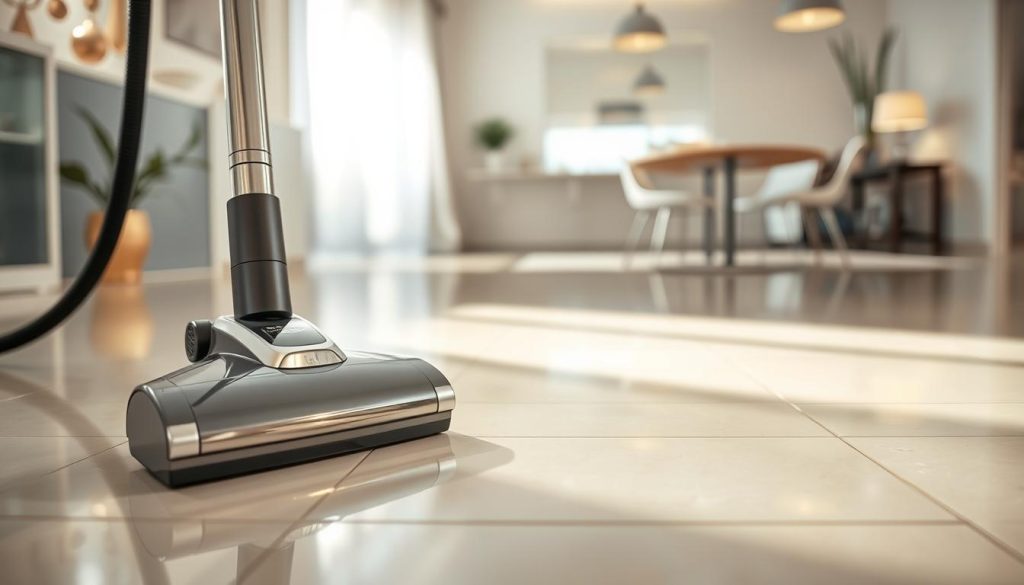
Grout lines, edge cleaning, and head design
The right head shapes pressure so a brush roll reaches into grooves and lifts dirt from grout instead of smearing it. We prefer designs that ride low and seal at the edge to pull crumbs out, not push them along skirting.
Handling wet spills vs dry debris without smearing
Good performance removes wet messes while still collecting dry debris in the same pass. Watch for streaks, dragged paste or cereal turned to slurry. Tests with milk or egg mixtures show whether a unit wets then lifts, or simply spreads the mess.
Preventing slip hazards: water control, passes needed, and drying time
Count how many passes are required to leave surfaces near-dry. We expect minimal residual water after one to two passes and quick surface drying in Singapore’s humidity. That reduces slip risk and odour buildup.
| Criteria | What we check | Practical cue |
|---|---|---|
| Grout cleaning | Brush contact, head seal | No grey outline after one pass |
| Edge reach | Head shape, swivel range | Skirting cleared without hand tools |
| Spill handling | Water pickup and debris capture | No streaks; no paste formation |
| Drying speed | Residual dampness after pass | Floor nearly dry within 10–15 minutes |
Maintenance, odour control, and long-term running costs
Long-term costs are driven less by the purchase price than by time spent on care and consumables. We must budget for replacement rollers, filters, pads and any brand refills. Regular upkeep keeps performance steady and reduces odours in humid climates like Singapore.
Self-cleaning cycles
Self-cleaning cycles flush internal pathways and rinse the brush. Typical docks take 8–12 minutes; Shark’s dock is about 10 minutes and can reach ~80 dB.
These cycles remove debris from the brush roll and move it into the dirty water tank. Run them after heavy jobs, but plan timing if noise matters.
Brush roll care
Air drying is fine after light use. Leave the brush roll upright in a ventilated spot and remove trapped hair.
Heat drying matters in humid Singapore. Units such as Narwal (≈194°F) or Tineco’s FlashDry (≈158°F) reduce mould risk and musty smells. Choose heat if you use the device daily or clean food spills often.
Cleaning solution and refills
Proprietary refills simplify dosing but add cost. Brands like Narwal push refills; others, for example Dyson, allow standard floor cleaner. We prefer machines that accept a mild floor cleaner to save money and avoid harsh chemicals.
Tank hygiene
Empty the dirty water tank immediately after use. Rinse seals, wipe filters and do not let dirty water sit overnight. This prevents bacterial growth and lingering odours.
“Empty dirty tanks promptly and run a rinse cycle weekly to keep systems fresh.”
Practical checklist:
- Run self-cleaning cycles after heavy messes.
- Air dry after light use; use heat drying where available.
- Choose reusable cleaning solutions where possible to cut costs.
- Empty and rinse the dirty water tank every session.
- Budget for brush roll replacements, filters and mop pads.
For an independent take on combo systems and consumable costs, see a detailed review of the best mop-vacuum combos at best mop-vacuum combo review.
Conclusion
, We close with clear guidance so you can pick a machine that fits Singapore living without overthinking specs.
Summary: choose a flagship wet dry vacuum if you want deep cleaning of hard surfaces and fast spill recovery. Pick a robot vacuum for hands‑free daily upkeep. A combo or stick system suits mixed surfaces and rugs while saving storage space.
Key trade‑offs are simple: water tank versus weight, automation versus manual upkeep, and wet cleaning power versus rug safety. Prioritise battery life and tank capacity based on home size and cleaning frequency.
Next step: shortlist two models, compare running costs (solutions, filters, rollers) and choose the one you will use weekly. That habit matters more than the highest price tag.

