

We introduce what this appliance does: it vacuums and washes sealed hard floors in one pass. Many models are ideal for Singapore flats where outdoor shoes bring in grit and sticky food spots appear often.
Wet dry options usually need charging, a clean water tank and a simple emptying step for the waste reservoir. Some are modular, offering a dry head for carpets and a wet roller for tiled halls.
In this roundup we group picks by use case, then show a comparison table and a short buying guide. We flag what matters most: edges and corners, tank size, maintenance and odour control. We also note when you may still need a separate dry unit for heavy carpet cleaning.
Our aim is to help shoppers in Singapore match models to HDB corridors, compact kitchens and pet-friendly homes. Read on to shortlist options that suit your floor mix and lifestyle.
Why we recommend a vacuum cleaner with a water tank for Singapore living
For many of us in Singapore, a wet dry vacuum can cut routine work by combining suction and a light wash in one pass.
Humidity, sticky spills and hard floors: where wet-dry cleaning helps most
High humidity makes grime cling to tiles and sealed wood, so a device that lifts dust and then runs a damp mop helps keep floors looking fresh.
In kitchens and dining areas we often face oil splashes, wet footprints in monsoon season and food crumbs. A single pass for suction and low-moisture cleaning saves time.
What these machines can’t replace
Limitations matter. Many wet dry units can’t deep-clean carpet fibres or reach high crevices. You should still keep a dry vacuum for rugs, sofas and mattresses.
Use the wet-dry as your floor specialist and rely on a separate dry vacuum for heavy pet hair, upholstery dust and thorough carpet care.
| Scenario | Ideal use | When to keep a dry unit |
|---|---|---|
| Sealed tiles and vinyl | Lifts dust, removes light dirt and mops | No — wet-dry unit sufficient for daily upkeep |
| Rugs and carpets | Not recommended | Yes — dry vacuum for deep fibre cleaning |
| Kitchen spills & wet footprints | One-pass suction and mop | Keep dry unit for crumbs on soft furnishings |
Wet dry vacuum basics: how clean and dirty water systems work
Understanding where fresh supply and waste go clarifies why some wet-dry units stay odour-free and others do not.
Many models use separate water tanks so a clean tank feeds fresh water while dirty water is collected in its own reservoir. This separation stops us from spreading grit or grime back onto floors.
Dual tanks versus combined trays
Dual tanks are a straightforward design: fresh feed, separate waste. Combined designs use trays and a roller to separate solids from liquid. The tray approach can cut blockages but may need more frequent emptying.
Brush roll and roller heads
A brush roll or twin roller agitates and lifts debris and pet hair, then channels dirty water into the waste side. Hair behaves differently by head design, so check how easy it is to clear tangles.
Self-propelling and real cleaning time
Self-propelling models pull themselves forward. We find they reduce wrist strain and shorten overall cleaning time in compact flats.
- Expectation: many units rely on roller pick-up rather than high airflow suction.
- Solids typically sit in a waste cup; liquid fills the dirty side faster during spills.
How we choose the best vacuum cleaner with water tank
We rate devices by how well they remove wet grime, dry quickly and stay easy to maintain in high-humidity homes.
Suction power and performance on wet‑dry messes
We measure suction and roller power on sticky spills and sandy entryways. Good performance means no streaks, quick drying and no smear of oily patches.
Battery life, charging time and swappable options
Real Singapore flats often need 25–35 minutes of run time. We note battery life, total charging hours (usually 4–5) and whether a swappable battery lets you finish in one session.
Edge cleaning and floor head design
Edge cleaning depends on nozzle geometry and head reach. Look for slim edges, flexible pivots and a low-profile head for closer wall contact and fewer missed corners.
Tank capacity and refill frequency
Tank size affects coverage. A larger clean tank and roomy waste reservoir reduce refill and empty stops, but dirty reservoirs fill faster when you pick up liquid.
Weight, handling and reach
Weight and overall design matter. Lighter units ease stair work; lie‑flat reach helps under sofas and beds without heavy lifting.
Maintenance, odours and hair control
Self-clean modes save time, but you must still empty reservoirs, clear hair from the roll and run a rinse cycle to avoid odours.
“We prioritise practical features that cut cleaning time and reduce upkeep.”
- What we test: suction, roller pick-up, tank endurance, edge cleaning and maintenance routines.
- Outcome: clear guidance so you match features to your flat size and daily messes.
Quick comparison of our top picks (runtime, tanks, standout features)
We lay out key specs so you can shortlist fast: runtime in minutes, tank capacities and standout features that affect daily cleaning and price decisions.
Practical note: battery minutes are useful, but realistic cleaning time per fill often matters more for tiled flats. Smaller reservoirs force more refills despite long run times.
“Match runtime and reservoir size to the typical area you clean in one session to avoid mid‑clean interruptions.”
| Model | Runtime (minutes) | Tank sizes (clean/dirty) | Standout feature / trade‑off |
|---|---|---|---|
| Dyson V15s | Up to 60 minutes | — (cordless, modular) | Long battery; cordless flexibility; higher price; limited water handling |
| Bissell CrossWave OmniFind | 25 minutes | 820ml / 640ml | One‑pass mop & suction; shorter runtime; good for hard floors; smaller tank |
| Tineco S5 Extreme | 35 min (auto) / 28 min (max) | 800ml / 700ml | Auto modes and self‑clean dock; moderate price; realistic cleaning time per fill ~20–30 minutes |
| Roborock Flexi Pro | Up to 50 minutes | varies (small semi‑opaque) | Lie‑flat reach and strong edge cleaning; smaller reservoirs limit continuous coverage |
How to use this: choose a model if its minutes cover a typical session for your flat size. If you clean large areas, prioritise larger tank sizes and swappable battery options over flashy features.
Best complete cleaning system: Dyson V15s Detect Submarine
For mixed Singapore homes we prize systems that swap heads fast so one machine serves carpets and sealed floors.
Why the modular heads suit mixed surfaces
Separate heads let us switch between an illuminated hard‑floor head, a carpet agitation head and the Submarine wet roller. Each head targets the task: the carpet head lifts fibres while the roll cleans sealed tiles without damaging finishes.
Runtime, charging and swappable battery
The unit claims up to 60 minutes of run time, though mode and head choice change real figures. A full recharge is about 4.5 hours. A swappable battery helps if you need to finish larger flats in one session.
Water limits and real‑world cleaning
The Submarine head holds 300ml, roughly enough for light, frequent mopping across ~1,000 sq ft. We find it ideal for quick upkeep rather than greasy deep cleans.
- Trigger‑hold design may tire some users over long runs.
- At 3.75kg it is heavier than many cordless units.
- Drain trench can leak if overfilled; mind the fill level.
“A premium system worth its price when you truly want one ecosystem for dry vacuum and light wet cleaning.”
Best one-sweep hard-floor cleaner: Dyson WashG1
The WashG1 is aimed at sealed hard floors and daily upkeep in compact Singapore flats. Its forward-and-back action and roller design make quick sessions easy to manage.
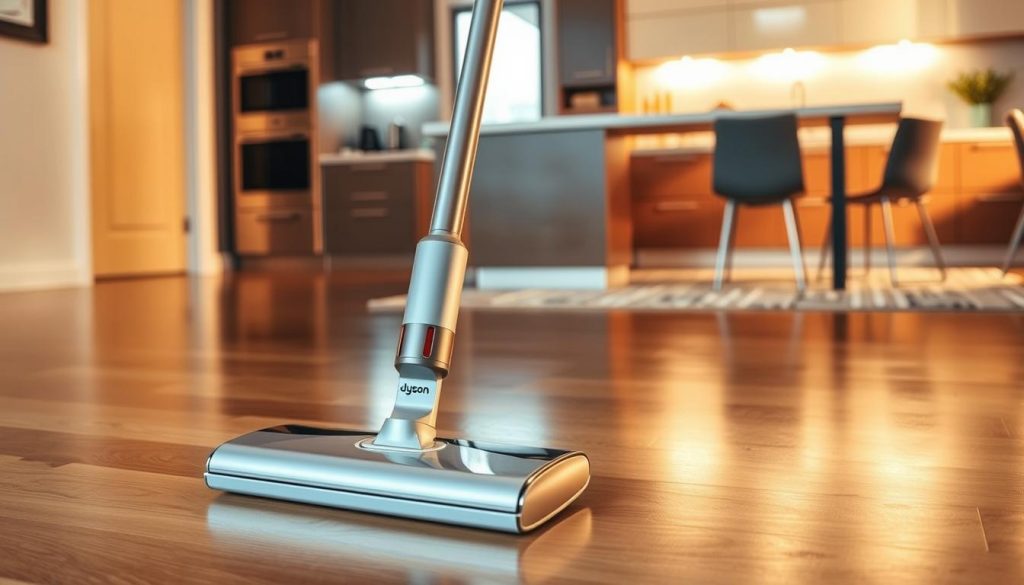
How the roller-and-tray system handles hair and reduces blockages
Rollers lift spills, hair and debris from the surface and fling solids into a separate tray. This stops most blockages in internal channels.
Result: less clogging and reduced odour, because dirty water goes straight to its own reservoir rather than recirculating through the head.
Edge cleaning to walls and the self-cleaning programme
The head offers one-sided edge cleaning so skirting boards and narrow corridors get closer contact.
There is a self-cleaning programme that rinses the rollers and channels. It helps hygiene but does not remove the debris tray—emptying that by hand remains necessary.
Water tank size and realistic cleaning time per fill
The unit uses 1L clean and 1L dirty tanks. In practice we get about 35 minutes per fill for normal sealed-floor runs.
Rollers are rated at roughly 25 hours of use and will need replacement eventually. Consider the premium price and the lack of steam sanitising when you decide if it suits your home.
“A fast one-sweep option for hard floors, ideal for pet owners and long-hair households who want fewer internal clogs.”
Best for homes with rugs and carpet: Bissell CrossWave OmniFind 4007E
When rugs and carpet are part of daily life, a device that treats both surfaces in one run earns its place. We recommend this model for small flats and rooms where mixed flooring is common.
Vacuum mop in one pass and separate clean/dirty water tanks
One-pass vacuum mop reduces steps during routine cleaning. The dual water tanks keep clean dirty water separated so we never mop with reused liquid.
FurFinder headlights for low-light spotting
The FurFinder headlights reveal dust and hair under tables and along hallways. This helps us target hidden messes quickly.
Where it falls short
Runtime is limited to 25 minutes, so battery life suits room-by-room work rather than a whole flat in one go.
Edge and corner performance can miss a narrow strip; expect a quick follow-up for skirting and tight corners.
- Why choose it: handles rugs and carpet while cutting cleaning steps.
- Caveats: tanks drain fast during heavy spills and it may power off if held too upright.
“A practical model for mixed flooring, provided you plan sessions to match its minutes and refill needs.”
Best steam option for hygienic cleaning: Bissell CrossWave HydroSteam Pet
Steam adds a hygienic edge to routine floor care, especially where pets and cooking grease meet. The CrossWave HydroSteam Pet pairs mop, suction and steam modes in one corded system to tackle greasy spots and pet accidents.
Dry, wet and steam modes for pet messes and area rugs
We like the three-mode set-up. Dry mode clears loose debris. Wet mode mops and suctions in one pass. Steam mode helps loosen grime and gives a more hygienic feel to rugs and sealed floors.
Tank sizes and what they mean for fewer refills
The clean tank holds 820ml and the dirty tank about 640ml. In practice this means fewer refills than many cordless mops, so longer continuous cleaning sessions before a pause.
Trade-offs: noise, cord limits and post-clean maintenance
Corded power gives consistent performance and stronger suction than many cordless rivals. But the unit is heavy at 5.67kg and can be noisy in use. The cable also needs care around tight furniture layouts.
| Feature | Spec | Practical effect |
|---|---|---|
| Clean tank | 820ml | Fewer refills for routine sessions |
| Dirty tank | ≈640ml | Accepts liquid messes before emptying |
| Modes | Dry / Wet / Steam | Flexibility for pet hair, rugs and oily spills |
| Weight & noise | 5.67kg; loud | Better for thorough cleans than quick touch-ups |
“The self-clean cycle helps, but allow time to empty and rinse parts to avoid lingering odours.”
Best value wet-dry floor washer: Tineco iFloor 5
The Tineco iFloor 5 aims to deliver strong daily cleaning at a lower price point than flagship systems.
Eco vs Max: practical battery expectations
In Eco mode we see over 30 minutes of run time, enough for a typical HDB living area. This suits light crumbs and everyday dust.
Switch to Max and power rises for stubborn grime, but runtime drops to just over 20 minutes. Charging takes about 4–5 hours.
Edge cleaning gains and corner reality
The head offers enhanced edge cleaning so skirtings and narrow corridors get closer contact. That reduces touch‑ups along walls.
Tight corners still need a quick follow‑up pass with a handheld or small brush. The iFloor 5 does well up to the edge but not inside acute corners.
Self-clean mode and hair on the brush roll
The self-cleaning cycle rinses the brush and channels, which cuts the gross parts of upkeep. We still empty the reservoirs and air parts to avoid odour.
The brush roll resists tangles, so long hair and pet hair come off more easily. That lowers maintenance time for multi‑person and pet homes.
- Value positioning: a cost‑conscious, dedicated floor one unit for sealed surfaces.
- Limitations: it cannot lie flat under low furniture and does not replace a dry-only machine for rugs and upholstery.
“A practical choice when you want efficient wet dry cleaning without flagship prices.”
Best smart wet-dry pick: Tineco Floor One S5 Extreme
We favour machines that match their modes to common Singapore spills rather than a one-size-fits-all approach. The tineco floor one S5 Extreme offers three clear options: suction-only for fresh spills, Auto for everyday dirt and Max for stubborn marks.
Suction-only vs Auto and Max
The suction-only setting picks up liquid spills fast and helps floors dry sooner. Use Auto for routine dirt; the unit ramps power as needed. Switch to Max when grout lines or greasy patches need stronger action.
Tank size and how dirty water behaves
Clean and dirty reservoirs are 800ml and 700ml respectively. Those water tanks feel generous, but dirty water fills faster on liquid messes and may force extra pauses.
App and voice guidance
We find the app and voice prompts useful for status alerts but not essential. Smart features are handy, yet they don’t replace a quick perimeter touch-up—edge cleaning remains a weak spot and hair can tangle the roll.
- Runtime: ~35 minutes (Auto) and ~28 minutes (Max), charge 4–5 hours.
- Weight: 4.5kg; good for flats but heavy for stairs.
- tineco floor one s5 extreme is a smart choice when you want flexible modes and clear cleaning feedback.
“A smart pick for mixed daily messes, provided you accept a quick edge pass afterwards.”
Best mid-range smart cleaner: Tineco Floor One S3
The Tineco Floor One S3 sits between budget and flagship lines, offering smart cues that help you finish routine cleaning without fuss.
Digital battery indicator and runtime expectations
The S3 gives a clear digital percentage readout so we know exactly how much charge remains. This makes planning a full session easier than guessing from bars.
It runs up to 35 minutes on a charge and needs about four hours to top up. In most HDB flats this covers a living room and kitchen in one pass.
Self-propelling feel and self-clean cycle for easier upkeep
Self-propelling motion reduces wrist strain during longer runs across open-plan spaces. The light, responsive design helps us move the unit steadily without forcing it.
The unit self-cleans after use. We still empty the clean and dirty reservoirs—600ml and 500ml respectively—then rinse and air parts to avoid odours.
| Spec | Value | Practical note |
|---|---|---|
| Clean / dirty tank | 600ml / 500ml | Adequate for routine jobs; large spills may need a mid-clean empty |
| Runtime | Up to 35 minutes | Covers typical rooms in a Singapore flat |
| Smart features | Digital display, app & voice | Useful guidance but optional for daily use |
“A practical mid-range option that balances smart guidance and simple upkeep for sealed floors.”
Best for edges and under furniture: Roborock Flexi Pro
We find the Roborock Flexi Pro excels where space is tight and dust hides beneath low furniture. Its low‑profile design and strong edge cleaning mean fewer follow‑up passes in rooms that collect crumbs and hair.

Lie-flat access and edge cleaning performance in tight layouts
The Flexi Pro can lie almost flat so it reaches under beds, sofas and TV consoles. That reach changes outcomes: we notice fewer missed dust lines and less manual sweeping along skirtings.
Detection mode that auto-adjusts power as needed
Detection mode senses dirt and ramps power automatically. This reduces guesswork when moving from open halls to greasy kitchen patches and keeps battery use efficient.
Small, semi-opaque water tanks: what this means day-to-day
The unit uses compact, semi‑opaque tanks (≈0.73L clean and 0.43L dirty). They suit quick sessions and look neat, but we often remove them to confirm levels rather than rely on sight alone.
Battery life of up to 50 minutes supports larger sessions and a four‑hour charge is reasonable for full‑flat coverage. A self‑cleaning cycle helps upkeep, though sticky spills may still need manual roller attention.
“If edge performance and under‑furniture access matter most, the Flexi Pro is worth the premium.”
- Good for: tight Singapore layouts, skirting and low‑profile reach.
- Consider: small tanks and occasional manual roller cleaning after heavy spills.
- Runtime: up to 50 minutes; charging ≈4 hours.
Best alternative to Dyson Submarine: Bosch Unlimited 7 Aqua
If you want a flexible system that swaps between dry suction and a mop head, the Bosch Unlimited 7 Aqua is worth a close look. It pairs a compact dry head with a dedicated wet mopping head and a set of tools for edges and spot jobs.
Dry head plus wet mopping head in one modular kit
Modularity matters. The dry vacuum head tackles crumbs and dust while the mop head handles light damp cleaning. Included tools cover skirtings, narrow gaps and quick spots around kitchens.
Runtime realities across Eco and Turbo modes
Expect up to 40 minutes in Eco when using a small tool, about 30 minutes Eco with the floor head and roughly 10 minutes on Turbo. That short Turbo span is best for quick bursts, not whole-flat sessions.
Where the mopping head works best
The mopping head shines for little-and-often cleaning routines that keep sealed floors tidy. Beware sticky, heavy spills: the head can smear tacky messes rather than remove them fully.
Value note: a single battery limits long, continuous runs. For most flats this is fine; larger or multi-storey homes may prefer swappable power despite the lower price versus premium rivals.
Best premium all-in-one floor care: Philips AquaTrio Cordless Vacuum & Wash
The Philips AquaTrio blends cordless convenience and high-speed brushing to tackle daily floor upkeep in one platform.
It is a true 3-in-1: vacuum, vacuum & mop, and handheld mode. This reduces clutter in compact Singapore flats where storage is tight. We can switch modes fast for hallways, kitchens and spot jobs.
Brush performance is a clear differentiator. The AquaSpin brushes reach up to 4,000 RPM to lift fine dust and grime from sealed floors. That speed helps remove sticky residues during routine cleaning.
Convenience features matter for real‑world use. An Auto-Clean System rinses the wet head after use, cutting manual upkeep. LED nozzle lights are useful, not a gimmick—they reveal fine dust under beds and along skirting in low light.
Runtime is up to 45 minutes per battery. Add an optional second battery and we approach 90 minutes, enough to cover up to 185m² in staged passes. At roughly 4.2kg it is manageable for most users, though carrying between floors still merits thought.
Why it suits Singapore flats
- Three-in-one setup saves storage and replaces multiple tools.
- High-speed AquaSpin brushes boost daily cleaning results.
- Auto-Clean and LED lights reduce upkeep and improve visibility.
| Spec | Value | Practical note |
|---|---|---|
| Modes | Vacuum / Vacuum & mop / Handheld | Flexible for mixed chores and spot cleaning |
| AquaSpin brush | Up to 4,000 RPM | Lift fine dust and light grime on sealed floors |
| Runtime | 45 minutes (single) / 90 minutes (dual) | Covers medium to large flats with optional second battery |
| Weight | ≈4.2kg | Manageable for most, consider stairs |
“A premium all-in-one that pares down tools while keeping daily floor care fast and visible.”
Best for hot-water deep cleaning: Dreame H15 Pro Heat Wet and Dry Vacuum Cleaner
Hot-water mopping lifts grease and baked-on food far more effectively than cold rinses, and that is the Dreame H15 Pro Heat’s core selling point.
ThermoRinse heats the mop roller to about 85°C. That temperature helps loosen sticky dirt and oily residue so our cleaning passes remove grime faster.
ThermoRinse hot-water cleaning for grease and stubborn stains
Hot roller action breaks down cooking residue better than cold mopping. In kitchens prone to oil and dried spills, this raises cleaning effectiveness.
Gap-free edge coverage and anti-tangle scraper for hair
The front offers true 0mm edge cleaning so we reach skirtings and narrow corridors without gaps. The anti-tangle scraper reduces hair wrap and keeps the roll turning during a run.
Self-cleaning and drying base, plus weight considerations
The dock rinses and dries parts using water up to 100°C, which cuts odours and reduces hands-on rinsing after use. Suction reaches up to 22,000Pa, giving strong pick-up for debris while the roller works.
Runtime is up to 70 minutes, and the unit lies flat to 180° for under‑sofa access. Note the machine is fairly heavy at ~6kg and runs about 74 dB. We advise gentler modes for delicate timber to avoid marking.
| Spec | Value | Practical effect |
|---|---|---|
| Suction | Up to 22,000Pa | Reliable debris and liquid pick-up during hot cleaning |
| ThermoRinse roller temp | ≈85°C | Loosens greasy stains for faster removal |
| Self-clean base temp | Up to 100°C | Reduces odour and speeds drying of parts |
| Runtime | Up to 70 minutes | Long sessions for medium to large flats |
| Edge cleaning | 0mm front gap | Tighter skirting and corridor coverage |
How to match a wet dry vacuum to your floors and home size in Singapore
Match runtime, refill needs and head design to your flat size and usual messes before you shop. This practical start helps us avoid models that interrupt a session or damage delicate surfaces.
HDB flats vs landed homes: battery choices and tank trade-offs
For compact HDB layouts we find ~25–35 minutes and modest tank capacity usually suffice. Longer runs or landed houses benefit from 50+ minutes or a swappable battery to finish bigger areas in one go.
Safe modes and rollers for sealed wood, vinyl and tiles
Use gentler modes and soft rollers on sealed wood to avoid over‑moisturising. Tiles and vinyl tolerate firmer action; an aggressive roller can lift baked grime but may need slower drying.
Pet hair and long hair: reduce tangles
Look for a brush roll that resists wrapping and includes scrapers. Heavy pet hair and long hair fill a tank faster and demand easy‑remove rollers to cut maintenance time.
| Home type | Runtime (minutes) | Tank note |
|---|---|---|
| Small HDB flat | 25–35 | Smaller tank, lighter handling |
| Large flat / landed | 50+ | Large tank or swappable battery |
| Pet household | 35–50 | Robust brush roll; easy‑clean roller |
“When floors vary, we pair a wet system for daily hard-floor resets and a dry unit for rugs and upholstery.”
Running costs and upkeep we factor in before buying
We judge a model by more than its upfront price. Ongoing costs and routine care shape how useful a device is for busy Singapore homes.
Proprietary cleaning solution vs plain water. Some brands recommend a proprietary cleaning solution to lift grease and stubborn stains. That helps in kitchens and pet areas.
For light daily cleaning, plain water and a mild detergent work well. Use a branded solution when the manual says it improves performance on oily marks.
Brush life, filters and replacement parts
Brush roll wear is a real cost. For example, the Dyson WashG1 rollers are rated at about 25 hours of use before reduced effectiveness.
Filters and spare brushes add to running costs. Check local Singapore availability and price of replacement parts before you buy.
Cleaning dirty water reservoirs without lingering smells
Dirty water builds odours fast if left sitting. Our routine: empty immediately after use, rinse seals, then air‑dry for several hours.
Self-clean cycles help but do not replace a full rinse after heavy spills. For hygiene, avoid leaving dirty water in the reservoir overnight.
Practical checklist and time trade-offs
- Estimate annual spend on solutions, filters and spare brushes against the unit’s price.
- Factor hair management: less tangling saves service time and keeps suction consistent.
- Check warranty, local parts supply and service centres to reduce unexpected repairs.
| Item | Typical life / interval | Practical monthly cost (SGD) |
|---|---|---|
| Brush / roller | 20–40 hours use | Varies |
| Filters | 6–12 months | Varies |
| Proprietary cleaning solution | 1–3 months (regular use) | Varies |
| Reservoir cleaning & drying | After every use | Time cost: ~5–10 minutes |
“A small monthly spend and a simple rinse routine keep machines smelling fresh and performing well.”
Conclusion
Conclusion — choosing the right kit. Our quick guide helps you match the best vacuum cleaner with water tank to your home and habits in Singapore.
For mixed floors choose modular systems; for sealed floors pick a one-sweep washer. If rugs or pets dominate, favour carpet-capable models. Hygiene-led buyers should consider steam or hot‑water options.
Focus on four filters: edge cleaning, tank size and refill rhythm, maintenance effort and realistic battery life in minutes. A wet dry vacuum speeds daily cleaning but rarely replaces a dry unit for deep carpet care.
Shortlist two to three models (Dyson, Tineco Floor One, Bissell, Roborock, Bosch, Philips, Dreame), match them to your flat size and priorities, then decide which trade‑off — weight, refills, corners or upkeep — you can live with.

