

We begin by clarifying how most Singapore readers frame this search: a wet‑dry machine that vacuums and washes hard floors in one pass, then keeps dirty liquid separate.
We set expectations: such machines are not a single do‑all gadget. Performance varies sharply with floor type, home size and cleaning frequency.
Our shortlist focuses on daily practicality for flats and HDBs, quick spill handling and the way high humidity affects odour. We explain how we score pickup, wash results, edge cleaning, runtime and upkeep.
We aim to guide purchases with real‑world trade‑offs: better cleaning often requires more maintenance of tanks, brushes and filters, so we outline ownership work involved.
For a deeper look at water filtration vacuums and why some models suit local homes, see our detailed note at Lura on water filtration vacuums.
Why we’re reviewing water vacuum cleaners for Singapore homes
Singapore flats and HDBs pose a distinct cleaning challenge that often pushes us towards machines that handle spills and damp messes. We see mostly hard floors in living areas and kitchens, so tools that mop and pick up liquid have real daily value.
Hard floors, humidity and everyday mess
Hard floors dominate local layouts, and humidity affects hygiene. When grime and water sit in a device, odour builds fast. That makes maintenance and tank separation crucial in this climate.
Wet dry versus dry vacuum: typical meaning
When readers search for a vacuum cleaner with liquid handling, they usually want a wet dry floor washer that lifts both liquids and solids. This is different from a simple dry vacuum that only deals with dust and crumbs.
- Local practicality: small dwellings favour compact tanks, light weight and small docking footprints.
- Limitations: many wet dry models suit hard surfaces only; mixed-floor homes may need a separate dry vacuum head or a different machine.
- Spill response: the right wet dry unit clears drinks, sauces and wet footprints quickly without spreading dirty water.
Next, we compare broad categories — manual floor washers, 2-in-1 stick systems and robot moppers — so readers can pick the right type before choosing a specific model.
How we tested and compared wet dry vacuum cleaners
We tested a broad range of wet dry machines in real Singapore rooms to see how they handle daily messes. Our protocol mixes small flats, common floor types and timed tasks to mimic local routines.
Cleaning performance on dirt, debris and sticky messes
We ran three mess simulations: fine dust and grit, larger debris like crumbs, and sticky spills that can smear. Each model earned scores for actual pickup versus smear. Reliable removal without residue scored highest.
Suction, brush and roller design, plus edge cleaning
We measured suction in context: raw pull matters, but brush design and roller action decide whether hair and debris end up in the tank or wrapped around shafts.
Edge cleaning tests checked how close heads get to skirting boards and corners. Units that left a visible line scored lower for edge cleaning.
Battery, runtime minutes and charge time
We standardised comparisons using published max runtime minutes, then translated those minutes into spot cleans and whole‑flat runs. Charge time mattered: a long top‑up reduces daily convenience even when runtime looks strong on paper.
Tank capacity and clean/dirty water separation
We scored tank size by how often we had to refill the water tank and empty dirty water. Consistent clean dirty water separation under load earned higher marks.
Maintenance, handling and value in Singapore
Self‑clean cycles help, but we assessed drying needs and odour buildup. Handling tests covered weight, balance, self‑propulsion and lie‑flat reach under furniture.
Value includes local price, spare part availability and running costs for filters, brushes and detergent. These shape long‑term ownership far more than launch price alone.
Quick spec comparison
| Model | Tank (L) | Max runtime (minutes) | Charge time (minutes) |
|---|---|---|---|
| Tineco Floor One S7 Pro | 0.6 / 0.8 | 35 | 180 |
| Roborock F25 Ace | 0.45 / 0.6 | 90 | 240 |
| Shark HydroVac Cordless | 0.5 / 0.65 | 45 | 210 |
| Dyson V15s Detect Submarine | 0.4 / 0.5 | 60 | 180 |
What is the best water vacuum cleaner for most people
For most flats and HDBs we favour a model that balances pickup and real‑world washing without heavy upkeep.
Our top pick is the Tineco Floor One S7 Pro. It pairs smart sensing with strong agitation and a self‑clean roller, which works well on hard floors in humid Singapore homes.
Smart sensors and Auto Mode
The iLoop sensor system scans debris and adjusts power and water flow automatically. This reduces guesswork and saves detergent for routine cleaning.
Usability and modes
Self‑propulsion, clear prompts and Ultra/Max/Suction settings give flexibility for spills or deep scrubs. We found switching modes quick and intuitive for non‑technical users.
Limits: battery and dirty tank
Spec wise, the unit has about 40 minutes max runtime and a 0.85L clean tank with a 0.72L dirty water tank. In practice, battery life can cover most flats but larger homes need breaks.
Important: the dirty water tank fills fast and should be emptied and rinsed after nearly every run to avoid odour and maintain performance.
| Feature | Spec | Impact for users |
|---|---|---|
| Clean tank | 0.85 L | Enough for routine flat cleans |
| Dirty water tank | 0.72 L | Requires emptying after most sessions |
| Max runtime | 40 mins | Good for small to medium flats |
| Weight | 9.75 kg | Stable but not ultra‑light |
Best runner-up for powerful wet and dry cleaning
For those who favour manoeuvrability and extended sessions, this model stands out.
Roborock F25 Ace for manoeuvrability and long battery life
Roborock F25 Ace feels notably lighter in use thanks to its 6.2kg weight and power-assisted wheels.
The lie-flat design lets us reach under beds and low cabinets with less fuss. Its 60 minutes max runtime handles larger flats, though higher power settings will cut that time.
Hot water versus room temperature dock cleaning for grease and grime
The dock offers a choice: room temperature cleaning saves energy, while a hot water cycle tackles kitchen grease more thoroughly.
After wash cycles the dock blows hot air to dry the roller and reduce odour, which helps hygiene in humid Singapore homes.
Who should choose the Combo option if you need carpets covered
This model is optimised for hard floors and wet dry performance. It is not a carpet-first device.
If carpets matter, consider the Combo bundle: a stick unit shares battery and dock, giving a handy two-in-one setup without extra storage fuss.
| Spec | Value |
|---|---|
| Clean tank | 0.74 L |
| Dirty tank | 0.72 L |
| Max runtime | 60 minutes |
| Charge time | 6h 30 |
Best budget water vacuum cleaner for hard floors
For small flats we favour a compact, affordable model that delivers credible wet dry cleaning on hard floors without feeling flimsy. Our pick gives strong everyday value at a lower price while remaining practical for routine use in Singapore homes.
Shark HydroVac Cordless for value‑led wet dry performance
Shark HydroVac Cordless earns its place by balancing price and reliable pickup. It weighs 3.95kg, holds a 0.5L water tank and runs up to 25 minutes on a full charge. Charge time sits around 4 hours, so quick top‑ups suit frequent short cleans.
Low‑pile rugs: what it can handle and what it can’t
It refreshes low‑pile rugs well and handles surface dust on mixed floors. It struggles with deep fibres and tight corners, so we do not recommend it for thick carpets.
Self‑clean realities: brush roll drying time and ongoing upkeep
The self‑clean cycle helps but does not remove all care. The brush must be removed to dry for about 24 hours to avoid smell and mould.
“Empty the dirty water tank after every run to keep odour and performance in check.”
| Spec | Value | Impact |
|---|---|---|
| Weight | 3.95 kg | Light for manoeuvring small flats |
| Clean tank | 0.5 L | Good for quick sessions; frequent refills |
| Max runtime | 25 mins | Best for spot cleaning, not marathon jobs |
| Maintenance | Regular | Brush removal, tank rinse after use |
Who should buy it? Value‑led shoppers who accept routine maintenance in exchange for strong daily performance will find this design suits most small to medium homes with mostly hard floors.
Best premium wet dry vacuum for mixed flooring homes
For homes that mix rugs and tiles, a single, well‑engineered cordless can handle both chores with fewer trade‑offs. Our pick here prioritises class‑leading dry performance while offering a usable mopping head for light spills.
Dyson V15s Detect Submarine for strong dry vacuum performance
Dyson V15s Detect Submarine excels as a dry vacuum first. Its refined tools and strong suction pick up fine dust and embedded debris in rugs with ease.
The swappable heads let us run a full vacuum pass on carpets, then fit the Submarine mopping head for kitchens or entryways. That flexibility suits mixed floors in compact Singapore homes.
Mopping head strengths — and the dirty tank leakage drawback
The mopping head handles wet footprints, light spills and fine dust well. It is not built for heavy scrubbing of dried stains, so treat it as a useful refresh rather than a deep‑clean tool.
Major caveat: the dirty water tank is not fully sealed. Removal can spill if handled carelessly, which may annoy owners at this price point.
- Water tank: 0.3L; light but limits continuous mopping.
- Weight: 3.8kg; easy to move and store.
- Design and features favour powerful suction and good dust control.
“A premium cordless model for households that want true vacuuming plus occasional mop refreshes.”
We recommend this model for buyers who want best‑in‑class suction and dust handling, and who accept careful wet‑head removal in exchange for one versatile system.
Best robot option for hands-off vacuum and water cleaning
For busy households that prefer scheduled upkeep, robot vacuum cleaners can keep floors presentable with little input from owners.
Roborock Qrevo Curv earns our recommendation for routine maintenance. TechRadar rates it highly for balanced vacuums and mopping.
Roborock Qrevo Curv for scheduled maintenance cleans
The unit uses two rotating pads to sweep and mop. One pad extends to reach skirting boards, helping to reduce that persistent dirty border.
Dock automation: refills, detergent dispensing, pad washing and drying
Its dock handles most chores. It empties dust into a 2.7L bin, refills clean water, dispenses detergent and washes plus hot‑air dries pads.
Tank capacities are generous: 2.4L clean and 2.4L dirty water tanks in the base, which cuts daily trips to the sink.
Edge cleaning with extending mop pad and carpet avoidance behaviour
The robot recognises carpets and lifts or drops pads at the base, so rugs stay protected while it still vacuums them.
We must stress that robovacs do light marks well but will not scrub dried spills. For sticky messes, a manual pass still has its place.
- Advantages: consistent upkeep, strong edge cleaning and true set‑and‑forget convenience.
- Costs: replacement pads, detergent and occasional bin bags add running spend.
- Fit for Singapore: automated care suits busy flats that need regular attention between deeper cleans.
Best for pet hair and everyday mess
When pets live with us, quick stain control and dependable fur pickup beat long run times for many Singapore homes.
Bissell CrossWave X7 Cordless Pet Pro for fur and stains
We recommend the Bissell CrossWave X7 Cordless Pet Pro for households that face frequent fur, tracked‑in grit and occasional food smears. Its brush roll agitates fibres while the unit washes and extracts in a single pass.
Specs matter for daily use: a clean tank of 820ml supports longer sessions, while a 420ml dirty tank means more emptying during heavy jobs.
When Turbo Pet mode is worth the trade-off in runtime
Turbo Pet mode boosts suction up to 20,000 Pa and increases solution flow to tackle set‑in paw prints and stubborn stains.
Use it selectively: the extra power shortens the 30‑minute max runtime, so reserve Turbo Pet for problem spots rather than whole‑flat passes.
- Everyday handling: picks up debris as it washes, cutting out a separate vacuum step for many quick cleans.
- Suction and brush: steady agitation lifts fine dust and grime from textured hard floors, improving visible results.
- Ownership tip: empty and rinse the dirty tank promptly after each run to avoid odour and mould in humid conditions.
“Prompt emptying and a quick rinse keep performance high and odour low in Singapore’s humid climate.”
| Spec | Value | Impact |
|---|---|---|
| Clean tank | 820 ml | Longer cleaning stretches between refills |
| Dirty tank | 420 ml | Frequent mid‑clean emptying for heavy pet homes |
| Max runtime | 30 mins | Sufficient for flats; Turbo mode reduces this |
| Weight | 4.8 kg | Manageable for regular use and storage |
Who should choose it: pet owners in Singapore who prioritise quick stain response and visible clean over ultra‑light weight or marathon runtime. For busy flats, it shortens chores and keeps floors presentable between deeper cleans.
Best for hot water mopping and oily spills
Kitchens and dining areas demand tools that attack oil and baked-on grease without multiple passes.
Dreame H15 Pro Heat for heat-assisted scrubbing
Dreame H15 Pro Heat is our specialist pick for greasy zones. It heats to 85°C so hot water helps break down oils faster than room-temperature washes.
Triple edge cleaning and where it may be harsh on wooden floors
Triple edge cleaning reaches skirtings and tight gaps. That improves visible results along walls and under cabinets.
Caution: high heat plus firm agitation can stress delicate wooden finishes. We advise spot testing and using gentler modes on softer floors.
Choosing between normal mode runtime and hot water mode runtime
Specs matter: 22,000 Pa suction and larger tanks support long sessions, but weight sits at 6kg.
Normal mode gives about 70 minutes runtime for whole-home maintenance. Hot water mode drops to roughly 25 minutes, so use it for target degreasing rather than every pass.
| Spec | Value | Impact |
|---|---|---|
| Clean tank | 800 ml | Fewer refills during bigger jobs |
| Dirty water | 650 ml | Emptying needed after heavy oil work |
| Suction power | 22,000 Pa | Strong lift on hard floors and baked grease |
| Runtime (hot/normal) | 25 / 70 minutes | Hot mode for spot degrease; normal for routine cleaning |
“A specialist option for deep degreasing where heat and reach matter most.”
Who should buy it: households that prioritise deep kitchen degreasing over ultra-light handling will value this unit’s heat, suction and tank capacity.
Most manoeuvrable for tight spaces and corners
Compact flats reward designs that reach awkward corners without heavy lifting or furniture moves.
Narwal S20 Pro for flat‑folding reach and lightweight handling
Narwal S20 Pro shines where reach matters. Its flat‑folding design lets the head glide under sofas and beds so we avoid moving furniture for quick spot work.
The unit weighs 4.27kg, which eases frequent use and reduces wrist strain during short sessions.
AI dirt sensing and multiple cleaning modes for different floors
AI Dirt Sense is a practical system. It raises intensity only when it detects grime, saving power and water tank use on already clean areas.
Five modes give tailored action for tiles, laminate or delicate finishes. Triple‑sided edge cleaning helps deal with persistent lines along skirtings and tight corners.
- Specs: 20,000 Pa suction power, 790ml clean tank, 720ml dirty tank, 60 minutes max runtime, 3.5‑hour charge.
- Features: flat‑folding reach, AI sensing, hot water support and balanced design.
“We recommend this model when manoeuvrability is the deciding factor in compact homes.”
| Item | Value | Impact for users |
|---|---|---|
| Suction power | 20,000 Pa | Strong lift for trapped dirt and dried marks |
| Clean / dirty tank | 790 ml / 720 ml | Longer sessions with fewer refills; still empty dirty tank after each run |
| Weight | 4.27 kg | Light enough for frequent spot cleaning |
| Runtime / charge | 60 minutes / 3.5 hours | Full‑flat passes in most Singapore homes; quick recharge between chores |
Best lightweight water vacuum cleaner for quick daily cleans
Grab-and-go designs change the chore equation for busy Singapore homes with limited space.
Dyson V12s in the Submarine range suits short, frequent jobs. Its low weight makes it easy to lift into tight spots and store in a small cupboard.
Dyson V12s Submarine range and filtration
We tested a model with HEPA filtration that traps fine dust and allergens. That feature helps indoor air quality after quick passes.
Small tank capacity: why this suits flats and spot cleans
The clean water tank holds about 300ml and the dirty tank about 360ml. This limits long runs but keeps the unit compact and light.
Practical trade-off: choose this cordless option when grab-and-go convenience matters more than marathon scrubs.
“Ideal for entryway spills and quick kitchen wipes; not for heavy, dried stains.”
| Feature | Value | Impact for users |
|---|---|---|
| Clean tank | 300 ml | Good for spot cleaning; needs refill for whole-flat work |
| Dirty tank | 360 ml | Frequent emptying during heavy use |
| Runtime | Up to 60 minutes | Long enough for most flats on a single battery charge |
| Charge time | ≈3.5 hours | Reasonable top-up time between sessions |
How wet dry water vacuum cleaners work
A plain view of how these machines move water and muck helps predict day‑to‑day hassles.
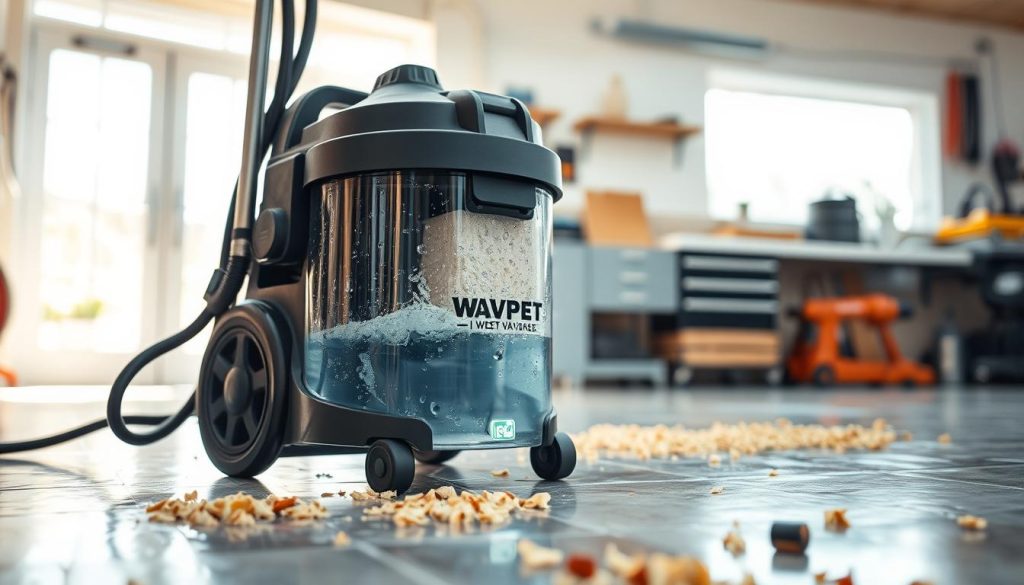
From clean tank to brush and dirty tank
Fresh solution sits in a clean water tank and feeds a rotating brush. The brush or roller loosens dirt and grime while targeted suction lifts the slurry into a separate dirty water tank.
Clean/dirty separation is the system’s defining function. Keeping used liquid apart prevents reapplying contaminated fluid and improves hygiene and results.
Detergent dosing, deodorising and disinfecting features
Some docks dispense measured detergent automatically; others ask for manual mixing. Automatic dosing gives consistent solution strength but adds running costs for branded fluids.
Claimed deodorising or sanitising depends on sealed tanks, correct solutions and effective drying. Treat such features as helpful, not a guarantee of sterilisation.
Why maintenance is non‑negotiable
Humidity speeds smell and microbial growth if dirty water sits in tanks or the brush remains damp. We stress a short care routine:
- Empty and rinse the dirty water tank after each session.
- Run any self‑clean cycle, then remove and dry the brush.
- Wipe seals and let parts air‑dry before storage.
Practical note: understanding the water path and roller design helps predict edge cleaning and how much upkeep a model will demand.
How to choose the right model for your floors and routine
A clear routine helps us pick a model that actually fits daily life in Singapore flats. Start by deciding the category: dedicated floor washer, 2-in-1 stick, or robot. That choice narrows sensible price and running costs quickly.
Mostly hard floors: dedicated washer or dry-only solution
Dedicated wet dry machines usually manage grime and drying better on hard floors. They handle slurry and keep clean and dirty water separate, which cuts odour risk in humid climates.
Carpets and rugs: when a 2-in-1 or robot fits
Choose a 2-in-1 if you need solid suction plus occasional mopping. Pick a robot if you want hands-off upkeep and scheduled passes between deep cleans.
Tank size, suction and noise in real use
- Large tank = fewer interruptions but more weight and storage bulk.
- Suction claims matter, yet head design and roller contact affect streaks and edge cleaning most.
- Consider noise level for evening cleans; perceived loudness often beats a single dB figure.
Cordless practicality and storage
Battery life, runtime and charge time must match your routine. Cordless units suit quick tasks, while docks with refill and drying cut chores for families.
Check local availability and warranty, and consult a detailed buying guide before you commit.
Conclusion
Key pick, for most Singapore flats we rate the Tineco Floor One S7 Pro as the strongest overall. It balances wet dry performance, sensible upkeep and smart modes while giving solid value for daily cleaning.
For longer runs and manoeuvrability choose the Roborock F25 Ace. Budget buyers get practical results with the Shark HydroVac Cordless. For mixed floors or lightweight grabs consider the Dyson V15s/V12s range.
Roborock Qrevo Curv handles routine upkeep automatically, but it does not replace a manual scrub for heavy spills.
Practical next step: shortlist two models, check Singapore availability, compare price and consumables, then pick based on your tank, battery and floor needs.

