

We present a practical guide to help you choose the best sofa cleaner for flats in Singapore. Humidity can slow drying and make odour control more important, so we focus on fast, safe methods that avoid leaving fabrics overly wet.
Our roundup looks at portable upholstery machines, sprays, dry powders and leather kits. We explain which products suit different fabrics and daily stains, and how to act in time so fresh marks do not set.
We stress checking care labels (W, S, WS, X) and doing a patch test before use. That simple step prevents damage and saves effort later.
In short: we aim to help you pick a cleaner that fits your fabric, schedule and common messes—from food spills to pet accidents—so cleaning is quicker and safer for Singapore homes.
How we chose the best sofa cleaner for Singapore homes
To reflect everyday use in Singapore flats, we prioritised tools and formulas that limit overwetting and speed drying. Humidity drives our choices: products that trap odour or leave fabric damp score poorly.
What matters most: humidity, odour control and drying time
We favour solutions that use less water or fast-extracting machines so fabrics dry quickly. Low residual scent is vital to avoid musty smells in warm, enclosed flats.
Machine vs spray vs powder
Machines work best for large areas and heavy messes. Sprays are ideal for immediate spot treatment. Dry powder suits water-sensitive fabrics.
Testing criteria
We measured stain removal on food, oil and dirt, checked fabric safety, ease of use and maintenance. We also judged machines on run time, tank capacity and attachments.
“Practical directions and easy maintenance matter as much as stain performance.”
| Type | When to use | Key trade-off |
|---|---|---|
| Machine | Large stains, thorough extraction | Heavier, needs drying time |
| Spray | Quick spot treatment | Limited on deep set stains |
| Powder | Water-sensitive fabrics | Slower on old stains |
For step-by-step machine guidance and practical tips on using extraction tools, see our walkthrough: how to clean a sofa with a carpet.
Check your upholstery care label before you clean
Start every cleaning job by locating the upholstery care label—this small tag guides safe action. You will usually find it under seat cushions or on the underside of the sofa. Checking the label is the first step in safe upholstery cleaning.
Understanding fabric codes: W, S, WS and X
The care code tells us which products and tool to use:
- W — safe for water-based solutions and light upholstery machines.
- S — use a solvent-based product only; avoid water which can stain or warp fibres.
- WS — allows either water or solvent methods; choose the gentlest option first.
- X — vacuum only at home; for spills or heavy soil, seek professional service.
Patch testing and avoiding water spots on sensitive fabrics
Always test any solution on a hidden seam or the underside of cushions first. Apply a small amount, let it dry completely, then check for colour change, rings, stiffness or texture shift.
Delicate fabrics such as silk or velvet may develop water spots if overwet. To reduce risk, apply liquid sparingly, blot immediately and allow even drying. Controlled application prevents rings from forming when water evaporates unevenly.
“A careful patch test and gentle blotting protect the fabric and your investment.”
Before any wet method, vacuum the area with an upholstery tool. Removing grit stops dry particles turning into muddy residue and improves final results.
Portable upholstery cleaner machines: deep-cleaning power for cushions, armrests and stairs
Small extraction units combine spray, agitation and suction to tackle local stains without a full-sized machine. We look at how a spot cleaner works and which features truly matter for flats and cars.
What to expect from a spot‑cleaning machine
A typical carpet cleaner sprays solution, uses a rotating or fixed brush for gentle agitation, then suctions dirty water into a removable tank. Emptying and rinsing the tank after each session prevents smells and residue.
Attachments that make a difference
Crevice tools reach seams and tufts. Upholstery brushes lift dirt across curved surfaces. Pet tools collect hair and dander. The right attachment changes results more than extra power alone.
Portability for flats and cars
We rate units by weight (around 9–11 lbs for compact corded models), cord length (often ~15 ft), and cordless run time (20–35 minutes). A manageable nozzle and hose make car seats and footwells easy to clean.
“Extraction removes more liquid than a cloth, so drying time is shorter in humid conditions.”
| Feature | Why it matters | Typical spec |
|---|---|---|
| Weight | Carry between rooms, stairs | 9–11 lbs |
| Tank | Holds dirty water; rinse after use | Small tanks need more trips |
| Attachments | Improve reach and hair removal | Crevice, brush, pet tool |
| Cord length / run time | Work radius for homes and car | ~15 ft cord or 20–35 min cordless |
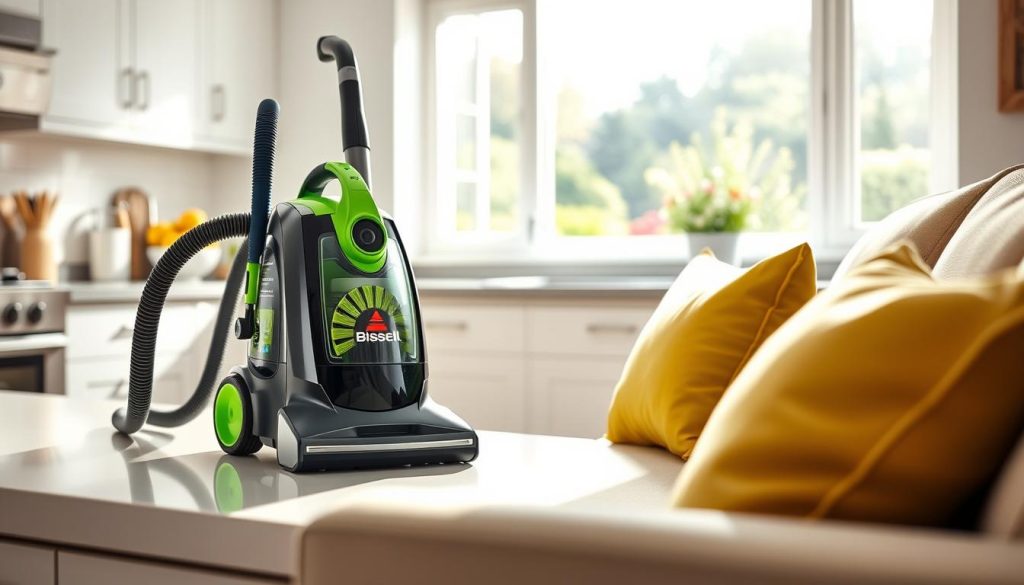
Best overall machine pick for sofas: Bissell Little Green Multi-Purpose Portable Carpet and Upholstery Cleaner
For compact extraction tasks around the home, we favour a model that pairs strong stain lift with easy storage.
Why we rate it
Quick stain removal in small areas makes it useful for daily spills and pet marks. The compact nozzle reaches tight creases and curved armrests, so grime comes out of seams with less fuss.
Easy, mess‑free tanks are simple to fill and empty. The comfortable wand and long hose make it feel like a portable carpet unit rather than a bulky machine. Attachments include a spraying crevice tool and HydroRinse for hose upkeep.
How we use it on a sofa
- Vacuum the area first to remove grit.
- Fill the clean tank with water and Bissell formula.
- Spritz evenly, agitate gently with the soft brush, then run the vacuum/suction back into the tank.
- Work in small sections and finish with suction‑only passes to cut overwetting.
Where it shines in real homes
It excels on armrests, curvy seams, narrow stairs and tight car backseats. The slim profile fits steps and boot spaces, so you get a targeted clean beyond just a lounge area.
Potential drawbacks and tips
The unit can be somewhat loud and some older or oily stains may need a few passes. For W and WS coded fabrics it is ideal, but always patch test first.
“Work in short runs and overlap passes. Extra suction pulls out more water and shortens drying minutes.”
Best cordless option for everyday messes: Bissell Little Green Cordless Portable Carpet Cleaner
For fast, everyday tidying in tight flats, a cordless option changes the workflow. We tested the Bissell Little Green Cordless and found it ideal for quick spills and routine maintenance.
Eco vs turbo modes: Eco extends run time for light jobs, while turbo gives extra power for heavy spots. Use eco for juice splashes and muddy paw prints, and switch to turbo for set stains.
Run time and charging
The battery lasts about 35 minutes in eco and roughly 20 minutes in turbo. If you plan to clean several cushions or a car interior, charge fully and attack the worst marks first.
Nozzle coverage vs precision
The wide nozzle covers seat bases and carpets quickly but is less precise in seams. For piping or narrow creases, a targeted spot cleaner or a small brush helps locate hidden messes.
It can leave cushions slightly damp; to speed drying in humid Singapore, run extra suction passes and boost airflow with a fan or AC. Tough red-wine stains often lighten rather than vanish, so pre-treat if needed.
“Cordless machines turn a small spill from a chore into a quick fix.”
Best high-suction alternative for stubborn spills: Dirt Devil Portable Carpet and Upholstery Cleaner
A high‑suction unit can pull out more liquid and loosened soil than lighter machines, which helps reduce drying time and residue. We found the Dirt Devil notably powerful; it can almost “stick” to cushions as it extracts, which speeds up wins on fresh red wine and similar wet marks.
When intense suction helps (and when you’ll still need a scrub brush)
Suction excels at removing pooled liquid and suspended dirt. For fresh spills it often lifts stains with little scrubbing.
However, tufted cushions, textured weaves and sticky food marks still benefit from agitation. In those spots we use a small brush or cloth first, then extract to remove loosened grime.
Storage wins: hose and cord organisation
The Dirt Devil stores neatly. The cord is about 15 ft and the hose tucks away, so the unit is easy to stow in compact Singapore flats. Good attachments like the stain tool and pet tool clip on securely, cutting clutter and saving space.
Solution usage: how to avoid running through a bottle too quickly
To stretch a bottle, we pre‑blot spills, dilute the solution where the label allows, and apply only what we can extract immediately. Concentrated use feels powerful but burns through product fast.
- Pre‑blot to remove excess liquid before extraction.
- Dilute the solution per directions to extend each bottle.
- Use the self‑cleaning hose port and rinse tools after use to stop odours and gunk.
“Powerful suction pulls more liquid and reduces drying time — but agitation still wins on textured fabric.”
Best for pet messes and lingering odours: enzyme and pet-focused cleaners
Tackling pet messes means addressing bacteria and odour, not just visible marks on fabric.
Bissell Professional Stain & Odor Remover is our go-to enzyme spray for organic accidents. The formula targets bacteria that cause persistent scent and reduces the chance of repeat incidents.
Use this simple dwell method to let enzymes do the job:
- Treat the visible stain, then blot to remove excess liquid.
- Cover the area with a lightly damp cloth and leave for 12–72 hours so enzymes keep working without soaking the cushion.
- Remove the cloth and air the spot; repeat if the odour persists.
When a motorised spot cleaner helps
For repeated accidents, multiple pets or heavy hair and dander, a Rug Doctor Pet Portable Spot Cleaner is worth considering. Its motorised brushes boost agitation and suction to lift embedded stains and loosen hair.
| Option | Strength | Limitation |
|---|---|---|
| Enzyme spray (Bissell) | Breaks down organic residue; reduces odour | Needs dwell time; not instant |
| Rug Doctor Pet spot cleaner | Motorised brush lifts dander and hair; stronger extraction | Best for local areas; tank filling can be awkward |
| Manual enzyme treatment + vacuum | Low cost; easy for quick spots | Less effective on embedded stains |
Motorised brushes add meaningful agitation, which helps remove trapped dog hair and deep-seated grime from upholstery. But remember to check fabric codes and patch test first; some materials react badly to water.
“It’s rarely just the stain—odour can attract repeat accidents, especially in warm, humid homes.”
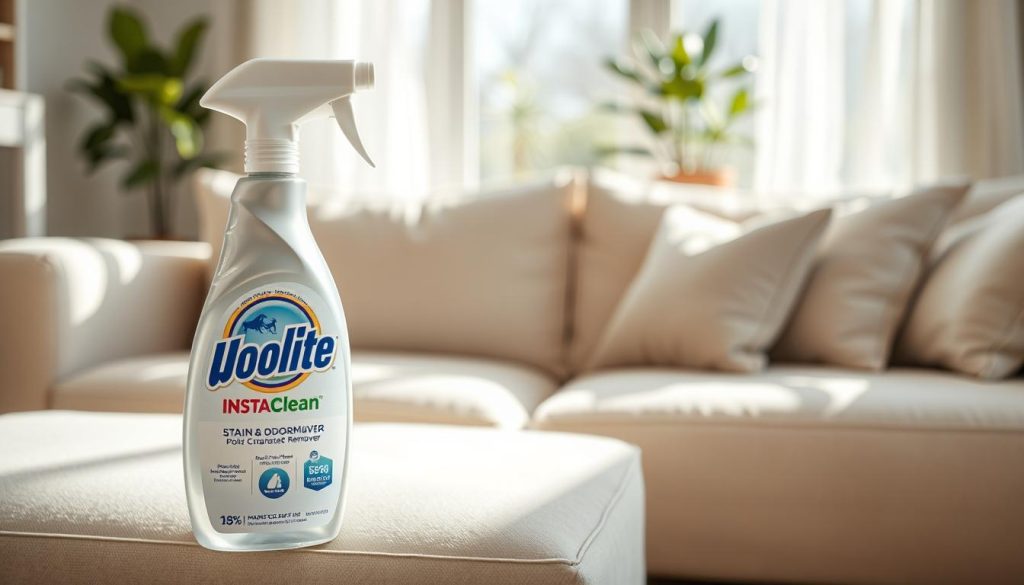
Best spray upholstery cleaner for quick spot treatment: Woolite INSTAclean Permanent Stain and Odor Remover
A small, fast-acting spray is often the quickest way to tackle a fresh spill before it sets. We recommend a spray when we want speed without hauling out a machine.
How oxy ingredients lift coloured stains
Woolite INSTAclean uses oxy-style ingredients. Hydrogen peroxide acts like a fabric-safe bleach to break colour bonds in coffee, fruit juice and similar marks.
EPA Safer Choice certified, it is safe for W and WS coded fabrics when patch-tested first. That makes it handy for many household upholstery situations.
One-minute method
- Spray the spot lightly from a short distance.
- Wait about one minute — no more — to let the oxy work.
- Blot from the outside toward the centre to avoid spreading the mark.
- Repeat short cycles rather than scrubbing to protect fibres.
Material limits and red wine note
Do not use on silk, velvet, vinyl or leather upholstery. Always test in a hidden area first.
For fresh red wine, a spray helps if the spill is surface-level. If wine soaked into cushion foam, you may need deeper extraction to remove colour and odour fully.
“A quick spray and blot is our first defence — then escalate to extraction if the mark has soaked in.”
Best plant-based upholstery cleaner with a pleasant scent: Method Stain and Odor Treatment Spray
Method provides a plant-based formula that suits unwashable textiles and light carpet touch-ups. Its Spearmint Sage scent is noticeable without overpowering indoor spaces, which we value in compact Singapore flats.
Best for: unwashable household fabrics and light carpets
We recommend this option for sofas, dining chairs and small areas of carpets where a full machine is unnecessary. It worked on wool carpeting in our tests and is suitable for W and WS coded materials when patch-tested first.
How to use
Spritz the affected area, wait around 10 minutes, then blot gently. Non-sudsy formulas rinse away more easily, so residue is less likely to attract new dirt in humid conditions.
- Spritz from a short distance.
- Allow about 10 minutes for enzymes and plant surfactants to act.
- Blot with a clean cloth; rinse lightly if needed and air to dry.
For older stains, repeat the cycle rather than scrubbing. Aggressive rubbing can damage fibres and fade colours. Check care codes and avoid delicate textiles that show water spots.
“Non-sudsy sprays are easier to rinse, leaving less residue that could trap odour in humid homes.”
Best for outdoor cushions and patio sofas: Sunbrella Stain Remover
Outdoor cushions need a different approach because grease, sunscreen and barbecue residue behave unlike indoor spills. We tested Sunbrella Stain Remover and found the wet-to-powder method well suited to balcony and patio fabrics.
How the wet-to-powder formula works
Spray the product evenly onto the mark and let the liquid bind oils and grit as it dries into a white powder. Once dry, the powder encapsulates loosened grime.
Remove residue with a soft brush or a vacuum, then inspect the area. This leaves less wet residue in the cushion core.
What it tackles well
We found it excels on oily and greasy stains—satay and BBQ drips, outdoor coffee spills and cooking grease. Old barbecue marks often lift noticeably after treatment.
When to repeat and practical tips
If residue remains, repeat the cycle rather than soaking the fabric. Ensure cushions dry fully outdoors before returning indoors to avoid trapped moisture and odour.
| Issue | How Sunbrella helps | Notes |
|---|---|---|
| Grease / BBQ drips | Wet-to-powder lifts oils | May need 2 applications for set marks |
| Sunscreen / sunscreen oil | Encapsulates and dries into powder | Brush lightly, then vacuum |
| Outdoor coffee | Surface lift with spray | Test first on hidden seam |
“Protect surrounding areas while you spray so powder does not settle back into indoor spaces.”
Best sofa cleaner for delicate fabrics and ‘S’ or ‘X’ codes: Capture Carpet & Rug Dry Cleaner
Dry powder systems offer a low‑risk route for delicate textiles where water would cause rings or shrinkage. Capture Carpet & Rug Dry Cleaner uses dry granules to lift surface soil without saturating the padding.
Why dry granules reduce risk on water‑sensitive upholstery
Granules absorb oils and loosen dirt while limiting moisture exposure. This reduces the chance of colour shift, shrinkage and water marks on S and X coded fabrics.
Step-by-step: sprinkle, brush in, wait about 30 minutes, then vacuum thoroughly
- Sprinkle generously and evenly across the affected area.
- Use a soft brush to work granules gently into fibres.
- Leave to act for about 30 minutes so granules bind grime.
- Vacuum thoroughly to remove all residue; repeat if needed for surface brightening.
When to stop DIY and call a professional for heavy soil or set‑in stains
Dry granules freshen and lift surface dirt but may not remove old, embedded stains. Call professionals if:
- Fabric shows distortion, dye loss or adverse change during patch testing.
- There is heavy overall soiling or odour that granules do not remove.
- Staining has penetrated cushion cores or the padding.
Between treatments we recommend regular vacuum maintenance to reduce grit wear and extend time between deeper cleaning sessions. For further guidance on upholstery products and methods, see our curated list at upholstery cleaners.
“Dry applications are often the safest home option for water‑sensitive fabrics; use them as a first step and escalate when necessary.”
Best for leather sofas and car seats: Furniture Clinic Leather Care Kit
Leather needs targeted care to stay soft and resist marks in humid climates like Singapore. We favour a two‑step system that cleans then conditions, rather than using general upholstery products or wet extraction machines that can dry or crack leather over time.
Two-step care: cleaning then conditioning to reduce future marks
Step one uses the cleaner to lift grime and oils from the grain. In testing the kit removed embedded dirt and erased blue dye transfer from jeans on a leather car seat.
Step two applies the protector/conditioner to keep leather supple and make future stains easier to wipe away.
How we use it
- Dust or vacuum to remove loose grit.
- Apply cleaner with a sponge and wipe off residue.
- When dry, apply protector sparingly and buff to a matte finish.
Where else it works and what it tackles well
The kit also suits bags, shoes, jackets and car interiors. It handles grime in the grain and dye transfer—common problems on light leather seats.
| Issue | Effectiveness | Notes |
|---|---|---|
| Grime in leather grain | High | Cleaner lifts oils; follow with protector |
| Dye transfer from jeans | Effective | May need repeat passes on heavy transfer |
| General conditioning | Good | Protector restores suppleness; reduces future staining |
“Always patch test on a hidden seam and use minimal product on aniline or delicate finishes.”
Best for red wine stains on sofa fabric: Wine Away Red Wine Stain Remover
A single spill can change the tone of an evening—swift action matters when red wine meets fabric. Wine Away acts on contact and begins to fade colour almost immediately, which makes timing crucial for a good outcome.
Why speed matters
We stress speed because pigments set quickly. Treating a fresh red wine mark within a few minutes improves the chance of total removal. In lab tests Wine Away removed fresh marks completely and lightened set-in ones.
Immediate response checklist
- Blot—don’t rub—to lift excess liquid.
- Apply Wine Away as a targeted spray.
- Watch the colour lift and continue blotting with a clean cloth.
Aftercare and realistic expectations
Because the formula is non-sudsy, residue should be rinsed or washed out. We advise using a lightly damp cloth and repeated blotting, avoiding over-wetting the cushion. Set-in marks often lighten but may need repeat treatment or extraction with a machine.
Bonus uses and fabric safety
Wine Away also works on berries, fruit juice and other red-coloured spills on many fabrics and upholstery. Always check the care code and patch test first; some delicate textiles react poorly to liquid cleaning.
“Treat red wine quickly and follow with gentle rinsing to avoid rings and residue.”
Conclusion
, We recommend a simple decision path: check the upholstery code first, then match the stain to a method—spray for quick spots, dry granules for water‑sensitive fabrics, and a machine for deep extraction.
In Singapore, limit overwetting, control odour and speed drying by using extra suction or blotting. Families and frequent spillers benefit from a portable carpet or extraction machine; occasional marks often respond to a spot cleaner or spray.
Keep machines and upholstery cleaners performing well by emptying the dirty tank, rinsing attachments and letting parts dry. For heavy overall soil, X‑coded fabrics or stubborn odours, stop DIY and hire a professional upholstery cleaning service.
Vacuum regularly, treat stains quickly and rotate cushions to protect furniture long term.

