

We introduce what sofa vacuum cleaning covers and how it slots into a practical care routine for Singapore homes. High-use seats pick up crumbs, dust, mites and odours, so regular attention keeps upholstery fresh and extends furniture life.
We set clear expectations: routine vacuuming removes surface dirt and allergens, while deeper methods are needed when residue sits inside fibres. In busy living room settings we favour repeatable steps that fit family life and short schedules.
Our approach focuses on simple tools — attachments, a turbo nozzle and optional extraction or steam — and on avoiding common mistakes like over-soaping or over-wetting. For spot advice on stubborn spots, see our guide on how to treat couch stains. We show when to do quick upkeep and when to use deeper care to protect fabric and padding.
Why regular sofa care matters in Singapore homes
In Singapore’s humid climate, regular care stops odours and hidden grime from taking hold in upholstered items. We focus on small, repeatable actions that protect indoor air and keep furniture looking its best.
Humidity, odours and hidden build-up
High humidity makes fabrics trap moisture, food residue and mould spores faster than in drier climates. This creates damp smells even when the surface looks clean.
Dust mites, allergens and indoor air quality
Dust, dust mites and skin particles build up inside fibres. We remove these regularly to reduce allergy triggers and improve the quality of the air you breathe.
How routine care extends the life of upholstered furniture
High-contact zones—armrests, headrests and seat centres—collect oils and fine debris. Simple weekly upkeep and occasional deep work prevent stubborn marks and sagging.
- Practical benefit: less dirt to tackle later.
- Cost saving: delayed replacement and preserved finish.
- Mindset: short weekly tasks plus periodic deep attention save time overall.
| Issue | Effect | Our routine benefit |
|---|---|---|
| Humidity build-up | Musty odours, mould risk | Reduces smells and prevents mildew |
| Allergens & dust mites | Worse asthma/allergy symptoms | Improves indoor air quality |
| High-contact wear | Fading, loss of shape | Maintains look and extends lifespan |
What we prepare before vacuuming upholstery
We begin with a short, practical check so the work that follows is safe and effective.
Checking fabric, colour-fastness and water resistance first
We identify the material at the outset — fabric sofa or leather — so we pick methods that avoid shrinkage, colour change or texture damage.
Colour-fastness test: try a gentle spot test in an unseen area before any water-based work. Use a white cloth and dab, not rub.
For water-sensitive textiles, we prefer distilled or boiled water to prevent lime spots. Leather must never be over-wetted; use only a lightly damp cloth and neutral soap.
Choosing the right cleaning equipment for fabric sofas and leather
We prepare targeted cleaning equipment to match each surface.
- Upholstery brush tool for loose dirt and gentle agitation.
- Crevice tool for seams and edges.
- Turbo upholstery nozzle for hair and mite removal.
- An extraction machine on standby for deep work if fabric allows.
Setting up the room for faster drying and less moisture residue
We set the room to speed drying: open windows when possible, use fans or air‑conditioning on dehumidify mode, and avoid blocking airflow around the furniture.
Residue control: apply the minimal amount of solution and plan ventilation to reduce sticky residue that attracts dirt back quickly.
With these checks done, the process moves smoothly into surface care and deeper methods as needed.
Sofa vacuum cleaning: the step-by-step method we use for surface dirt
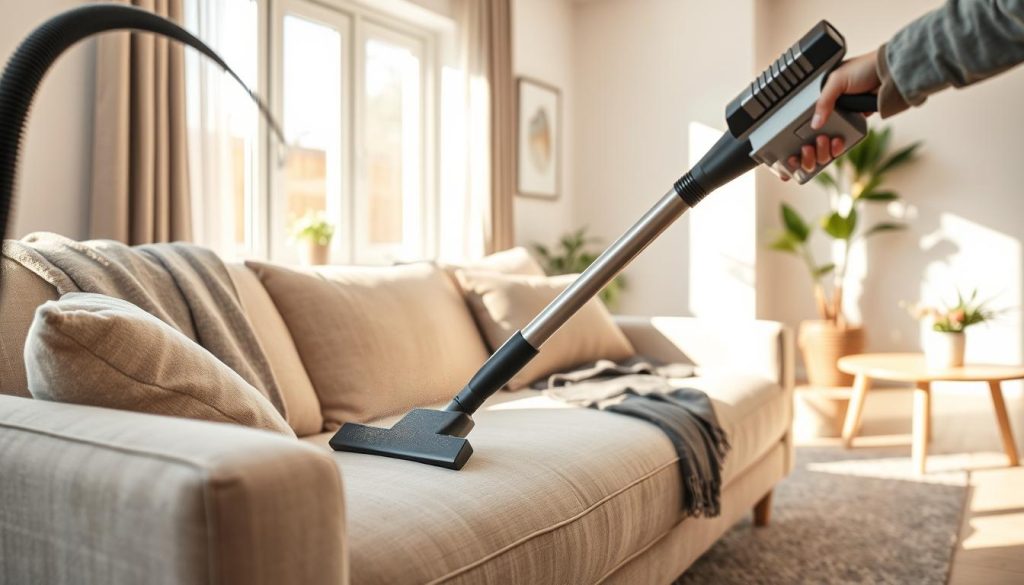
We use a clear, repeatable routine to remove loose debris from upholstery without harming fibres. Our focus is on gentle action, correct attachments and checking seams where most residue hides.
Removing crumbs and loose dirt without grinding it in
First, we remove cushions and loose items so every edge is exposed. This simple move lets us reach seams and the junctions between seat and back panels.
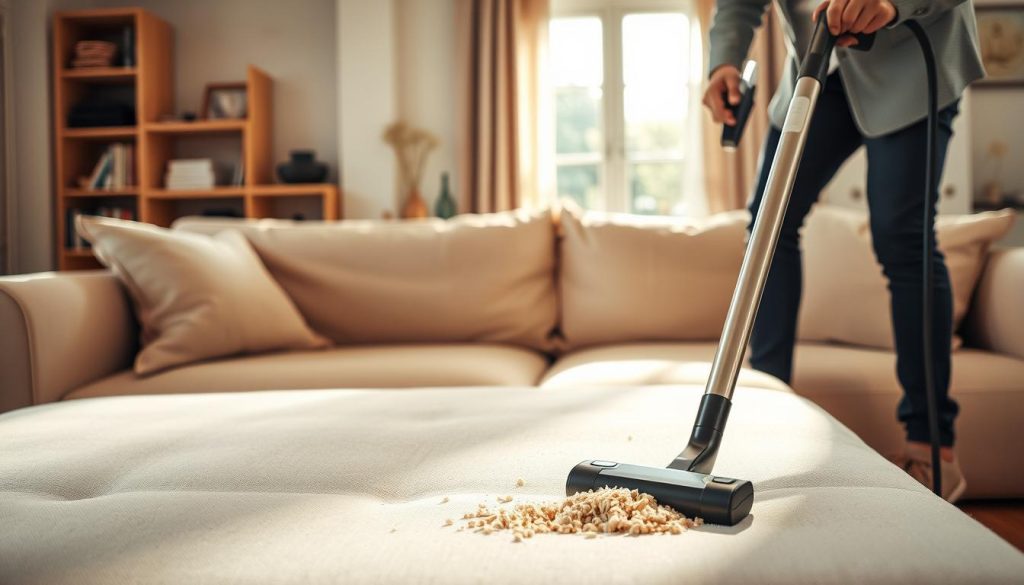
We make slow, shallow passes. Pressing hard grinds grit into fabric and speeds wear. Instead, we lift particles with repeated, light strokes.
Using the best vacuum cleaner attachments for upholstery
Our toolkit: an upholstery brush for broad areas, a crevice tool for gaps, and a softer brush for delicate fabric. These choices reduce abrasion and improve pick-up.
When standard suction struggles, we switch to a turbo upholstery nozzle to remove embedded hair and mites.
Targeting seams, creases and high-contact zones
We focus on piping, seams and creases—the main collection points for dirt and dust. Slow strokes along seams, then across them, dislodge trapped debris.
Quality check and final passes
“Multiple slow passes in alternating directions reveal what a single sweep misses.”
We finish with a visual check under strong light. If fibres still hold particles, we repeat the step until the surface is clear.
Deep cleaning beyond vacuuming with spray extraction
Spray extraction reaches deeper fibres to remove grime that surface methods miss.
How spray extraction works for dirt trapped deep in fibres
Spray extraction is a deep cleaning method: we spray a measured mix of water and detergent into the fabric and then extract the solution with suction.
This pulls out dissolved dirt and trapped particles that routine surface work cannot remove.
Our process for spraying, dwell time and slow extraction
We set up the machine: fill the tank with clean water, dose a suitable upholstery detergent and fit a nozzle that controls wetting.
Hold the spray about 10 cm from the fabric and mist evenly rather than spot-soaking one area.
Allow a short dwell time of 3–5 minutes so the solution loosens grime without over-wetting the fibres.
We then make slow, overlapping extraction passes. Taking time reduces residual moisture and improves dirt removal.
Avoiding water marks and when to rinse
Wet connected surfaces evenly: we clean whole panels, not single squares, to prevent water marks at joins.
Repeat the spray-and-extract cycle until the return is clear of colour and detergent.
If residue remains, we rinse once or twice with clear water to remove sticky detergent and then extract again.
Drying time tips for Singapore weather
Start work during the day and ventilate the room well. Use fans or dehumidify mode to speed drying.
Typical drying takes about 4–6 hours. Avoid using the sofa until fully dry to prevent re-soiling and moisture issues.
How we remove stains without damaging upholstery
When a spill happens, our priority is to act quickly to limit damage and keep fibres intact.
Blot wet marks fast and never rub
Act fast: blot a fresh wet stain with a clean, dry cloth using press‑lift‑repeat. This removes liquid before it spreads into padding.
Do not rub: rubbing grinds particles deeper and roughens the fabric.
Test for water‑soluble marks first
About 90% of stains are water‑soluble. We test with a white cloth and lukewarm water in an unseen seam.
If colour transfers, choose a non‑aqueous approach to avoid dye loss on the fabric.
Use products safely and manage residue
For non‑water‑soluble stains, we spray a universal stain remover onto a colour‑fast cloth and dab gently. This keeps the product off cushions and limits spread.
After removal, we may rinse or extract lightly to remove detergent residue. Leftover solution can attract dirt later.
“Remove stains quickly and choose the right method for the best chance of safe restoration.”
| Step | Action | Purpose |
|---|---|---|
| Blot | Press‑lift‑repeat with dry cloth | Stop spread and absorb liquid |
| Test | White cloth + lukewarm water | Check if stain is water‑soluble |
| Treat | Apply product to cloth, dab | Controlled removal without overspray |
| Finish | Rinse/extract if needed | Remove residue and prevent re soiling |
Household remedies we trust for stubborn stains on sofas
When common spills happen, simple cupboard ingredients often remove stains without harsh chemicals.
Bicarbonate of soda for coffee, red wine and general stain removal
Dry method: sprinkle bicarbonate of soda, leave overnight, then vacuum the powder away to reduce odour and lift light marks.
Paste method: mix 1 tbsp powder with 1 tbsp water, apply to the spot, rub gently, allow to dry and then remove. This helps to break down a stubborn stain.
Mineral water, salt and cornflour for fresh red wine spills
Blot with mineral water and a clean cloth. Next, scatter salt or cornflour to absorb liquid and lift colour. Remove once dry and finish with a cold dab if needed.
Lemon juice and salt paste for dried blood stains
For fresh blood, always start with cold water; heat sets proteins and makes the mark permanent. For dried marks, make a paste of lemon juice and salt, allow ~30 minutes, then remove and rinse with cold water.
Washing-up liquid or soap for grease and oily residue
Mix a few drops of washing-up liquid or mild soap in warm water. Work from the edge inward to stop spread. Dab with clean water to remove soap residue and let the fabric dry before use.
“Act quickly, test in an unseen area, and always remove any residue after treatment.”
Steam cleaning on upholstery: when it helps and when to avoid it
We view steam as a specialist tool. It works well for targeted spot work and for sanitising but is not our first choice for heavy surface dirt or saturated fabrics.
Using steam to lift small stains with a detail nozzle and microfibre cloth
For small stains we hold the detail nozzle at an angle, not vertically.
Place a microfibre cloth beside the jet to catch loosened grime. This prevents wetting the padding and speeds drying.
Fabric sensitivity to temperature and how we test first
Always test first: pick an unseen spot and apply a short burst of steam. Look for colour change, shrinkage or texture loss.
If the fabric shows any reaction, we avoid steam and use gentler, non‑heat methods instead.
Steam cleaning versus extraction for stain reduction and odour control
Steam can break down oils and sanitise surfaces. It refreshes smells and helps with light marks.
Extraction, however, pulls out dissolved dirt and moisture and usually reduces odour more effectively.
“Steam excels at spot sanitisation; extraction wins for deep residue removal and faster drying.”
- Best use: spot stains, light sanitising and quick refreshes.
- Avoid when: delicate, heat‑sensitive fabric or heavy soiling.
- Decision factors: stain type, fabric type and how quickly the piece must dry in humid Singapore conditions.
| Approach | Strength | When we use it |
|---|---|---|
| Steam | Sanitises, loosens small marks | Spot work, quick refresh, low-moisture jobs |
| Extraction | Removes deep dirt and moisture | Deep stains, odour control, heavy soiling |
| Dry spot treatment | Minimal moisture, safe for delicates | Heat-sensitive fabric or visible dye transfer |
For larger or persistent marks we often recommend extraction; see our guide on a recommended machine method how to clean a sofa with a carpet for a practical way to tackle deep stains and odour in humid climates.
Material-specific methods for fabric sofas, velvet and leather
Different upholstery materials demand specific care to keep colour, texture and fit intact.
Fabric dos and don’ts for moisture and drying
Do avoid over-wetting. Work in measured amounts and extract or blot promptly.
Don’t stack damp cushions. Keep panels separate so airflow reaches padding and speeds drying.
For natural fibres we often prefer extraction rather than heavy hand-washing to reduce shrinkage risk.
Velvet and pile: gentle handling
Velvet and similar pile fabrics need a soft touch. Aggressive brushing or strong wetting can crush the nap and leave patchy shading.
We use low‑moisture methods and gentle lifting strokes. For stubborn marks, dry cleaning or specialist spot work is safer.
Leather basics: wiping, soap and conditioning
Remove dust and crumbs with a soft cloth or careful vacuum pass before any wet work.
Wipe with a lightly damp cloth and a neutral (hard) soap in lukewarm water. Avoid grease‑cutting detergents that strip oils.
Condition regularly to maintain suppleness and prevent cracking, especially in air‑conditioned Singapore homes.
Preventing lime spots
We recommend distilled or boiled water for final wipes. This prevents lime deposits that show on darker finishes and keeps surfaces even.
How often we recommend cleaning and vacuuming your sofa
A predictable maintenance rhythm keeps upholstery looking and smelling fresh in busy homes.
Weekly upkeep for busy households
We advise a realistic weekly routine: a thorough pass of seats, backs, arms and creases to stop dust and debris embedding. This short session keeps wear down and saves effort later.
Deep-care frequency for families, pets and allergy-sensitive homes
Standard schedule: professional or machine deep work every six months for typical use.
Higher risk households: every three months when you have children, pets or dust mites concerns. Regular upholstery cleaning reduces allergens and improves indoor air quality.
Timing your session so the piece dries within the day
Start early in the day. With good airflow most fabrics dry in about 4–6 hours.
- Ventilate well: open windows or use dehumidify mode.
- Use fans: aim airflow across—not directly at—the fabric.
- Expose surfaces: space cushions to let air reach padding.
“Short, regular care protects fabric and keeps the living room ready for daily use.”
Conclusion
To wrap up, we focus on steady, small actions that protect fabric and reduce long‑term wear.
Our simple process: prepare and test the material, remove surface debris with a light vacuum pass, treat stains by blotting and testing first, then use extraction or steam only when the fabric allows.
Humidity in Singapore makes ventilation and fast drying as important as the method itself. Good airflow cuts odours and helps prevent trapped dirt from returning.
Keep a weekly upkeep habit, plan periodic deep work, and act quickly on spills. For a practical reference, see our sofa care guide to match tools and timing to your living room needs.
Treat maintenance as routine: consistent care extends usable life and keeps your seating inviting day to day.

