

We help Singapore shoppers find the right unit by focusing on real cleaning performance, sensible running costs and dependable local support. Our goal is to make buying easier so readers can choose a model that works in daily life, not just in brochures.
This roundup is built for commercial intent. We test devices for bedrooms, large living rooms, cooking odours and compact desks. Expect clear picks for quiet use, fast particle removal and low running costs.
We also call out common industry issues such as inflated room-size claims, missing lab reports and affiliate hype. Our recommendations balance measurable air performance with comfort so a device will be used consistently, not left in a corner.
Why air purification matters in Singapore right now
Recent events have shown us that what happens outside can build up quickly inside our homes and affect breathing for hours. The pandemic and high-smoke episodes abroad pushed attention to indoor air as a direct health concern, not just a comfort choice.
What crises taught us about smoke and particles
When ventilation is poor, smoke and fine particles can concentrate in small spaces. That matters in dense flats and homes near traffic corridors. We learned that simple airing is not always enough during haze or wildfire events.
Health priorities for homes and family spaces
Household buying decisions usually target dust and fine particles, pet dander in family rooms, and concerns about bacteria and viruses in nurseries or shared bedrooms. Purification reduces the particle load you breathe for hours at a time, not just the smell.
- Where it helps most: bedrooms, living rooms and study corners.
- Our aim: show how to choose devices that cut particles and smoke across a wide range of situations without paying for gimmicks.
How we review air purifiers and what “top rated” means to us
We focus on measurable performance and real‑world comfort. Our approach judges how quickly a unit clears particles in a lived-in room and whether it is cheap to run across a year.
Our test‑led method
We run timed tests to record particle removal in minutes and log PM1 CADR estimates. We translate CADR and airflow into air changes per hour so room guidance matches real-room performance. For example, a solid model might reach a 23‑minute removal time in a medium living room.
Noise and everyday comfort
We compare quiet modes (sub‑45 dBA) with top‑speed results. Many models claim fast cleaning but are too loud for bedrooms. We prioritise units that balance speed and tolerable sound.
Running costs and filter tech
We measure filter lifespan, availability and electricity draw to estimate the total price per year. We decode filtration layers — pre‑filters, activated carbon, HEPA and true hepa filter grades — and explain what each layer handles.
Red flags we watch
- Exaggerated room sizes and missing lab reports.
- Affiliate‑driven recommendations that ignore poor results.
- An ionizer offered without clear, ozone‑free evidence of benefit.
Top rated air purifier service options we recommend in Singapore
Below is a compact shortlist of models we trust for bedrooms, living rooms and workspaces.
We match each pick to common local needs: HDB bedrooms, open‑plan condos and home offices. Our focus is measurable cleaning, low running costs and quiet daily use.
- Levoit Vital 200S — balanced home device; 23‑minute particle test; PM1 CADR ~260 cfm.
- AirFanta 3Pro — best value for CADR per dollar; PM1 CADR ~353 cfm.
- Luggable XL‑7 — quiet performance under 40 dBA; PM1 CADR ~260 cfm.
- Xiaomi 4 Compact — compact for desks and bedrooms; PM1 CADR ~117 cfm; good app control.
- Coway Airmega ProX — high output for large spaces; PM1 CADR ~462 cfm.
- Levoit Core 600S — fast cleaning for bigger rooms; suited to ~559 sq.ft. at 5 ACH.
- Austin Air HealthMate — for odours and VOCs; large carbon mass, modest particle CADR.
| Model | PM1 CADR (est.) | Best use case | Key note |
|---|---|---|---|
| Levoit Vital 200S | 260 cfm | Bedrooms, family rooms | Balanced performance and app features |
| AirFanta 3Pro | 353 cfm | Open plan living, budget large rooms | High CADR for the price |
| Luggable XL‑7 | 260 cfm | Quiet bedrooms, study spaces | Sub‑40 dBA operation |
| Xiaomi 4 Compact | 117 cfm | Desks, nurseries | Portable air unit with app control |
| Coway Airmega ProX | 462 cfm | Large living spaces | Dual filtration, high output |
What this list means for buyers: we pick models that earn their place through measured cleaning times, reasonable filter costs and livable noise levels. Expect deeper reviews next, where we unpack filtration stacks, noise and owning these units in Singapore.
Best overall air purifier for Singapore homes: Levoit Vital 200S
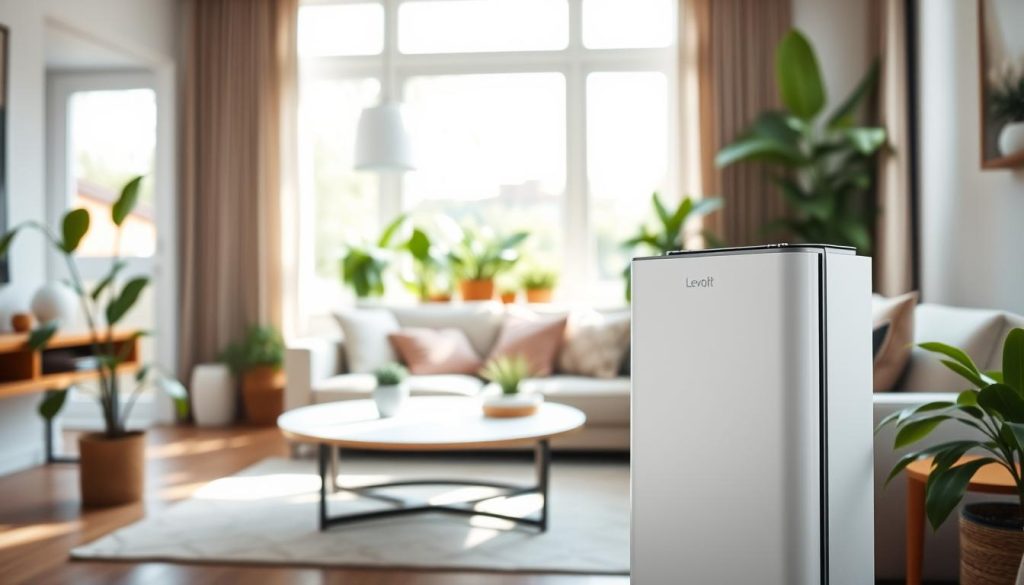
For most Singapore homes, the Vital 200S balances measured cleaning power with features you actually use every day. Our timed particle test cleared a typical room in 23 minutes and we estimate PM1 CADR at about 260 cfm. Those results mean meaningful air changes for bedrooms and family rooms without constant high speed.
Filtration set-up
The stack pairs a washable pre-filter with pleated particle media and pelleted activated carbon. The particle and carbon layers are bonded, so the combined filter is replaced when carbon saturates.
Everyday usability
Auto mode uses the onboard sensor to keep noise down; measured sound ranges 38.3–57.7 dB across speeds. VeSync app control and a low standby draw make scheduling and monitoring simple for busy households.
Considerations before buying
Note: the particle media is not a true HEPA grade despite some earlier claims. Carbon saturation can shorten replacements to 3–6 months in heavy odour use, so factor that into running costs.
- Power & warranty: modest draw and a two‑year warranty.
- Maintenance: wash the pre-filter regularly and clean the sensor for reliable readings.
Best budget high-CADR unit: AirFanta 3Pro for fast air changes in bigger rooms
For buyers who need fast circulation in larger rooms, the AirFanta 3Pro delivers remarkable CADR for the price. It is estimated at PM1 CADR 353 cfm and still gives ~213 cfm under sub‑45 dBA operation. Its launch price makes it a strong value play.
PC fan design benefits
The cube uses four PC fans. That layout gives strong flow with a smoother noise profile and good energy efficiency compared with many tower designs.
True HEPA H11 with optional carbon
Filtration is four True HEPA H11 modules. Add the pelleted carbon when smoke and odours are an issue in kitchens or corridors. Note: the unit requires OEM filters; generics are not supported.
Portability and space fit
It disassembles into a carry‑on friendly form and has a small footprint suitable for tight Singapore flats.
Availability and stock
Stock can be scarce on Amazon. If sold out, check the official AirFanta shop and buy spare filters at the point of purchase. Warranty is one year; factor filter cost into long‑term price planning.
Best quiet high-performance option: Luggable XL-7 DIY purifier for low-noise spaces
This DIY model proves that thoughtful design can deliver strong particle removal while staying whisper‑quiet.
Why it stands out
Seven PC fans push flow through two 20×25 MERV 13 filters to achieve an estimated PM1 CADR of ~260 cfm. Measured noise sits at 38.8 dBA and our timed test cleared a room in 23 minutes.
MERV 13 HVAC filters explained
MERV 13 captures fine particles, pollen and many combustion particles. In practice they reduce particulate load close to HEPA for many home uses, and standard sizes keep running costs lower.
Example: 3M Filtrete MPR1900 fits the unit and is widely available, so replacements are simple and affordable.
Fit, limits and serviceability
The unit’s larger footprint works well in living rooms or master bedrooms but can be bulky in narrow HDB corridors. There is no carbon option, so odours and VOCs are not well handled. The device has no smart functions or app control.
Value point: lightweight wood body, repairable fans and standard filters make maintenance easy. Power draw is 10.5 W and warranty is one year, with a DIY kit available for owners who prefer hands‑on upkeep.
| Spec | Value | Implication | Note |
|---|---|---|---|
| Fans | 7 PC fans | Strong flow with smooth noise | Repairable components |
| Filters | 2 × 20×25 MERV 13 | Good particle capture, lower cost | Use common MPR1900 options |
| Performance | PM1 CADR ~260 cfm | 23‑minute room clear | Measured 38.8 dBA |
| Power & warranty | 10.5 W, 1 year | Low running draw, basic cover | DIY kit available |
Best portable air purifier for small rooms: Xiaomi 4 Compact
When space is limited, sensible design and good sensor control matter more than raw cleaning numbers. The Xiaomi 4 Compact is built for bedrooms, study corners, nurseries and compact HDB spaces where a small footprint and quiet running are priorities.
Ideal use cases
We recommend this device for rooms up to ~175 sq.ft. at 5 ACH. Sleep mode runs near 35.6 dB and the everyday sub‑45 dB setting gives a PM1 CADR of about 77 cfm, with peak PM1 CADR ~117 cfm for short boosts.
App and sensor benefits
The built‑in infrared laser particle sensor feeds a colour indicator and reliable auto mode. That means the device ramps when dust spikes — for example after sweeping — and stays quiet the rest of the day.
Mi Home app support adds scheduling, speed control, filter life tracking and simple automations, which helps where on‑device controls are minimal.
Filter layers and odour expectations
The three‑layer cartridge has an outer pre‑filter mesh, pleated particle media and an inner activated carbon layer. Vacuum the pre‑filter regularly and plan to replace the combined filter at about six months in typical urban flats.
Note: the compact carbon mass limits gas and odour capture, so expect modest VOC performance compared with larger, carbon‑heavy models.
- Value point: portable design and low sleep noise encourage daily use.
- Limit: not a substitute for a high‑CADR unit in a large living room.
- Ownership tip: vacuum the mesh and replace the filter on schedule to keep dust removal steady over months.
Best for large open-plan areas: Coway Airmega ProX
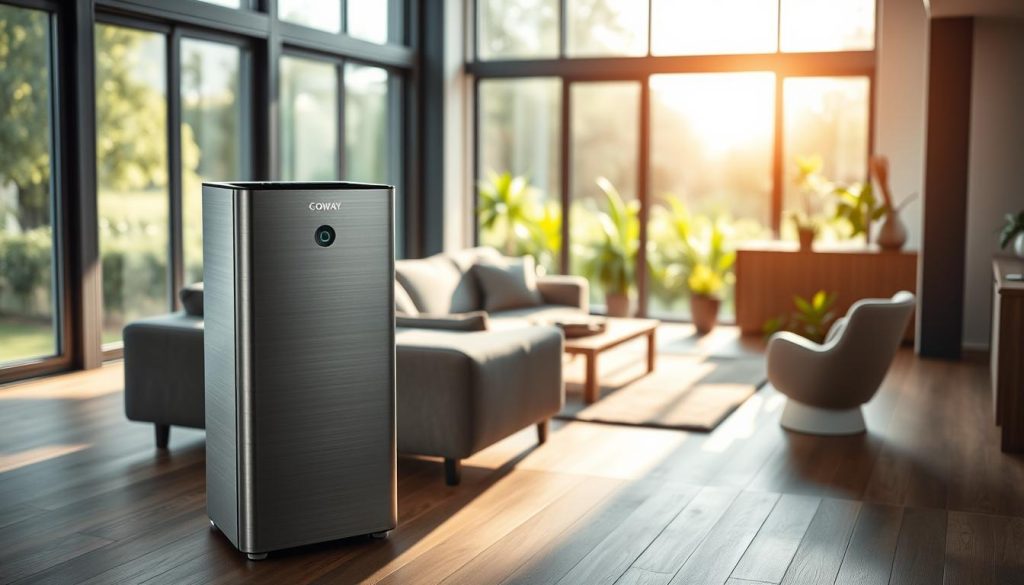
When a single device must cover a whole shared floor, output and run time decide value. The Coway Airmega ProX is built to move a lot of air and keep particle levels low across connected living and dining spaces.
High-output cleaning
Measured performance: estimated PM1 CADR 462 cfm, with sub‑45 dBA performance at about 299 cfm. AHAM PM2.5 CADR is listed near 586 cfm, which translates to coverage for roughly 693 sq.ft. at 5 ACH.
That speed means faster reductions in particles across wide spaces and less need to run the unit at noisy top settings.
Double-sided filtration
The ProX uses True HEPA media on both intake sides plus pelleted carbon layers. This layout captures fine particles while helping control everyday odours from cooking and guests.
Practical result: fewer filter changes under normal household loads and better VOC handling than single-sided designs.
Smart enough without an app
Onboard sensors feed a real‑time PM2.5 display. Modes include eco, silent, turbo and auto so the device adapts without smartphone control.
Notes on use: the unit is heavy and best sited in a dedicated spot. Noise reaches 53.6 dBA at full speed, standby draw is 0 W, and warranty cover is three years—useful for families who want one main unit for large shared spaces.
Best value for bigger rooms under a premium price: Levoit Core 600S
We see the Core 600S as the “big room without premium pricing” option: it cleared our test room in 16 minutes and is positioned for roughly 559 sq.ft. at 5 ACH while retailing at a competitive price.
Speed versus space
Fast cleaning matters where particle spikes happen. The Core 600S moves a lot of air quickly, but the unit needs floor space. Plan placement so flow is unobstructed in living spaces or a large bedroom.
Features for daily use
Auto mode, an on‑board air quality display and reliable app control make the device simple to run. These functions help keep noise low while maintaining steady performance.
Trade‑offs and maintenance
The particle filter is not true HEPA, yet it still delivers quick particle removal. The pre‑filter is not removable, so cleaning is fiddlier and neglect will reduce effectiveness over time.
- Worth noting: pelleted carbon helps with routine odours but won’t match large carbon beds.
- Running cost: efficient design keeps annual high‑use energy bills modest.
When odours and VOCs are the priority: Austin Air HealthMate
If your main problem is VOCs rather than dust, weighty carbon and zeolite make the practical difference. The HealthMate is a specialist device built around gas capture, not smart sensors or app control.
Why carbon mass matters
Key differentiator: the gas filter contains over 15 lbs of activated carbon and zeolite. That large carbon bed adsorbs many household gases and keeps working far longer than thin carbon sheets.
Performance balance
Independent VOC testing described it as the quickest and the only unit to reach zero ppm in some trials. Particle cleaning is modest (estimated PM1 CADR ~113), so it performs like a small unit on particulates.
Real‑life trade‑offs
Practical notes: expect higher noise at full speed (~61.5 dBA) and a maximum draw near 148 W. It carries a premium price, and there are no smart features or sensors.
| Spec | Value | Implication |
|---|---|---|
| Carbon & zeolite | 15+ lbs | Exceptional VOC and odour capture |
| Particle CADR (est.) | PM1 ≈ 113 cfm | Modest particle removal; best as a specialist unit |
| Noise & power | ~61.5 dBA, 148 W | Higher running cost and louder at full speed |
| Smart features | No app | Premium price for gas control, not smart conveniences |
We recommend this model for homes with renovation off‑gassing, persistent chemical smells or strong recurring odours. If dust and allergens are your primary concern, consider a higher‑CADR model instead. Read our detailed Austin Air HealthMate review for full test results and buying guidance.
Singapore service and maintenance: filters, servicing, and what we’d book locally
A clear maintenance plan separates effective units from neglected ones in busy homes. We focus on routines that keep flow and sensors accurate so real-world performance matches lab figures.
Scheduled upkeep
Clean the pre-filter every 2–4 weeks. Vacuuming or gentle washing keeps dust from blocking flow.
Wipe particle sensors monthly. A clean sensor prevents unnecessary high-speed runs and reduces running price over a year.
Replacement planning and stock
Expect filter lifespans of 6–12 months depending on load; compact models often need change near six months, larger units nearer 12 months.
Buy replacements early if local stock is patchy. Novita SG lists an Air Purifier/ Sterilizer Service Maintenance package and A5 HEPA H13 packs, which shows real ownership cost.
Warranties, support and ioniser claims
Before purchase check warranty length, local distributor support and whether consumables are OEM‑locked. We favour easy spare availability.
For ionizer or “virus elimination” claims, seek third‑party test details and clear conditions. We remain cautious about broad marketing claims and prefer solid particle filtration, timely filter replacement and safe design to reduce bacteria and viruses risk.
Conclusion
Match CADR and noise tolerance to your room and routine, then sanity‑check filter costs and local spare availability before you buy.
Our simple shortlist covers common needs: Vital 200S for most homes; AirFanta 3Pro for value cleaning per dollar; Luggable XL‑7 for quiet rooms; Xiaomi 4 Compact for small spaces; ProX for large open plans; Core 600S for big‑room speed; HealthMate for VOC‑heavy issues.
We judge devices by real‑room results at tolerable sound levels, not inflated claims. Plan ownership: budget for filters, clean pre‑filters and confirm stock in Singapore.
Next step: shortlist two models, compare total annual cost, then buy the unit you will actually run. For an extra demo, see our best air purifier guide and watch video tests before committing.

