

We present a practical, safety-first introduction to a simple DIY project that pairs an existing vacuum and hose with a large jug to trap dust in liquid.
This set-up can help with quick pick-ups around an HDB flat, car boot tidies and balcony corners. It is not a substitute for deep cleaning or professional wet-rated machines.
We define the water-trap concept in plain terms and outline essential safety steps: keep liquids away from motor housings and seal connections before switching on.
Our guide suits practical DIYers with a canister or shop-style vacuum and hose. We advise against attempts without supervision or using vacuums not rated for any moisture exposure.
Finally, we preview the article flow: build the jug trap, explain suction and filtration basics, then compare small alternate builds. For filter care and related maintenance, see our guide on vacuum maintenance and filter care.
How to make water vacuum cleaner using a water-jug trap and your vacuum hose
We show a simple jug‑based trap that routes dirty airflow through liquid and cuts the dust that reaches the motor. This short build works with a canister or shop-style unit and a length of hose.
What a jug trap does and why liquid helps
Particles in the airstream strike the liquid, wet out and fall out of suspension. That reduces how much dust travels onward toward the filter and motor.
“Routing airflow through a chamber of liquid captures fine grit more effectively than an open hose alone.”
Materials and simple Singapore substitutions
- vacuum with hose
- 5‑gallon jug (or sturdy sealed bucket from local suppliers)
- utility knife
- spare hose or vacuum tubing
- duct tape
Preparing the jug and safe inlet placement
Measure the hose diameter and mark the side hole. Cut carefully and keep edges neat for safer sealing.
Keep the side inlet at least 15–16 cm from the main spout opening. This spacing lowers the risk of pulling liquid into the hose during operation.
Sealing the side inlet and fitting the main spout
Wrap the hose end with 2–3 turns of duct tape for a snug press‑fit, then tape fully around the joint to prevent air leaks. Repeat when fitting the main hose into the jug spout.
Test run and useful adjustments
Start with a low liquid level and set the jug upright on a stable floor. Switch on briefly and watch for bubbling or water travel up the hose; pause at once if either appears.
Improve suction by tightening seals, repositioning the inlet, and limiting fill. For common Singapore dust—fine renovation grit, balcony sand and car mat fibres—use steady motion and avoid large debris.
| Issue | Likely cause | Quick fix |
|---|---|---|
| Weak suction | Leaky joint | Rewrap with duct tape and retest |
| Water creeping into hose | Inlet too close or overfilled | Move inlet 15–16 cm away; lower fill |
| Clogged hose | Large debris | Remove debris; avoid large pieces |
How suction works in a vacuum: air, motor power and filtration
We start with the simple fact: moving air, not an empty void, carries grit into the inlet.
Air pressure basics and why units pull in dust
Creating a pressure difference makes surrounding air rush in and pick up particles. This explains why a nozzle lifts fine dust and fibres from floors.
Fans, propellers and motors: how airflow is created
A motor spins an impeller or propeller. The rotating blades push air along a path, so fresh air enters at the nozzle. That flow is the working element of suction.
“A spinning fan moves air; the result is airflow that carries debris into the collection stage.”
Simple filtration ideas using netting or open-weave bandage
Liquid in our jug trap catches much material, but fine dust can stay in the headspace. Adding a loose net or open-weave bandage near the inlet traps larger grit while letting air pass.
Do not block airflow with dense cloth. That raises motor load and risks overheating small motors in a project.
| Concept | Effect | Quick tip |
|---|---|---|
| Pressure difference | Air rushes into nozzle | Keep inlet clear |
| Motor and impeller | Create airflow | Use steady power and avoid stalls |
| Filtration stage | Captures grit and fibres | Use open-weave layers, not dense fabric |
Alternative builds for different needs in Singapore
Different builds suit different jobs; here we compare compact educational kits and simple bottle rigs for quick household work. These choices matter in Singapore where storage is limited and quick pick-ups are common.
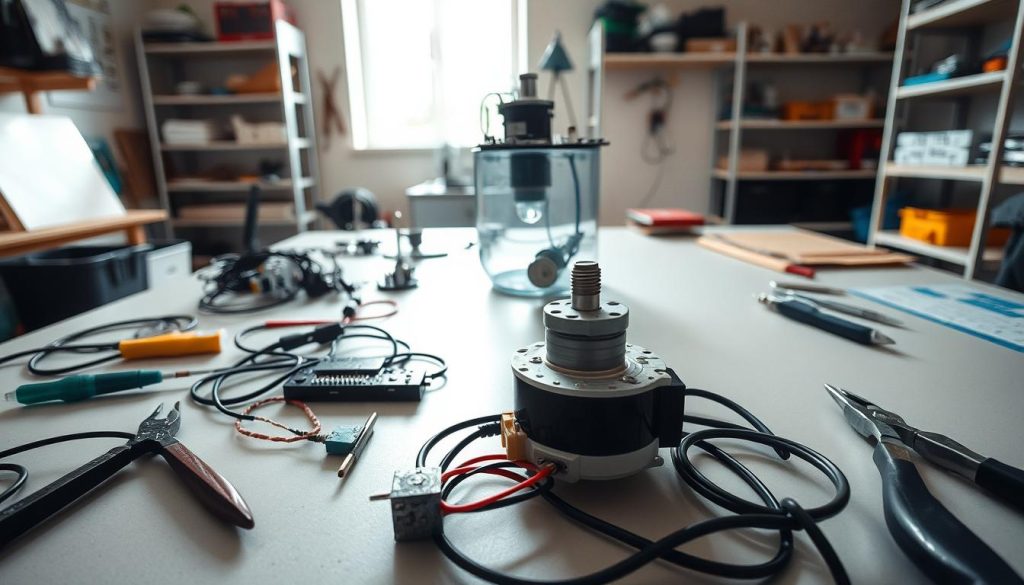
Mini water-bottle kit with small DC motor and AA cells
Parts: a small DC motor, propeller, AA battery holder and batteries, double-sided tape, net and simple supports. This light kit is an educational project rather than heavy-duty equipment.
Role of parts: the motor spins the propeller, the net traps debris, and the battery pack gives portable power for short bursts. Take care around sharp blades when cutting and mounting components.
Plastic-bottle prototype powered by a power bank
Use a 700 ml bottle as housing, add one side hole and several bottom holes for intake, and fit a cardboard disc to mount a gearless motor. Attach a propeller, route the cable through the side hole and tape a power bank for USB supply.
Cover openings with open-weave bandage as a collection net; this keeps airflow while catching fine dust more effectively than dense fabric.
Choosing the right build
For crumbs and craft debris we recommend the mini bottle. For a clear demonstration of airflow and dust capture, pick the plastic-bottle prototype.
Practical limits: small motor builds have short runtime, can clog and are best for dry dust—not wet spills unless electrics are fully isolated. For wet pickup, our jug trap with an existing unit is the safer option.
Conclusion
We close by stressing that a jug‑trap works when seals are tight, the inlet sits about 15–16 cm from the main spout, and testing is cautious. This set-up captures much debris while keeping the main unit protected from direct contact with liquid.
Safety first: keep any water away from the vacuum body, watch the hose for upward movement, and stop at once if liquid nears the connection.
The device relies on a motor‑driven fan to create airflow; capture depends on managing the air path and a sound filtration stage. For further design notes and a bottle‑prototype outline, see our linked prototype paper.
Next steps: refine seals, fit better tubing or choose a small educational build if learning is the goal. In Singapore, prioritise safe filtration for haze or renovation dust and avoid pushing a DIY rig beyond its limits.

