
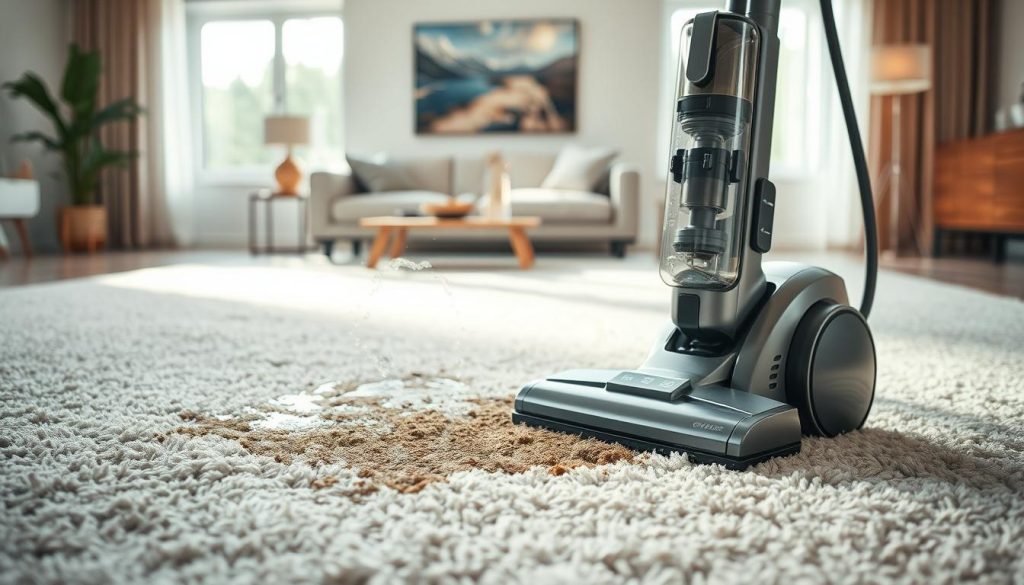
We introduce our commercial range designed to cut routine time while preserving a high finish on hard floors. Facility teams in Singapore will find this product useful for busy shared spaces where repeatable results matter.
In daily use the wet dry approach lets teams pick up dust and lift fresh spills in one pass. Our description explains how a single workflow combines suction with mopping action to reduce downtime.
Who this is for: we support facility managers, operations teams and owners who value hygiene, compact storage, cordless mobility and separate tank designs. These features are key when buyers compare systems for large floors.
Note: images and colours vary by country model and are illustrative. Performance figures are indicative and will depend on floor type, soil, traffic and how the unit is used in practice.
Wet and dry vacuum self cleaning for commercial floors in Singapore
We design our systems for busy Singapore sites where uptime matters. High footfall, sudden spills and tight shift handovers demand equipment that performs reliably and quickly.
Built for daily footfall, spills and fast turnarounds
One machine, two actions. Our unit clears loose dirt and removes light spills in the same pass. This reduces area closure time and speeds routine spot care during trading hours.
Where our wet dry approach fits best across sites
Typical locations include retail entrances, office corridors, clinics, tuition centres, gyms and F&B back‑of‑house areas. These spaces see mixed debris and need consistent results.
- Standardises results across multiple sites to cut reliance on manual mopping.
- Best suited to sealed hard floors where controlled water use matters.
- Porous surfaces need adjusted modes and extra care to avoid residue.
| Site type | Primary issue | Recommended routine |
|---|---|---|
| Retail entrances | Dust, tracked dirt, light spills | Spot cleans during peak; deeper pass after close |
| Office corridors | Foot traffic debris | Quick daily passes to maintain finish |
| F&B back‑of‑house | Food debris, liquid spills | Immediate spot response; scheduled wash at night |
Vacuum and mop at the same time to handle dust, debris and spills
We let teams handle dry dust, scattered debris and new spills in one continuous workflow. This reduces stop‑starts and keeps busy Singapore sites presentable during trading hours.
Hard‑floor performance across tile, vinyl and sealed surfaces. Our combined system suits tiled lobbies, vinyl corridors and other sealed finishes common in commercial interiors. Low‑water passes pick up fine dust and light marks without over‑wetting. High‑water passes tackle sticky spots and fresh spills.
From quick dust passes to stubborn spill clean‑ups. One operator can move from a dry sweep to a wetter recovery mode without fetching a separate mop and bucket.
- Efficiency: fewer tool changes, faster area turnarounds.
- Practical limits: designed for frequent maintenance, not deep restorative work.
- Safety: controlled water use reduces slip risk and speeds reopening.
“A single workflow that moves seamlessly between dust pick-up and spill recovery greatly improves routine productivity.”
See independent reviews and practical guides such as stain recovery tips for further context.
Powerful suction and brush performance that cleans in minutes
High suction paired with fast brush action turns a routine pass into a visible result in minutes. We design contact, airflow and power delivery so the machine lifts tracked-in dirt while controlling moisture for sealed commercial floors.
Roller speed and wiping impact. In supported modes the roller brush can reach up to 900 rpm after a full charge on test surfaces. The wiping action can occur up to 15 times per second on test surfaces, a measure of agitation and repeat contact.
Optimised pick-up for dust and mess
We combine targeted suction with brush contact to pick up dry dust and light spills in one pass. Results vary by floor type, so mode selection matters for run time and finish.
- Operational benefits: fewer repeat passes, faster corridor clears and shorter downtime — often cutting tasks to minutes.
- Mode guidance: use higher power for heavy debris zones; choose controlled modes for routine maintenance to balance time and battery life.
“Combining high suction with rapid brush contact reduces repeat work and keeps busy sites presentable between shifts.”
Self-cleaning system with one-button activation
One press begins a programmed rinse that saves time and reduces manual scrubbing between shifts.
We designed the function so teams can hand the unit to the next user with confidence. Press one button to activate automatic rinsing of the brush roller and the waste-water channel.
Automatic rinsing of the brush roller for a fresher next use
The built-in rinse removes residue that can redeposit on floors. This keeps the brush performing consistently and shortens prep time before the next task.
Waste-water channel rinse to reduce lingering odours
Channel flushes clear trapped dirty water and reduce smells in shared storage areas. This is especially useful in Singapore’s warm, humid conditions.
- Quick SOP: empty dirty water, run one-button rinse, allow to dry, then dock.
- Solution use: a compatible cleaning solution may be added if the model recommends it; avoid harsh chemicals that harm internal parts.
- Benefit: improved hygiene and lower labour for multi-shift operations.
| Action | Result | Time |
|---|---|---|
| One-button rinse | Brush and channel cleared | Approx. 90 seconds |
| Empty dirty water tank | Prevents odour and contamination | 30–60 seconds |
| Dry then dock | Ready for next use | 5–10 minutes air dry |
Hot air drying and heated water support for hygienic results
After the programmed rinse ends, an automatic hot-air cycle speeds drying to limit residual moisture on the roller. This reduces the chance of lingering odours in shared storage and helps the unit be ready for the next user.
Automatic hot-air drying: once the air outlet temperature stabilises the flow reaches about 55°C at typical room conditions. Ambient temperature and ventilation affect this figure, so actual results will vary.
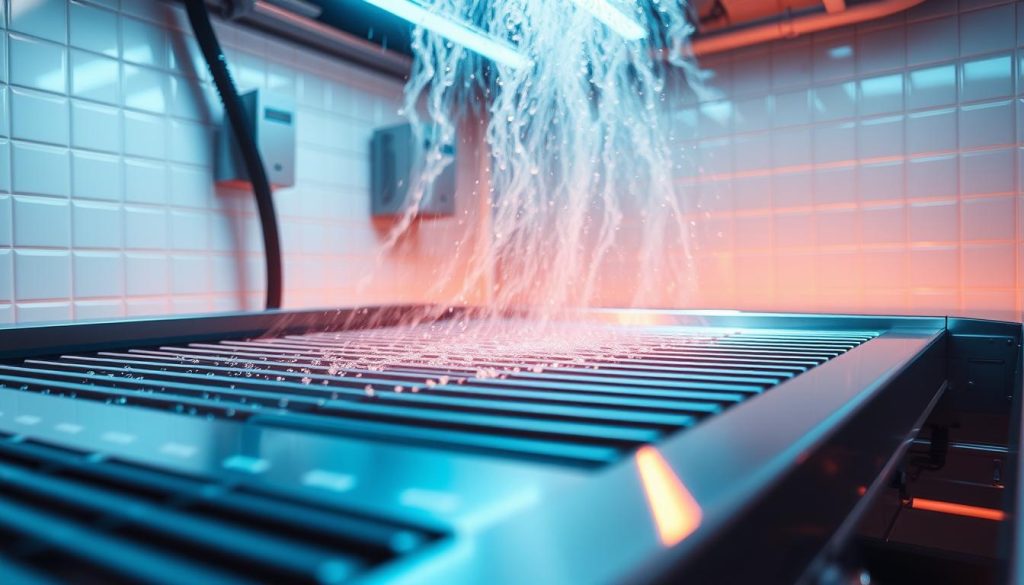
High-temperature water support
In high-temperature mode the main tank can heat water up to 75°C under normal pressure. Early uses may show lower values; performance generally stabilises after the first two cycles.
Practical-use notes
The roller brush may hit roughly 55–60°C when the unit runs in higher power. These temperatures help break down oily residues and tough grime, improving hygiene for multi-user stations.
| Feature | Indicative temp | Typical time |
|---|---|---|
| Hot-air drying | ~55°C | Approx. 90–120 minutes (varies by ventilation) |
| Main tank high-temp mode | Up to 75°C | First heats may be slower |
| Roller peak | ~55–60°C | Stabilises after a few cycles |
How this helps us: higher temperatures reduce bacterial risk and leave the cleaner ready for duty faster. Expect variation by floor material, usage and local climate, and allow a short run-in period for best results.
Clean and dirty water separation to keep every pass effective
We keep clean water and used water separate so each pass leaves a floor truly refreshed.
Why separation matters: a distinct water tank for fresh supply prevents soiled water from being spread back over larger areas. This reduces residue and helps control debris during routine work.
Separate tanks to prevent recontamination
Our design feeds clean water into the wash while isolating waste in a separate dirty water reservoir. That split preserves suction and wash performance as an area is covered.
Capacity options and practical impact
Standard capacity is a 600 ml clean water tank with a 450 ml dirty water tank. Some models raise the clean tank to about 745 ml for fewer refills on medium corridors and lobbies.
Quick-empty workflow for dirty water
Fast handling: drain the dirty tank after higher soil loads to reduce odour and maintain suction.
- Higher clean water capacity cuts refill interruptions for busy shifts.
- Timely emptying prevents redepositing soil and keeps wet dry routines efficient.
- Separation helps manage mixed debris without performance loss.
| Tank type | Typical capacity | Benefit |
|---|---|---|
| Clean water tank | 600 ml (up to ~745 ml) | Fewer refills, longer runs |
| Dirty water tank | 450 ml | Isolates waste, reduces odour |
| Combined effect | — | Stable suction and consistent results |
Base station convenience for busy teams and shared storage
A compact base station keeps kit organised and ready for quick handovers across shifts. It gives a clear place to charge units, store spare parts and stage refills so teams spend less time preparing and more time on duty.
Compact docking base: the small footprint suits tight storerooms common in Singapore facilities. The station minimises loose parts and reduces the risk of units being left uncharged between shifts.
Base water tank capacity up to 3000 ml
Large tank: where supported, the base holds up to 3000 ml of water in a refill reservoir. This reduces trips to supply points during busy service windows.
Designed to support near one‑week routines
Typical-cycle example: if a unit is used once every two days and each use draws about 745 ml, a 3000 ml base provides nearly four cycles — roughly one week. Actual delivery will vary with usage and site conditions.
- Station convenience shortens prep time and improves shift handovers.
- A central base helps supervisors track readiness and schedule delivery or refills.
- Fewer refill trips free up labour for higher‑value tasks during operating time.
“Our base station design brings tidier storage, fewer interruptions and predictable support for weekly routines.”
| Feature | Benefit | Typical effect |
|---|---|---|
| Compact docking base | Tidier storerooms | Less lost equipment, faster handovers |
| Base water tank (up to 3000 ml) | Multi‑cycle refills | Fewer supply trips per week |
| Centralised station | Operational oversight | Easier shift planning and delivery tracking |
Cordless performance, run time and charging expectations
Cordless operation lets teams move between zones quickly without trailing cables. That mobility reduces trip hazards and speeds routine passes at entrances, corridors and lobbies across Singapore sites.
Battery life is rated up to 35 minutes for typical use, but real results vary by floor material and soil load. Lab references (report 0316-22A-01) give mode-based figures: 50.3 minutes in water absorption mode, 41.4 minutes in automatic mode and 21.2 minutes in high-power mode.
We recommend planning runs by mode so operators know how much area they can cover per charge. Use quick maintenance passes during peak trading and schedule deeper work when a recharge window exists.
Charging specs differ by model. Check the listed charging time (mins) and whether a battery level indicator is fitted; the indicator is essential for predicting if a job can finish before returning to the dock.
| Mode | Lab minutes | Practical note |
|---|---|---|
| Water absorption | 50.3 | Best for low-power, long passes |
| Automatic | 41.4 | Balanced run time and power |
| High-power | 21.2 | Short bursts for heavy soiling |
“A clear understanding of runtime and charging makes shift planning predictable and reduces downtime.”
Power levels, modes and smart dirt recognition
Adjustable power lets teams match performance to the task, saving runtime where full output is unnecessary.
We offer multiple power levels to control noise, suction and battery use. Short, selectable steps let operators pick a conservative setting for routine dust or a higher one for heavy debris.
Multiple settings for controlled suction
No. of power levels is a useful procurement checkpoint. Sites with mixed traffic should choose models with more options so users can adapt without changing equipment.
Smart dirt recognition for responsive cleaning
Smart dirt recognition senses heavier soiling and boosts performance automatically. This reduces missed spots when different staff run shifts.
Low and high water modes for spill response
Low water mode suits routine dust and small marks. High water mode handles larger spills and stickier residues.
Decision guidance: combine low water with lower power for quick passes; use high water and higher power for stubborn spills to avoid repeat work and cut overall operating cost.
| Control | When to use | Benefit |
|---|---|---|
| Low power / low water | Routine maintenance | Longer run time, less noise |
| Medium power / auto mode | Mixed traffic areas | Balanced performance and battery life |
| High power / high water | Heavy soiling, large spills | Faster recovery, fewer repeat passes |
For procurement, check the No. of power levels and ensure smart dirt recognition is included to keep results consistent across shifts in Singapore sites.
Handheld unit and edge-to-corner practicality
A compact handheld head gives us precise reach for fixture bases, skirting lines and narrow gaps. This small module solves detail tasks that a full-width floor tool cannot access.

Practical use cases around fixtures and tight areas
High-value spots: toilet perimeters, pantry edges, under seating lips and around shopfitting often gather crumbs and dust. The handheld option clears these zones quickly with minimal disruption.
Complement, not replacement. We position this tool as a practical add-on to main routines. It improves overall presentation with only a small time penalty.
- Portability: a light feel in handheld mode reduces operator fatigue during short spot tasks.
- Control: precise nozzle access improves edge capture versus broader heads.
- Comparison: teams weighing a stick vacuum will find the handheld gives similar manoeuvrability while staying within a single system.
“A handheld module closes the gap between scheduled passes and everyday touch-ups.”
Some buyers consider use at home, yet our focus is commercial: shared equipment, quick deployment and predictable results. For more inventive applications see unusual uses.
Filter type, washable components and routine upkeep
Choosing the right filter helps preserve suction and extends service intervals in commercial settings.
We specify a clear filter type so buyers know its effect on airflow, odour control and maintenance frequency. A washable filter reduces consumable spend and simplifies daily routines for teams that run frequent cycles.
Washable filter to cut operating costs
Rinse the washable filter, let it dry fully, then reinstall. This prevents loss of suction and lowers replacement cost over time.
Brush, tank and channel care
Clean the brush roller weekly. Wipe the tank after each shift and quick‑empty when soil is high. Check the channel after a programme rinse to prevent residue build‑up that slows drying.
- Routine: rinse filter, brush clear, empty tank, inspect channel.
- Cleaning solution: use compatible formulas; avoid heavy foaming products that harm sensors and paths.
- Benefit: regular upkeep keeps the unit a dependable go‑to cleaner and reduces downtime.
| Component | Action | Frequency |
|---|---|---|
| Filter type (washable) | Rinse & air dry | Weekly or as needed |
| Brush | Remove debris, rinse if required | Weekly |
| Tank & channel | Empty, wipe, check after rinse | After each heavy use |
Wet/dry dust separation and debris management
A clear internal split between wet and dry paths keeps mixed floors from clogging the system.
We separate liquid residue from fine particles so the main paths stay clear. This makes upkeep simpler when entryways bring grit, light rainwater and tracked-in dirt.
Separation of wet/dry dust prevents damp matter from reaching dry collection channels. That lowers the chance of blockages and keeps suction stable during long shifts.
Separation of wet/dry dust for cleaner internal handling
Our design routes solids and moisture into distinct compartments. The result is cleaner internals and fewer smells over time.
Managing mixed debris without compromising performance
For mixed debris we recommend removing large items first when safe to do so. Choose the correct water mode and empty tanks after heavy jobs to preserve performance.
- Operational tip: clear visible litter, then run a balanced pass.
- Maintenance: prompt emptying and a routine rinse keep channels free of residue.
- Benefit: consistent suction, reliable brush contact and smoother programme cycles.
| Issue | How separation helps | Operator action |
|---|---|---|
| Grit plus damp patches | Prevents clumping in dry path | Remove large grit; use moderate water mode |
| Fine dust with light spills | Keeps suction steady over time | Run balanced pass; empty dirty tank after shift |
| Food residues | Isolates liquids to reduce odour | Quick-empty and rinse programme post-use |
Weight, handling and noise-aware operation
We choose equipment that staff will use consistently. Weight distribution, handling and audible output affect whether a model becomes part of daily routines. Poor balance or heavy heft increases fatigue and reduces consistency across long shifts.
Unit weight and balance considerations for longer cleans
Check the declared weight and test how it feels in a push‑pull motion. A well balanced machine eases turning and reduces strain when covering multiple zones.
Practical advice: try a short trial with a fully loaded tank to see real use. Pace your teams and schedule docking breaks to manage operator load and safe handling.
Power-off delay and control responsiveness
Confirm the power-off delay (sec) in specifications. A short delay helps when you stop near thresholds or obstacles, while too long a lag can feel clumsy.
Choose a model with clear power level controls so teams can lower output for occupied spaces and raise it only where needed.
| Factor | Why it matters | Operator action |
|---|---|---|
| Weight | Impacts fatigue over time | Test push feel; schedule breaks |
| Balance | Affects turning in narrow aisles | Assess in tight corners |
| Noise & power level | Less disruption in occupied areas | Use lower level during service hours |
| Power-off delay (sec) | Controls stop/start responsiveness | Verify spec; choose short delay for thresholds |
What’s included, items you can add and delivery in Singapore
We list precisely which components arrive with each unit so procurement can close purchase checklists with confidence.
What arrives with the system and docking station
Each product shipment includes the main system, the docking station, a primary brush roller, a clean water tank and a dirty water tank. We also supply the mains charger, basic spare seals and a quick‑start guide.
Please confirm the exact item list at checkout to avoid surprises when the order reaches your store room.
Recommended add‑ons: solution and spare brush components
We recommend purchasing a compatible cleaning solution and at least one spare brush component for high‑use sites.
- Cleaning solution: choose a low‑foaming, facility‑grade formula approved for the product.
- Spare brush: keep an extra roller to reduce downtime during routine replacement.
Delivery, lead times and on‑site handover options
Typical delivery in Singapore is shown at checkout; lead times vary by model and stock. Plan for receiving checks and a small storage area on arrival.
We offer on‑site handover where available. Training covers filling tanks, mode selection and running the rinse programme so teams can begin safe operation immediately.
- Confirm included items at quotation stage.
- Plan consumable purchase by expected usage and number of users.
- Schedule delivery and handover to reduce deployment delay.
Product page feature notes and data transparency
Our product page aims to make specification facts clear so procurement teams can compare models with confidence.
What this page shows: images may be illustrative and colours can vary by country model. Use the listed specification as your primary reference for any purchase decision.
Why results differ: performance depends on floor type, soil load, humidity and user technique. A single mode setting can behave differently in a tiled lobby versus a vinyl corridor.
How to read our data
We flag figures sourced from Shunzao Laboratory where shown. Those numbers give useful context but are not unconditional guarantees for every site or run time.
- Representative imagery versus confirmed specification.
- Colour and trim can vary by market and distributor.
- Verify motor behaviour, run time and supported mode in the spec sheet.
| Item | Meaning | Action |
|---|---|---|
| Illustrative image | Shows styling only | Check model spec for exact colour |
| Lab data | Test context provided | Use as reference; validate on-site |
| Performance claim | Depends on environment | Plan trials for your site |
“We aim to provide clear, auditable notes so commercial teams can trust the page data during procurement.”
Why choose our wet dry vacuum cleaner range for your facility
Operational gains come from combining targeted suction, adjustable water modes and quick-empty handling. We package features so teams cover more area with fewer interruptions.
Efficiency gains: fewer passes, cleaner floors, less downtime
Faster cycles: one run replaces separate sweeping and mopping tasks. That cuts area closure time and keeps customer zones open.
Quick-empty tanks reduce refill stops and speed handovers between shifts.
Better hygiene via clean water control and automated self-cleaning
Separate tanks prevent recontamination by keeping clean supply apart from used water. The one-button rinse and channel flush reduce residue and odour risk.
Convenience benefits for teams: docking, quick-empty tanks and cordless use
Our compact docking base stores spares, holds a refill reservoir and charges units ready for the next shift. Cordless freedom lets staff move between zones without trailing cables.
Practical result: predictable handovers, consistent results across operators and less time spent on routine waste handling.
Conclusion
For busy commercial sites, combining suction with a controlled wash lets teams finish zones faster while keeping standards high.
When choosing a unit, verify tank separation, run time, suction performance and available power levels. Check the station features and whether the model offers the one-button rinse plus heated drying support.
Routine care matters: select correct mode, wash filters, empty tanks and inspect the brush to protect long-term performance and hygiene.
Remember that real-world results vary by floor type, soil load, motor wear and environment. Use the specification sheet as your procurement reference.
For facilities that may use the kit at home occasionally, prioritise commercial workflow needs—storage, docking and repeatable cycles—then assess secondary uses. Next step: review exact model specs and pick the configuration that fits your site size, frequency and staffing.

