

We set clear expectations for what a realistic comparison looks like in Singapore. Local catalogues list models from Nilfisk, Viper, Bosch and Makita, often in 240V/50Hz format, so buyers face many like-for-like options.
Our aim is to show how downtime, consumables and support change long-term value. We will compare suction stability, tank strength, filter systems and service coverage so teams can shortlist the right model fast.
We frame the roundup around real site needs: construction dust, mixed spill pickup, large liquid recovery and hazardous dust compliance. That means our outputs focus on a practical comparison framework, what drives different cost bands, and a shortlist that maps products to use cases and budgets.
For a closer look at a popular local option, see our link to a Lura review and useful specs here.
Why wet & dry industrial vacuums matter for Singapore worksites
We see these machines earning their keep across busy Singapore worksites every day.
Typical environments include construction sites, workshops, plant rooms and other indoor spaces where teams face mixed debris types. A single unit often needs to switch between dry dust, damp residue and liquid spills during a shift.
What they handle: these machines cope with heavy dust loads, gritty debris and shallow water without stopping work. That resilience keeps crews moving and reduces interruptions.
Where they outperform a standard unit
Compared with a standard dry vacuum cleaner, robust designs offer tougher housings, stronger mobility parts and uninterrupted suction for long shifts. Kärcher called such units “a cut above” for heavy contamination; this matters on tight schedules.
- Better for heavier contamination and mixed spills
- Less downtime from tool swaps
- Improved site hygiene, which boosts productivity
| Feature | Standard dry unit | Dual-purpose unit |
|---|---|---|
| Suitability for sites | Light, intermittent | Continuous, heavy-duty |
| Liquid handling | No | Yes |
| Housing & mobility | Basic | Rugged, jobsite-ready |
Choosing the right class up front prevents misuse and extra service events. For model options and specs, see our look at the Nilfisk wet and dry range.
How we compare industrial wet & dry vacuum cleaner prices fairly
We measure value by day-to-day performance and long‑term running costs. Our aim is to show which units keep crews working and which add hidden expense.
Value metrics beyond the sticker
We assess price against delivered performance: suction stability, usable airflow under load, and recovery when filters begin to clog.
- We quantify downtime as lost shifts from filter cleaning, blocked hoses, full tanks and trips for consumables.
- We check running costs by examining filters, bagless operation potential, and the service ecosystem that keeps machines moving.
- We compare within an application range first, then only cross‑compare where use cases overlap.
Minimum professional expectations
For real work we require a robust motor, strong suction power and a durable filter system. Practical features should cut operator friction and reduce service events.
“Automatic filter cleaning maintains consistently high suction power for large quantities of fine dust, supporting uninterrupted work.”
| Metric | Why it matters | What we test |
|---|---|---|
| Suction stability | Keeps cleaning rate steady | Airflow under load, recovery time |
| Running cost | Drives TCO over months | Filters, bags, service turnaround |
| Build & features | Reduces site downtime | Motor durability, hose routing, mobility |
industrial wet and dry vacuum cleaner price in Singapore: what drives the range
Costs in Singapore reflect not just the unit tag but the engineering behind motor and airflow choices. We look at the components that change purchase and running costs across the local range.
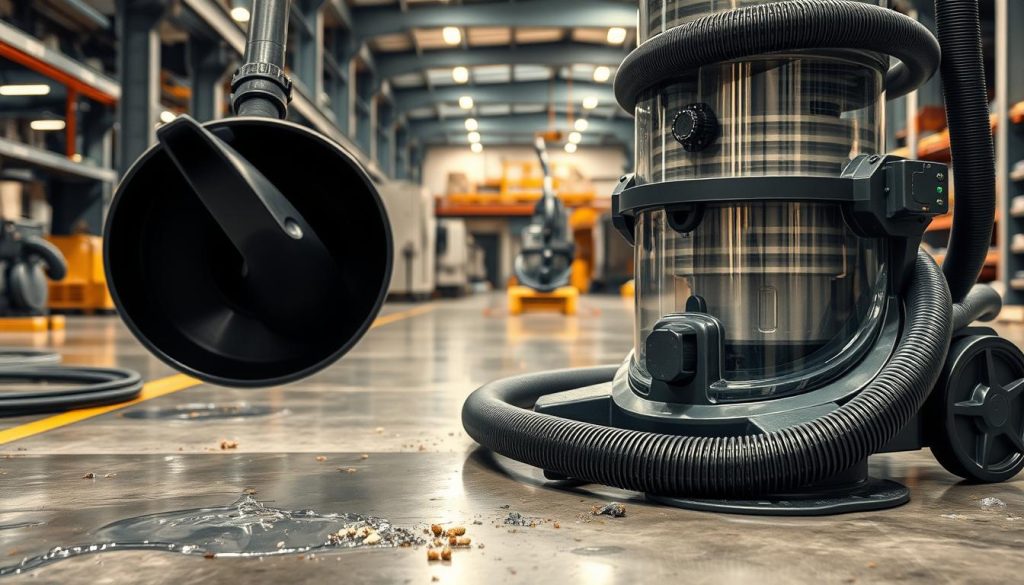
Motor, suction power and airflow system considerations
A robust motor and a well‑designed air path keep suction steady under load. We test how the suction system performs when hoses, nozzles and filter begin to clog.
Suction power that holds up reduces downtime and speeds tasks, so motors with better cooling or twin‑stage designs command higher prices.
Tank capacity, stainless steel construction and site durability
Larger tanks cut emptying frequency. Machines with stainless steel tanks resist dents and last longer on harsh sites, raising their upfront cost but lowering lifetime loss.
Filters, HEPA options and dust-class certification impact on pricing
Higher separation needs lift cost. PTFE, PES or paper media suit L/M use, while H‑class HEPA filters meet the strictest dust limits and add significant expense.
“Class M is the minimum legal level for many construction applications; H‑class offers near total protection.”
Convenience features and local service that affect cost
Tool sockets, hose storage, strong castors and compact layouts save labour and raise the spec. Wet‑pickup guards such as mechanical floats or electronic cut‑offs protect the motor and are priced accordingly.
Service and parts availability in Singapore also shape value. Fast support and clear warranty terms often outrank small initial savings when a machine is critical for site applications.
Top brands and model families we see in the Singapore market
Local suppliers tend to group machines into a few clear model families, which helps buyers compare like with like.
We focus on three practical range concepts that recur in listings. Each one maps to typical site tasks and service expectations.
Professional ranges for trade and industry
NT Tact style models target fine dust work. They keep suction high for uninterrupted use on construction sites and workshops.
Ap class and standard class concepts
The Ap class covers all‑round needs: liquids, moist dirt and medium‑fine dust with semi‑automatic filter cleaning. The standard class suits coarse debris and large water volumes for routine contract cleaning.
- We orient buyers to naming logic so comparing models is faster.
- Expect differences between models mainly in filtration, tank size, durability parts and included accessories.
- Catalogues in Singapore often list Nilfisk, Viper, Bosch and Makita side‑by‑side, so compare specs and local support, not just brand familiarity.
“Category labels can hide important differences such as dust class or filter cleaning method.”
Best for fine dust on construction sites and workshops
Fine dust from cutting, grinding and sanding creates hazards that ordinary cleaning gear cannot manage. We focus on real materials—concrete, brick, plaster and wood—that produce respirable particles such as silica and MDF dust.
Why fine dust behaves differently
Small particles clog a filter rapidly and cut suction within minutes. When filters load, airflow falls and operators must stop to clean or swap parts.
Patented Tact filter cleaning keeps suction steady
Tact uses brief reversed air blasts to clear the media from the clean side. The result is consistently high suction power and long running periods without manual interventions.
Extraction at the source with tool connections
Connecting a tool to the vacuum via an auto‑start socket captures dust before it becomes airborne. This reduces site spread, helps other trades and improves housekeeping.
| Need | What to check | Benefit |
|---|---|---|
| Fine masonry and wood dust | High‑efficiency filter, Tact cleaning | Maintains suction, fewer stoppages |
| Tool‑mounted extraction | Auto‑start socket, tight hose coupling | Less airborne dust, safer site |
| Long shifts | Durable motor, reliable air path | Lower downtime, better value |
Best all-rounders for mixed wet/dry waste
For mixed site tasks we favour machines that switch quickly between liquid recovery and dry debris without adding complexity.
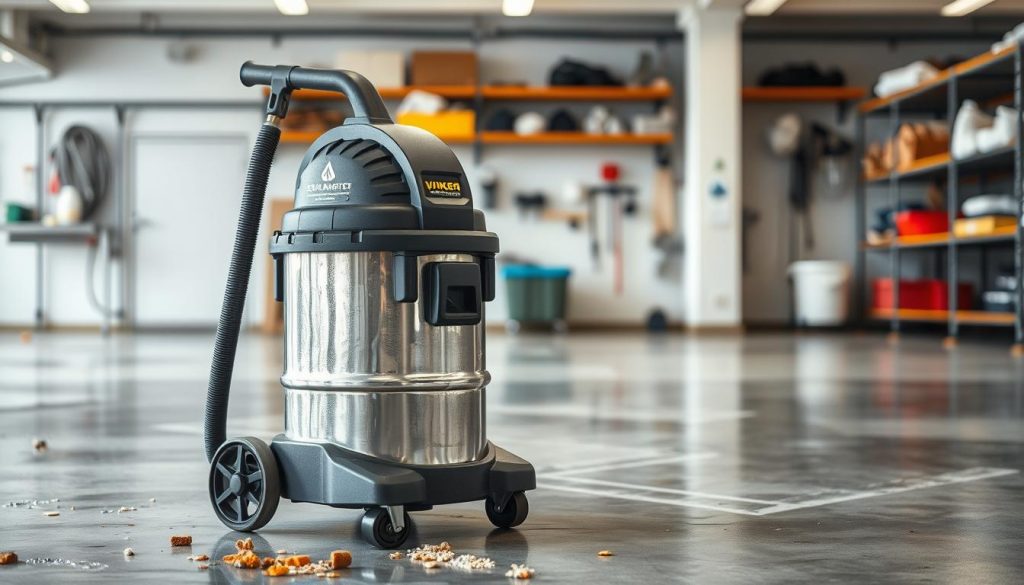
Ap class machines are positioned as true all‑rounders. They recover liquids, handle moist dirt and cope with medium‑fine dust while using semi‑automatic filter cleaning to keep suction steady for long periods.
Why semi‑automatic filter cleaning matters
The semi‑automatic filter action clears the media with brief pulses. This maintains performance through extended shifts and keeps running costs sensible.
In Singapore car bays this matters. Oil residue, damp grime and general debris often appear together. One reliable unit reduces storage, cuts machine swaps and simplifies staff training.
- Check tank capacity and easy emptying for daily use.
- Confirm the filter system switches between wet and dry modes cleanly.
- Look for accessory sets that cover squeegees and tool connections.
“A single all‑rounder that holds suction lets teams finish jobs faster and with fewer interruptions.”
Expect compromises: Ap‑class models handle medium‑fine dust well, but extreme fine‑dust work can still justify a Tact‑type specialist.
Best for large liquid volumes and frequent wet pickup
Where rapid liquid recovery matters most, we prioritise machines designed for robust water handling. Standard‑class units suit jobs with heavy washdowns, frequent spills and coarse debris that comes with maintenance work.
Standard-class positioning for coarse dirt and large water volumes
Standard-class models are built for simple, reliable recovery of large water volumes. Kärcher notes these machines cope with coarse dirt and high flow without fuss.
Wet-pickup safety: float systems and automatic cut-off to prevent overfilling
Protective measures stop liquid reaching the blower. Mechanical float systems block the suction channel when levels rise.
Electronic automatic cut‑offs switch the motor off when probes detect liquid. Both prevent costly damage and downtime.
- We recommend this class when water runs are frequent and speed matters on the floor.
- Look for quick‑drain outlets, stable mobility and rugged build for daily cleaning.
- These systems favour liquid handling and durability over advanced fine‑dust filtration.
“For spills and rapid recovery, reliable overfill protection keeps machines working and sites safe.”
Best for hazardous dust and compliance-led sites
Selecting equipment for high‑risk dust work demands a clear plan for capture, containment and disposal. We focus on how dust class, certified filtration and safe workflows change procurement and on-site use.
Understanding dust classes L, M and H
Dust class labels state permeation limits and guide legal compliance. L ≤ 1.0% suits low‑risk materials like chalk and plaster.
M < 0.1% is the usual baseline for construction tasks that produce concrete, brick and hardwood dust. H < 0.005% is for highly hazardous particles and requires strict controls.
| Class | Permeation limit | Typical use |
|---|---|---|
| L | ≤ 1.0% | Chalk, plaster; low risk |
| M | < 0.1% | Concrete, brick, hardwood; construction baseline |
| H | < 0.005% | Asbestos, lead, silica; hazardous work |
When HEPA and H‑class filters are worth the premium
H‑class media, often described as HEPA with 99.995% separation, is vital when client rules or risk assessments demand absolute containment.
Pay the premium where exposure could harm workers or trigger strict disposal duties.
High‑risk examples and practical steps
We list common high‑risk dusts: silica from concrete cutting, mould during remediation, lead in refurbishment and asbestos‑related work.
- Choose H‑class filtration and sealed bagging for these tasks.
- Plan safe disposal and certified service to maintain compliance.
- Brief teams on correct bags, filters and extraction use to cut exposure.
“Correct filter choice and disposal workflows turn a compliant machine into a safe site practice.”
Filter systems and running costs that change total value
Filter choice and cleaning routines decide whether a machine is an asset or a headache on site. We focus on how filter systems affect uptime, consumables and monthly cost so buyers in Singapore can budget with confidence.
Semi‑automatic vs fully automatic cleaning: daily gains
Semi‑automatic cleaning gives a quick pulse to clear media and restore suction. It still needs operator action at intervals.
Fully automatic systems reverse airflow to clean from the clean side. The benefits are clear: steady suction power, fewer stops and less contact with dust.
Bagless operation: consumables and usable volume
Bagless setups can cut consumables spend and allow full container use. But they raise exposure risks if filters must be handled manually.
Filter types and durability cues
PTFE or PES media resist moisture and rot and deliver ~99.9% separation for M/L tasks. Paper or cartridge filters suit dry vacuum duty only.
- Buyer checklist: spare filter cost, expected service life, ease of safe cleaning.
- Match media to dust type and avoid using dry‑only filters where liquid pickup is likely.
- Confirm how the system cleans to estimate real work time saved.
“Automatic cleaning keeps suction steady while cutting time spent on filter maintenance.”
What to buy for your application: quick selection guide
We match common site tasks to the simplest machine spec that will do the job reliably. This fast path links applications to dust class, required suction power and wet dry capability so teams can shortlist without overbuying.
Construction and renovation teams: dust class and suction power priorities
Prioritise dust class M as a baseline for many construction uses.
Choose units with steady suction power and tool‑connection readiness for source extraction.
Workshops and manufacturing: materials, chips, oil and mixed debris handling
Focus on the types of debris and materials you handle: chips, mixed dust and oil residues.
Select robust separation media and easy‑clean filters to avoid frequent clogging.
Facilities, hotels and restaurants: robustness, wet pickup and ease of handling
For daily cleaning choose standard class units for liquids, quick emptying and safe mobility.
Operator convenience and fast maintenance keep turnover high.
Automotive and detailing bays: all-round wet/dry performance and downtime control
Ap class all‑rounders suit car bays; they balance liquid recovery with fine dust control.
Check local service and spare parts in Singapore to avoid long downtime.
| Application | Key check | Recommended class | Main benefit |
|---|---|---|---|
| Construction | Dust class, suction power | M (baseline), H for hazards | Compliance and steady performance |
| Workshop | Materials, oil handling | Ap class or workshop‑spec | Less clogging, better hygiene |
| Facilities | Wet pickup, emptying ease | Standard class | Fast daily turnaround |
| Automotive | All‑round use, service | Ap class | Reduced downtime, versatile use |
Conclusion
Choosing the right machine starts with matching capability to the mess you face each day. The best wet/dry unit for your team fits the dust type, the work rhythm and local service needs.
We prioritise total value over sticker figures: steady suction, a reliable filter system and fast parts support cut downtime and ongoing cleaning costs. For compliance-led work, let dust class and HEPA rules steer your choice.
Practical next steps: define your main application, confirm the minimum dust rating, shortlist two to three machines and check local service and spares. For a useful local reference see our Lura review.
In Singapore’s tight schedules, investing in the right machine and support often beats repeated replacement of under-specified cleaners.

