
We introduce our air purifier weekly service for homes across Singapore. Our aim is simple: keep your unit performing consistently, not just working. We focus on cleanliness, steady airflow and measurable outcomes.
We run scheduled, repeatable checks in real living conditions. That means better air quality readings, steadier flow and less recirculated dust. Modern units with built‑in sensors help us confirm improvements.
Singapore homes often see high usage, enclosed rooms, cooking and humidity. For many households this makes a weekly cadence practical and cost effective. We design our visits for busy families who want clean air with minimal hassle.
What follows on this page: why regular care matters, our process, filtration standards and how to choose the right plan for your home and room needs.
Why weekly servicing matters for cleaner indoor air in Singapore
Keeping rooms healthy in Singapore needs regular attention because particles and pollutants build up fast. Our approach focuses on steady air quality so families notice fewer symptoms and clearer readings.
Indoor air can be more contaminated than outdoor air
Everyday living brings contaminants into the house. Dust, pollen and pet hair enter on clothing and shoes. Humidity can encourage mould growth and spores in corners.
What weekly upkeep helps reduce
- Dust and dust mites that settle on surfaces and vents.
- Pollen tracked in from outside and lingering particles.
- Pet dander and hair from dogs and cats.
- Mould spores and cooking smoke that raise indoor pollutant levels.
When routine care delivers the most value
We recommend frequent checks for homes with pets, heavy cooking, frequent cleaning that stirs dust, or during haze periods. Short intervals also help stabilise device readings and reduce drop-offs in performance.
| Household scenario | Main buildups | Primary benefit |
|---|---|---|
| Family with pets | Pet dander, hair, dust mites | Fewer allergens in bedrooms |
| Frequent cooking | Smoke, odours, fine particles | Cleaner room atmosphere |
| Haze or renovation | Outdoor pollen, fine pollutants | Stable air quality indicators |
Preventative care is about keeping problems from returning, not only fixing them. For guidance on timing and when monthly checks may be insufficient, see our maintenance timing advice. Regular upkeep will also help to purify air and support healthier living.
Our air purifier weekly service process
We follow a clear checklist at each visit so customers see what we inspect and why. We begin with pre-service checks of the unit’s built-in sensors and the overall air quality indicator. These readings reveal unusual patterns, sensor contamination or restricted flow.
Pre-service checks and sensor review
We note indicator history, and check light sensors that trigger auto modes. This helps us decide whether calibration or cleaning is needed before further work.
Filter inspection and airflow assessment
We examine the HEPA filter condition, seals and fitment. A poor seal can let particulates bypass filtration even if the element looks clean.
Deep cleaning of intake and outlets
We clear dust-prone zones: intake grills, pre-filter areas and outlet vents. Removing built-up debris reduces resistance and supports minimal noise operation.
Performance verification and notes
After cleaning, we confirm consistent airflow, check that noise remains low and ensure the unit covers the intended room size.
- What we record: findings, actions taken and follow-up dates.
- When to replace filters: we advise based on fitment, pressure indicators and visible loading; see our guide on when to replace filters.
- Household tips: placement tweaks and timing after cooking help keep rooms cleaner between visits.
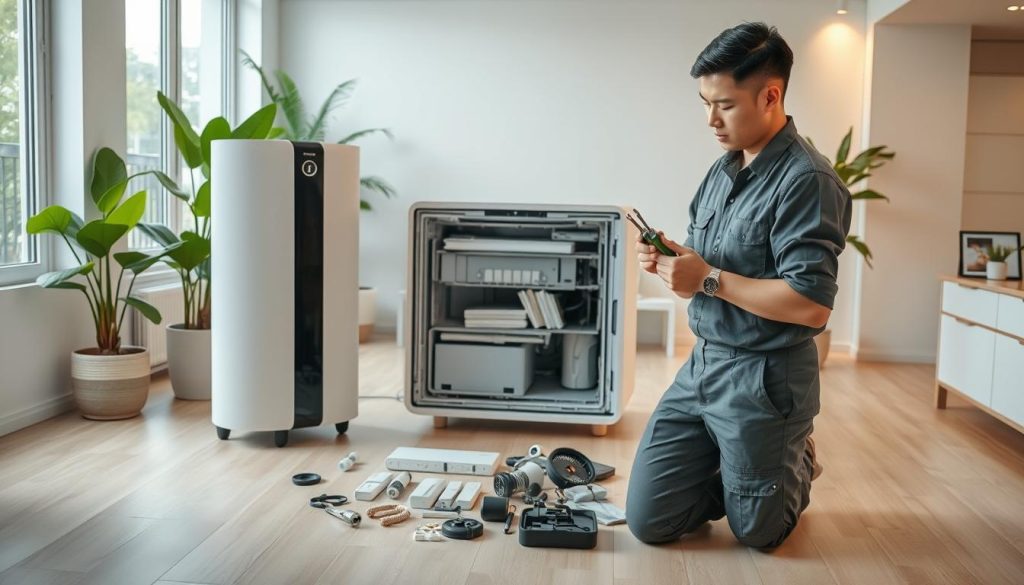
| Step | Main check | Outcome | Typical time |
|---|---|---|---|
| 1. Pre-check | Sensor & indicator review | Identify drift or contamination | 5–10 mins |
| 2. Filter inspection | HEPA fit, seals, visible loading | Decide clean vs replace | 10–15 mins |
| 3. Deep clean | Intake, vents, pre-filters | Restore flow, reduce noise | 15–25 mins |
| 4. Verification | Airflow, noise, room coverage | Confirm performance | 5–10 mins |
Filtration and performance standards we support
We set clear filtration benchmarks so customers know what proper performance looks like. Our checks confirm that rated capture rates are achievable in real rooms and that units maintain those levels over time.

HEPA protection explained
H14 Zero Clear HEPA is our baseline for high-efficiency capture. That class is rated to remove up to 99.997% of 0.3µm particles. We verify seals, seating and flow so the HEPA filter can reach its design performance.
Ultra-fine dust capability
Certain models achieve even higher removal. For example, the Wells Tornado can remove up to 99.999% of 0.01µm ultra-fine dust (model-dependent). We check that nothing in the unit or its placement allows bypass leakage that would reduce these figures.
Specialised filters for real-life needs
Beyond HEPA, we support fitted options for deodorisation, allergy support, exhaust gas capture and pet load reduction. Choosing the right combination helps with cooking odours, traffic exposure and homes with high pet presence.
For guidance on cleaning companion items and fabrics that affect room load, see our carpet cleaning guide at how to clean a carpet. Regular checks keep rated filtration working as intended; they do not change the filter’s certification, but they do protect its real-world effectiveness.
Choosing the right weekly service plan for your room, home and air purifier in Singapore
Choosing the right plan starts by matching priorities to each room and household routine. We map our focus to bedrooms for night-time comfort, study rooms for minimal noise operation, and large communal areas for full coverage.
Matching priorities to space
Open-plan living needs different attention to enclosed rooms. We check circulation paths so the unit reaches corners and reduces load where particles collect.
Optimising everyday use with circulation modes
We recommend modes based on Wells Jet Blue examples: normal for even coverage in living rooms, jet after heavy cooking, speed for whole-home refresh and multi‑air for quick local cleaning when dust is stirred.
Design, placement and value
Slim tower units fit close to walls to save space; wall-mounted options suit tight layouts. Expect more than a quick wipe — our plan includes structured checks, thorough cleaning and performance verification.
Service confidence
We aim for high standards similar to the market leaders: Wells has a 4.9/5 Google rating from 273 reviews and many customers (Chelsea, Ben, Bernice, Jason, Johnson, Ah Fu, Ah Xiong) praise responsiveness and after-care. We also work with other home wellness systems, including water units, to keep processes consistent and outcomes measurable.
Conclusion
To conclude, we emphasise predictable outcomes and fewer surprises for families who prioritise consistent unit upkeep. Our core promise is simple: regular checks keep your purifier clean, maintain steady airflow and make daily performance more reliable in Singapore conditions.
Practical benefits: you get steadier circulation, less build‑up that undermines capture, and stronger support for households aiming to purify air reliably. This is a preventative approach that cuts the chance of sudden drops during heavy cooking or haze.
Start with regular visits when pollutant load is high, then adjust once readings and flow stabilise. Visit our showroom or contact us via the website to confirm suitability for your model, room sizes and preferred cadence. We help you maintain cleaner air with less guesswork through repeatable checks, thorough cleaning and performance verification.

