

We introduce a practical, low‑risk guide to keeping your leather sofa looking fresh in Singapore homes.
In short, we explain how to identify material and finish, set realistic time expectations, and pick the right leather cleaner for sofas without guessing. A quick refresh can take 10–20 minutes; a deeper clean with conditioning usually needs about 45–60 minutes.
We outline a clear routine: check the hide, gather tools, patch test, follow a gentle process, then treat stains and mould only when you are sure of the method. This keeps colour and texture safe.
Our aim is to make home maintenance repeatable and safe. We also flag when to call a pro to avoid costly damage.
Key takeaways: simple routines save time, always patch test, avoid harsh chemicals and excess moisture, and dry thoroughly to reduce water harm.
Why choosing the right cleaner matters for leather sofas in Singapore homes
Choosing the right product is crucial if we want to avoid costly wear and discolouration. In humid climates like Singapore we must balance effective soil removal with gentleness to protect the hide and finish.
How the wrong product harms finishes and colour
Strong solvents or bleach can strip oils and dull the sheen. They may weaken a protective coating, causing patchy colour and long‑term fade.
Humidity, mould risk and daily wear
Excessive water leaves tide marks and encourages mould when ventilation is poor. Headrests, armrests and seat cushions show the most wear because body oils and friction build up.
- Use minimal liquid and quick wipe‑downs.
- Dry immediately with a clean, dry cloth and keep items out of direct sunlight.
- Prefer pH‑appropriate, material‑specific products over harsh options.
| Risk | Cause | Control |
|---|---|---|
| Colour loss | Alkaline or solvent cleaners | Patch test; use pH‑balanced product |
| Mould | Left‑over moisture in humid rooms | Fast drying; improve airflow |
| Finish damage | Abrasive rubbing or bleach | Gentle wipes; avoid harsh chemicals |
Identify your leather type before you clean leather sofa surfaces
Knowing the hide and finish guides every step of a safe cleaning process. We first inspect grain, sheen and tags to confirm the exact leather type.
Aniline and why it needs the gentlest approach
Aniline leather has no heavy topcoat and soaks up liquids quickly. We use minimal moisture, spot test, and gentle blotting only to avoid staining.
Semi-aniline and pigmented finishes
Semi-aniline has a light protection layer and tolerates mild wiping. Pigmented or protected surfaces are the most forgiving and handle routine stain removal better.
Top-grain, full-grain and ageing
Top-grain is uniform; full-grain develops a patina with time. We treat marks as part of natural ageing and avoid aggressive polishing that erases character.
Bonded, faux, nubuck and pull-up
Bonded and faux surfaces may delaminate if over-wetted; we keep moisture controlled. Nubuck prefers dry methods, while pull-up needs gentle conditioning to restore oils.
Understand finishes and protective coatings on your leather surface
Finishes play a decisive role in how your sofa responds to spills, wear and routine care. We always check the top layer before we start any work.
How to tell aniline, semi-aniline and pigmented finishes
Aniline pieces absorb a tiny droplet quickly and show natural grain variation. Semi-aniline has a light film and looks more even. Pigmented surfaces have a polymer layer that feels slightly smoother and resists small stains.
What a protective coating changes about cleaning and conditioning
A protective coating shifts the task. Cleaning leather becomes about lifting grime from the surface, not soaking the hide. Conditioning leather aims to keep flexibility so the top layer does not crack.
We adapt our method to avoid damage: lighter pressure, less product, short dwell time and immediate drying. These steps let us manage daily wear in Singapore homes—many families choose durable options, while prized aniline pieces need slower, careful care.
What we prepare before cleaning leather sofa cushions and the entire surface
We set up a clear staging area so each pass is calm and controlled. Small steps save time and prevent damage in humid Singapore conditions.
Tools we rely on
- Vacuum with brush attachment — remove grit first to prevent micro‑scratches when wiping in circular motions.
- Soft cloth — light‑coloured, lint‑free for final wiping and drying.
- Microfibre cloth — ideal for lifting residue without abrasion; keep one damp cloth ready for gentle passes.
Products to keep handy
- Leather cleaner for routine grime; use sparingly.
- Leather conditioner to restore feel and flexibility after cleaning.
- Mild soap or a tiny amount of dish soap diluted for light spots.
- Baking soda to absorb oil or grease before vacuuming.
What we avoid
- No bleach, ammonia or other harsh chemicals.
- Avoid abrasive tools and heavy scrubbing.
- Don’t over‑wet — excess moisture collects in seams and can cause mould.
- Steam cleaning is off limits; it can deform faux and bonded finishes.
“A vacuum with a brush attachment is the simple step that prevents many problems later.”
| Item | Why we use it | Tip |
|---|---|---|
| Vacuum with brush attachment | Removes grit and dust before wiping | Work seams, crevices and cushion joins first |
| Microfibre cloth / Soft cloth | Non‑abrasive wiping and drying | Keep one slightly damp and one dry for finishing |
| Leather cleaner / Mild soap | Lift surface grime without stripping oils | Use pH‑balanced product; patch test first |
| Leather conditioner | Replenishes flexibility after cleaning | Apply small amounts; buff with a dry cloth |
How we choose a leather cleaner for sofas that cleans effectively without damaging
We begin by inspecting the finish and testing the degree of dirt, then select the least aggressive treatment that works. Our decision framework balances the hide, finish and how soiled the surface is.
Specialist formula vs a mild soap solution
We favour a pH‑balanced, purpose-made option when the finish is delicate or stains are set. For light body‑oil or fresh food smears a diluted mild dish soap solution can be the gentler start.
Why pH balance matters
pH‑balanced formulas help protect natural oils and reduce the risk of drying, stiffness and premature cracking that harsh chemicals cause.
Patch testing and following labels
We always patch test on a hidden spot and look for colour change, dulling or tackiness before proceeding. We follow manufacturer care labels first; coatings and dyes react differently.
Matching cleaner to the job and technique
Start with the least aggressive option, then step up only if needed. Apply product to a clean cloth, work in controlled circular motions, and remove residue with a second dry cloth.
“Start gentle, test first and prioritise technique over force.”
For additional step‑by‑step guidance we reference a specialist cleaning guide and an easy home routine.
specialist cleaning guide · easy home routine
Our regular cleaning method for keeping a leather sofa fresh
Consistency is the secret: a simple three‑step pass keeps the entire surface fresh and resilient. We design this quick routine so households in Singapore can maintain condition with minimal time and risk.
Dusting and vacuuming
We begin by removing grit. Use a vacuum with a soft brush attachment to work seams and crevices. Trapped particles cause scuffs and accelerate wear.
Gentle wiping
Next, we gently wipe the entire surface with a slightly damp cloth. Use short, controlled circular motions to lift oils and light grime without stressing the finish.
Residue removal and drying
Follow with a second clean cloth to remove residue or soap film. Immediately dry with a dry microfibre or soft cloth, paying attention to stitching lines and folds to reduce the risk of water damage.
- Timing guide: most sofas take 10–20 minutes for this regular clean.
- Repeat weekly in humid climates to keep the material resilient and tidy.
“A routine pass prevents small problems becoming costly repairs.”
Spot-cleaning for spills and stain removal without spreading marks
A fast, calm response to a spill keeps marks small and makes stain removal simpler.
Gently blot first: what to do the moment a spill happens
We always gently blot immediately. Do not rub — rubbing spreads the liquid and risks finish loss.
Use a dry, absorbent clean cloth and press, lift, and repeat. Leather absorbs slower than fabric, but stains can set if left to sit.
Using a mild soap solution on a damp soft cloth for light stains
For light marks we mix a tiny amount of mild soap with water and dampen a soft cloth. Work from the outer edge towards the centre to contain the spot.
Apply the solution to the cloth, not the surface, and make short, controlled passes. Re‑fold the cloth to a clean section as it picks up grime.
Handling stubborn stains and when repeat passes are safer than scrubbing
For stubborn stains we avoid heavy scrubbing. Repeat gentle passes lift more without abrading the finish.
If progress stalls, stop and dry the area with a dry cloth. Prompt drying prevents moisture lingering in humid Singapore conditions and helps keep the clean leather looking even.
“Blot first, use mild soap sparingly, and repeat passes rather than scrub to protect the surface.”
Tackling tougher problems: ink, grease, wine, and other stubborn stains
For persistent marks we act quickly but deliberately, using absorption and controlled dab‑techniques.
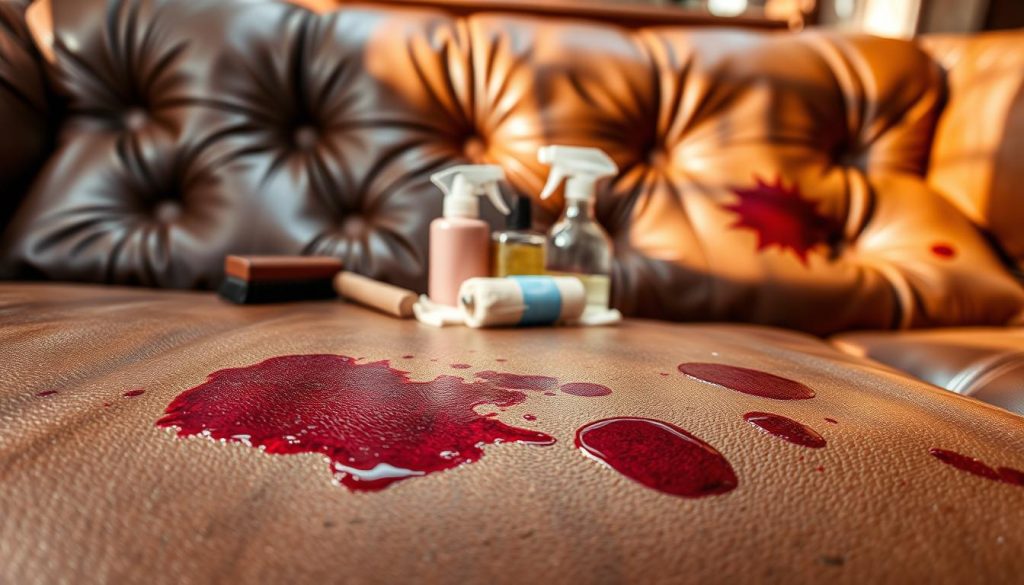
High‑risk stains include ink, dye transfer, grease and deep‑coloured drinks such as red wine. Wrong technique can lock a mark into the surface. Speed matters: the sooner we gently blot, the higher the chance of success.
Oil and grease
We first press a dry cloth to remove excess. Next, we sprinkle baking soda over the spot and leave it to draw out oil for several hours.
After the powder has done its work we remove it carefully and vacuum the area. Use a brush attachment to avoid grinding residue into the grain.
Ink and dye transfer
Ink needs controlled dabbing. We use a cotton swab or a small clean cloth with rubbing alcohol and work from the edge inward to limit spread.
If colour lifts, we stop and dry the area. Repeat touches only when the stain recedes without damaging the finish.
When to seek help
Stop and call a professional cleaning service when stains cover large areas, colour keeps transferring, or the material is delicate and prized. In these cases, professional cleaning protects value and avoids costly errors.
“Quick blotting, patient absorption and knowing when to stop are the steps that save a surface.”
| Stain type | Immediate action | When to call professionals |
|---|---|---|
| Oil / grease | Gently blot; apply baking soda; vacuum after hours | Large spread or repeated darkening |
| Ink / dye | Dab with rubbing alcohol using a swab; limit wet edge | Deep set ink or colour transfer across panels |
| Red wine / dark drink | Blot; dilute very lightly if needed; dry quickly | Persistent staining after repeated gentle passes |
For step‑by‑step external guidance see a specialist note on home methods or an appliance routine: detailed guide · cleaning routine.
How we remove mould from leather furniture safely in humid conditions
Before we touch any affected panel, we evaluate severity to decide whether DIY treatment is appropriate or if we need a professional. Small surface spots can be treated at home; large or deep infestations that penetrate seams need specialist care.
Assessing risk, PPE and ventilation
Safety first: we wear protective gloves, a mask and eye protection. Open windows and run a fan to reduce spore concentration. Carefully vacuum loose spores with a brush attachment before any wet work.
Gentle cleaning and drying protocol
We use a solution of water and a tiny amount of mild soap, or a weak water‑vinegar mix when suitable. Apply the solution to a cloth rather than the surface to limit wetting.
Blot gently, do not scrub. After cleaning we press with a dry cloth to remove surface moisture, then allow the panel to air dry completely in a well‑ventilated spot. Repeat drying until the area feels fully dry.
Preventing return with airflow and humidity control
To stop recurrence we improve airflow around the sofa and avoid placing it in damp, enclosed corners. Aim for balanced indoor humidity (roughly 40–60%) to reduce excess moisture and lower the chance of mould on leather furniture.
“Quick assessment, protective steps and thorough air dry time are the measures that protect both finish and health.”
How to apply leather conditioner after cleaning for long-term leather care
A measured application of conditioner prevents stiff, dry panels and keeps seating pleasant. We use conditioning as the last step after a full clean to replace oils that cleaning may remove and to slow cracking.
When to condition and how often
For typical homes we apply leather conditioner every 6–12 months. In high‑traffic households, sunny rooms or heavy use, we shorten that to every 3–6 months to help extend lifespan and maintain feel.
Precise application technique
We put a small amount of product onto a soft cloth and evenly spread it. Then we work in gentle circular motions until the formula sits lightly on the surface.
After a few minutes of absorption we buff with a dry microfibre cloth to remove excess and restore an even, natural sheen. This leaves no greasy residue and helps keep sofa panels comfortable.
Focus zones that matter
Concentrate on seat cushions, armrests and headrests. These high‑traffic areas benefit most and conditioning here helps extend lifespan and keep sofa panels looking newer for longer.
“Small, regular applications protect the hide and preserve comfort without over‑conditioning.”
Maintenance habits that protect leather sofas from fading, cracking, and wear
We set out a few simple habits that cut the risk of fading and cracking and help extend lifespan. These actions are practical for Singapore flats where strong daylight and warm interiors are common.
Avoid direct sunlight and keep away from heat sources
Place the sofa well clear of windows or use curtains to block direct sunlight. Heat and UV speed up colour fade and make the surface brittle.
Keep seating away from heaters and air‑con vents that blow hot, drying air. Small adjustments protect finish and softness.
Use covers, rotate cushions and guard against sharp items
We recommend throws or fitted covers in family rooms to reduce daily wear. These are an easy barrier against spills and pet claws.
Rotate and flip cushions regularly to even out compression and shade. Also set simple house rules for keys, buckles and jewellery to avoid scratches.
Routine schedule: weekly dusting to annual deep care
Dust weekly and vacuum crevices monthly using a brush attachment to remove grit. This reduces the need for aggressive products later.
Plan periodic deep cleaning and conditioning, and consider an annual professional service. These steps keep material supple and help extend lifespan.
“Small, steady habits protect value more than occasional heavy treatments.”
Common cleaning mistakes that can damage leather (and what we do instead)
Many common mistakes happen because people rush the job or assume one method suits every surface.
Too much water and poor drying: Excess moisture causes tide marks, swelling and mould risk in humid Singapore flats. We use a barely damp soft cloth and immediately follow with a dry cloth to remove residual dampness.
Abrasive scrubbing and rough tools: Heavy scrubbing scratches the finish. We always use a soft cloth with gentle pressure and repeat short passes rather than one hard scrub.
Coloured or dye‑shedding cloths: Light seating can pick up dyes when damp. We stick to light‑coloured, lint‑free cloths and test any rag before use.
Wrong products and over‑conditioning: Multi‑surface sprays or too much leather conditioner attract dirt and leave a sticky feel. We follow labels, patch test, and apply conditioner sparingly on schedule.
“Read the care label and patch test every new product — these are non‑negotiable.”
| Mistake | Why it harms | What we do instead |
|---|---|---|
| Excess water | Tide marks, mould and swelling | Barely damp soft cloth; dry promptly with dry cloth |
| Abrasive tools | Scratches and finish loss | Use soft cloth; gentle, repeated passes |
| Over‑conditioning | Sticky surface; dirt attraction | Condition on schedule; buff off excess |
Conclusion
A clear, steady routine keeps a prized sofa looking its best without risky shortcuts. We favour conservative product choices and gentle technique to protect grain and finish.
Our workflow is simple: identify material and finish, prepare tools, patch test, clean gently, remove residue, dry fully, then apply a light conditioner. Use a suitable leather cleaner sparingly and always test first.
Singapore humidity makes fast drying and good ventilation essential. Small, frequent dusting and quick wipe‑downs beat occasional heavy work every time.
If stains are set‑in, colour keeps transferring, mould is widespread, or the material is highly delicate, seek professional cleaning to protect the item and your budget.
Consistent care keeps the sofa comfortable, coloured and sound for years.

