

We introduce a concise roundup for Singapore shoppers seeking a wet-and-dry solution that speeds up routine cleaning.
By “water based vacuum cleaner” we mean units with separate clean and dirty tanks that let you vacuum and wash in one pass. This makes daily upkeep simpler and more hygienic.
Our guide suits HDB flats, condos, landed homes and pet households. We focus on appliances that handle spills, dust and tracked grit without the need for multiple tools.
How we pick: performance, usability, hygiene and value for money. We weigh real-world factors such as refill frequency, docking footprint and ongoing upkeep when judging price against convenience.
What follows: a quick “top picks at a glance” section, then deeper reviews so readers can jump straight to the product that fits their home and lifestyle.
Why a water based vacuum cleaner makes sense for Singapore homes
In compact Singapore homes, a unit that vacuums and rinses in one pass saves time and reduces clutter. We find the wet dry capability matches everyday life here: spilled drinks, kitchen splashes, muddy shoes after rain and pet accidents need fast attention.
Wet dry cleaning for everyday spills, dust, and pet mess
One-pass cleaning removes liquid and dry debris without swapping tools. That lowers the chance of lingering odour in our humid climate. Prompt emptying of dirty water is important to prevent smells.
Hard floors and tight layouts: what matters in HDB flats and condos
Tiles, vinyl and sealed surfaces respond best to water-assisted floor washing. We prioritise slim head movement and a tight turning radius so the unit navigates corridors and narrow kitchens.
Trade-offs to expect: heavier builds, more noise, bulkier systems
These devices use stronger motors and added tanks, so they can be heavier and louder than a standard dry-only option. Performance varies with how each system handles water flow and debris separation.
- Pros: quick spill response, better hygiene on floors.
- Cons: added weight, larger storage footprint, louder high-suction passes.
| Feature | Why it matters | What to check |
|---|---|---|
| Tank separation | Prevents dirty water re-use | Clear clean/dirty indicators |
| Head profile | Manoeuvrability in tight spaces | Slim, swivel head |
| Noise & weight | Daily handling and storage | Decibel rating and carry handle |
How we shortlisted and reviewed these wet dry vacuums
We tested a shortlist of machines to judge real-world performance and daily usability in Singapore homes. Our focus was on measurable results and the design features that make cleaning faster and less fiddly.
Real-world criteria
Suction and water tank volumes were measured against advertised figures. We checked how capacity and runtime affected actual cleaning time for a one-room sweep and mop cycle.
Usability checks
We assessed wheels, swivel head movement, lie-flat reach and how close the brush cleans to edges. Manoeuvrability often mattered more than raw power in tight flats.
Hygiene checks
We verified whether clean and dirty tank separation worked, how easy parts were to rinse, and whether any self-cleaning mode reduced odour and maintenance.
“We judged each unit by specs and by how simple it was to keep running day to day.”
- Practical cleaning time: includes refills, dock clean and drying, not just runtime.
- Feature validation: we cross-checked marketing claims with hands-on tests and spec sheets.
- Consistency: screens and sensors affect mode choice and repeatable results.
For readers who want a deeper technical comparison, we also link to an expanded guide on related floorcare devices: full vacuum guide.
What to look for when choosing a wet dry vacuum cleaner
Choosing the right wet–dry model means matching tank size, suction and filters to how we live and clean at home. These factors shape daily handling, refill needs and long‑term hygiene in Singapore flats and condos.
Tank capacity and separation
Look for clear separation between the clean tank and the dirty water container. Separate tanks prevent re‑use of used water and give streak‑free results on tiles and sealed floors.
Also check tank volumes: larger tanks reduce refill frequency but add weight. For typical HDB routines we prefer a mid‑size water tank that balances runtime with easy lifting.
Suction: Pa versus Air Watts
Manufacturers quote Pa and Air Watts. Pa measures air pressure and suits floor washers; Air Watts often appears on stick models.
Both relate to real pick‑up on floors, so we compare spec sheets with hands‑on tests rather than relying on one figure alone.
Filter system and HEPA
HEPA filters trap fine dust and allergens. A sealed system keeps captured particles from re‑entering the room, which matters for sensitive noses.
Cordless convenience versus corded reach
Cordless models aid quick transitions between rooms and narrow corridors. Corded units suit longer sessions if sockets are well placed in your flat.
Noise, weight and daily handling
Check decibel ratings, grip comfort and carry points. Lighter units help with daily maintenance cleans; heavier builds can be tiring.
Accessories and attachments
Crevice tools, upholstery brushes and multi‑surface heads add versatility. We advise against paying extra for rarely used features; choose attachments that match sofas, corners and stair needs.
“Pick the features that reduce daily fuss — not the ones that look good on spec sheets.”
| Factor | What to check | Why it matters |
|---|---|---|
| Tank design | Separate clean/dirty tanks, volume labels | Hygiene and refill frequency |
| Suction | Pa or Air Watts, real‑world tests | Actual pick‑up on floors |
| Filtration | HEPA and sealed airflow | Allergen control and dust capture |
Our top picks at a glance
We present a scannable roundup of leading wet dry options and why each earns a spot on our list. This helps you compare models fast and match features to routine cleaning needs in Singapore flats.
Tineco Floor One Switch S7 Stretch — overall choice
Why it stands out: balanced performance, smart guidance and reliable runtime make it suited to mixed debris and daily upkeep.
Bissell CrossWave X7 Cordless Pet Pro — pet hair specialist
Why it stands out: Turbo Pet mode and anti‑tangle brush target fur and stains for frequent spot cleaning.
Simplus Cordless Wet-Dry — budget pick
Why it stands out: strong suction for its price, sensible tank sizes and usable features for smaller homes.
Narwal S20 Pro — most manoeuvrable
Why it stands out: slim profile, edge reach and easy handling make it ideal for tight corridors and multi‑room flats.
Dreame H15 Pro Heat — hot water option
Why it stands out: hot water cleaning up to 85°C helps lift greasy residues, though users should check flooring compatibility first.
Quick note: our shortlist balances suction, runtime and tank design so you can weigh price against daily convenience.
Best overall: Tineco Floor One Switch S7 Stretch for smart auto mode cleaning
Smart sensing and clear guidance are the features we prize most for fuss‑free floor maintenance. The Tineco Floor One Switch S7 Stretch brings those qualities together with sensible tank sizes and strong suction for everyday use.
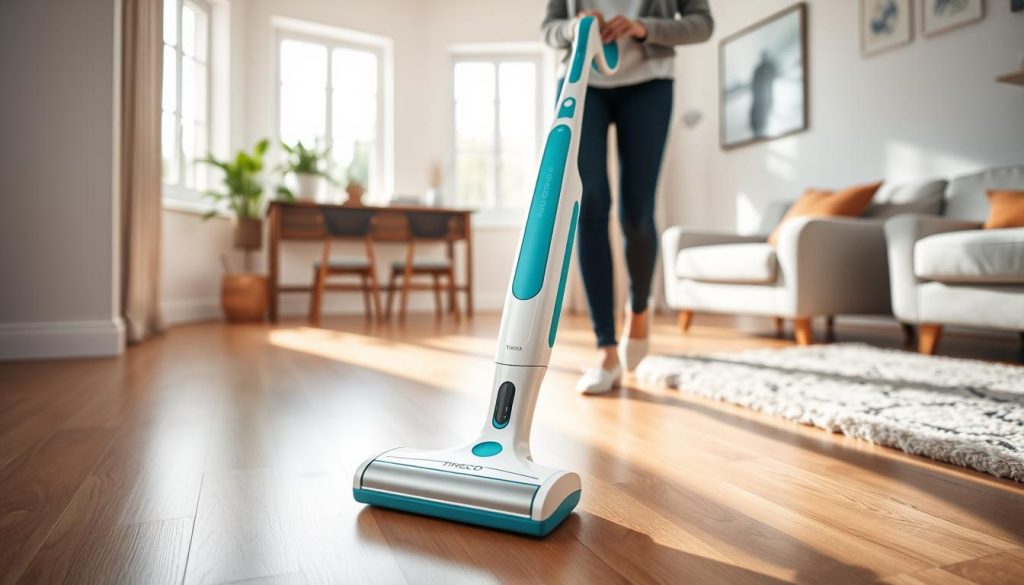
Key specifications
Clean tank: 1,000 ml. Dirty tank: 720 ml. Suction: up to 22,000 Pa. Runtime reaches up to 50 minutes as a floor washer and up to 70 minutes as a vacuum; charge time is about 4.5 hours.
iLoop sensing and LCD guidance
The iLoop sensor adjusts suction and water flow to match mess levels. The LCD shows when the floor is clean and helps select the right cleaning modes, reducing guesswork and over‑wetting.
Edge and corner reach
A dual‑side brush roller cleans to roughly 0.5cm from the wall. That near‑wall performance helps remove grime along skirting and cabinet runs in compact Singapore kitchens.
Who it suits
We recommend this model for mixed debris, frequent maintenance and multi‑surface homes. It balances tank separation, clear dirty water handling and smart sensors so daily cleaning becomes faster and more consistent.
Try a closer look: see the official Tineco listing for specifications and accessories — Tineco Floor One Switch S7 Stretch.
Best for pet hair: Bissell CrossWave X7 Cordless Pet Pro
For homes with fur and frequent small accidents, we look for tools that pull hair and lift stains without endless fuss.
Why it suits pet households: the CrossWave X7 is positioned as a pet pro model. Its Turbo Pet mode tackles embedded dirt and stubborn stains around feeding areas and litter zones. We find this mode useful for spot treatment where fur and sticky residue meet.
Turbo Pet mode for stubborn stains and embedded dirt
The Turbo Pet mode increases suction and brush action to dislodge trapped hair and dried mess. It works best when you make a couple of deliberate passes over a stained patch rather than a single rushed sweep.
Tank set-up and runtime expectations for pet-heavy households
The clean tank holds 820ml while the dirty tank takes 420ml. That mismatch means you will often refill less than you empty. For a pet-heavy session expect to pause regularly to empty the smaller dirty tank.
Runtime tops out at about 30 minutes and charge time is roughly 4 hours. Plan short, targeted cleans rather than whole‑house runs when pets generate frequent mess.
Best‑use surfaces: hard floors and rugs
This model performs strongly on hard floors and area rugs. Use measured passes on textiles to avoid over‑wetting delicate materials.
Brush and head care: clear hair from the brush after each session and check the head for residue. Regular maintenance preserves suction and keeps performance consistent in busy pet homes.
- Key specs: 20,000 Pa suction; 30 minutes runtime; 820ml clean / 420ml dirty tank.
- Practical tip: use Turbo Pet mode for concentrated stains; switch to normal mode for routine floor cleaning.
Best budget wet dry: Simplus Cordless Wet-Dry Vacuum Cleaner
For buyers watching the price tag, a compact wet‑dry cordless model can deliver the core features you need without premium extras.
Value highlights: the Simplus pairs 21,000 Pa suction with a 500ml clean and 550ml dirty tank. That split keeps used liquid separate and gives hygienic results for small flats.
Brush head and folding design
The 6.5cm brush head is slim enough to reach skirting and tight spots. A 180° flat‑folding design helps clean under low furniture and into corners with less fuss.
Who should buy it
We recommend this model for first‑time tank users and smaller households. Its 50 minutes maximum runtime suits routine cleaning sessions, but note the 4.5‑hour charge time if you plan multiple runs in a day.
“A simple, reliable design wins in compact homes where ease of use matters more than extra smart modes.”
| Spec | Value | Why it matters |
|---|---|---|
| Suction power | 21,000 Pa | Good pick‑up for rice, crumbs and light debris |
| Tank volumes | 500ml clean / 550ml dirty | Hygienic separation; enough for small rooms |
| Runtime / charge | 50 minutes / 4.5 hours | Daily maintenance fits single sessions |
| Weight & head | 4.4kg; 6.5cm brush head | Light to carry; narrow head for edges |
Best manoeuvrability: Narwal S20 Pro for fast, low-effort floor cleaning
For tight Singapore flats we prize tools that turn with little effort and tidy edges without wrestling the unit.
Narwal S20 Pro blends a light 4.27kg build with a flat-folding design and triple-sided edge cleaning. Its 790ml clean and 720ml dirty tank split keeps used liquid separate while the head reaches close to skirting and around chair legs where dirt hides.
Light handling and edge reach
The slim profile and assisted wheels lower wrist strain in narrow corridors. Triple-sided brushes sweep along skirting and baseboards so you need fewer passes near furniture.
Smart sensing and modes
AI Dirt Sense adjusts intensity automatically as you move from dining areas to kitchens. Five cleaning modes give quick choices for busy households or anyone who prefers guided routines.
Battery life and whole‑home coverage
The battery delivers up to 60 minutes runtime and recharges in about 3.5 hours. In a typical HDB or condo this usually covers single‑session cleaning; heavier sessions may need a pause for charging.
| Spec | Value | Why it matters |
|---|---|---|
| Suction | up to 20,000 Pa | Strong pick‑up for crumbs and tracked dirt |
| Tank volumes | 790ml clean / 720ml dirty | Separate tanks for hygienic rinsing |
| Runtime / charge | 60 minutes / 3.5 hours | Whole‑room runs for many flats |
| Design & wheels | Flat‑folding head; assisted wheels | Easy manoeuvre under furniture and around legs |
Best for hot water stain-busting: Dreame H15 Pro Heat
When spills turn sticky or greasy, a heated cleaning pass often lifts what cold rinses cannot. The Dreame H15 Pro Heat uses hot water up to 85°C to tackle set‑in stains and kitchen grease.
Hot water mopping up to 85°C for grease and stubborn stains
Hot water loosens cooked-on residues and oily spots so they come away with fewer passes. In practical terms, this reduces the time spent on tough marks versus repeated cold mops.
Suction power and runtime: normal mode versus hot water mode
The unit delivers 22,000 Pa suction and holds an 800ml clean tank and a 650ml dirty tank. Expect up to 70 minutes runtime in normal mode, and about 25 minutes in hot water mode — the heat trades minutes for cleaning intensity.
Design notes: auto-traction wheels, lie-flat reach, and weight
At roughly 6kg the model is heavier, so the auto‑traction wheels and flat‑folding head help with manoeuvre. These design choices ease handling and improve edge reach under low furniture.
Flooring caution: when hot water may be harsh on wooden floors
Hot water works well on tiled and sealed floors but can be harsh on certain wooden finishes. We advise testing a small patch first or using gentler settings where floors are unsealed.
“Ideal if stubborn stains are your main concern and you accept a heavier, purpose‑built system.”
| Spec | Value | Why it matters |
|---|---|---|
| Suction power | 22,000 Pa | Strong pick‑up for dirt and debris |
| Tank volumes | 800ml / 650ml | Separate clean/dirty tanks for hygienic rinsing |
| Runtime | 70 min (normal) / 25 min (hot) | Choose long sessions or heat‑focused passes |
Best lightweight premium alternative: Dyson Submarine models for quick wet cleaning
Dyson’s Submarine range shifts the conversation toward lightweight, fast touch‑ups that suit busy Singapore flats.
These models use a cordless dry vacuum platform adapted for short wet passes with small tanks. They are ideal for quick spills and daily dust control rather than long, tank‑heavy floor washes.
Dyson V12s Origin Submarine
Key points: 130 Air Watts, up to 60 minutes runtime, 3.5‑hour charge, 2.2kg, 300ml clean and 360ml dirty tank.
We find it suits frequent, brief sessions across tiled kitchens and living rooms. The combination of air power and light design makes handling easy in narrow HDB corridors.
Dyson V12s Detect Slim Submarine
Key points: 140 Air Watts, up to 60 minutes runtime, HEPA filtration and Fluffy Optic head for visible dust pickup.
This model benefits allergy‑aware homes and users who want to see fine dust as they clean. The HEPA system helps keep captured dust sealed away.
Dyson Digital Slim Submarine
Key points: slimmer design, shorter runtime (~40 minutes) and easier storage.
We recommend this for flats where storage space matters and sessions are short. The trade‑off is reduced battery life but greater compactness.
Why Dyson costs more
Practical rationale: higher price reflects R&D, cyclonic suction systems, refined filtration and compact, cordless engineering.
For shoppers in Singapore, the premium may be justified if you prioritise lighter handling, stable power delivery and a filtration system that controls fine dust in the home.
| Model | Air (Air Watts) | Runtime (minutes) | Tank (clean/dirty) |
|---|---|---|---|
| V12s Origin Submarine | 130 | 60 | 300ml / 360ml |
| V12s Detect Slim Submarine | 140 | 60 | 300ml / 360ml |
| Digital Slim Submarine | 130 | 40 | 300ml / 360ml |
Best steam option: Tineco Floor One S9 Artist Steam for sanitising-style cleans
For kitchens and dining areas, a steam option gives a thermal boost that helps break down dried-on food and oil. We position steam as a different value proposition: heat-assisted cleaning for suitable hard floors rather than routine rinses.
HyperSteam delivery and high-temperature floor contact for sticky messes
HyperSteam uses a 140°C boiler and still delivers at least 99°C to the floor. That heat loosens stubborn stains so the unit’s suction and brush lift residues with fewer passes.
Anti-tangle design and FlashDry self-cleaning for lower maintenance
The DualBlock anti-tangle brush cuts hair wrap and saves time for long-hair households and pet owners. FlashDry uses 85°C air for about five minutes to dry the head and reduce odour after use.
Battery runtime and handling: what to expect from a heavier model
The S9 offers around 75 minutes runtime, but the steam option adds weight. We find the SmoothDrive-style handling and 180° lay-flat design make manoeuvring easier despite the heavier build.
| Feature | Value | Why it matters |
|---|---|---|
| Suction | ~22 kPa | Strong pick-up with steam-assisted lifting |
| Runtime | Up to 75 minutes | Long sessions for multi-room cleans |
| Self-clean | FlashDry ~5 minutes at 85°C | Lower maintenance and odour control |
“A steam-capable floor one suits buyers who value heat-assisted sanitising and reduced chemical use over the very lightest body.”
Other noteworthy wet dry and floor-washing models we considered
To help with comparison shopping, we summarise a few more models that bring distinct features to the table. These options are useful if availability or price in Singapore shifts, or if you need a particular feature such as antimicrobial rollers or strong self‑clean routines.
Shark HydroVac WD210SM
Why it stands out: antimicrobial rollers that help reduce odour and bacterial build‑up in humid conditions.
Specs: 500ml clean tank / 360ml dirty tank, ~2,700 Pa suction, ~30 minutes runtime. The roller treatment appeals to buyers who prioritise odour control and simpler maintenance.
Dibea H8 versus Dibea HC26
We compared these two models for tank sizes, self‑cleaning and mode options. The H8 offers 500ml/600ml tanks, ~13,000 Pa and a 38‑minute auto cycle with self‑cleaning. The HC26 steps up to 700ml/700ml tanks, similar 38‑minute auto use and a much higher quoted suction figure.
Why modes matter: selectable modes let you choose light refresh passes or deeper wash cycles without wasting clean fluid or battery life.
Philips AquaTrio
Notable feature: true vacuum‑and‑wash versatility and an auto‑clean support system. It suits buyers who want one machine for multiple tasks and lower daily maintenance demands.
Electrolux UltimateHome 700
This model promotes bacteria reduction and includes an auto‑maintenance nozzle. Runtime is around 35 minutes, making it a practical choice for routine floor care with a focus on hygiene and brand aftercare.
“Shortlist two to three models, then confirm tank handling, spare parts and dock fit before you buy.”
| Model | Tank (clean/dirty) | Key features | Runtime / Suction |
|---|---|---|---|
| Shark HydroVac WD210SM | 500ml / 360ml | Antimicrobial rollers; odour control | ~30 min / 2,700 Pa |
| Dibea H8 | 500ml / 600ml | Self‑cleaning; auto mode | 38 min / 13,000 Pa |
| Dibea HC26 | 700ml / 700ml | Larger tanks; higher suction claim; auto mode | 38 min / quoted high suction |
| Philips AquaTrio & Electrolux UltimateHome 700 | Varies by model | Vacuum‑and‑wash versatility; auto‑clean nozzle; bacteria reduction claims | ~35 min (Electrolux) / varies (Philips) |
How to use this list: pick two or three models that match your routines. Then check spare parts availability, confirm how the tanks empty, and measure dock or storage space in your flat before you commit to a purchase. This reduces surprises on maintenance and price when shopping in Singapore.
Quick comparison guide: matching features to your home and routine
To make a quick choice, match the single feature you value most to the model that delivers it.
We give a short decision shortcut so you can pair priorities — power, tank, battery, automation or pet care — with the right option. Below are focused notes on reading specs and what they mean in everyday cleaning.
If you prioritise suction power for debris and dirt
Check quoted suction and real pick‑up. High Pa or Air Watts matter, but edge pick‑up and roller contact can affect how well the unit clears debris and dirt from skirting and rugs.
If you prioritise larger tank capacity to reduce refills
Larger tank capacity reduces pauses for refills in larger homes. For condos and smaller flats, mid‑size tanks often balance weight and practical time between emptying.
If you need longer battery life and runtime per charge
Plan by minutes, not claims. Estimate session length in minutes for your typical clean and match that to stated runtime per charge. Remember battery performance falls slightly over months of use.
If you want smarter auto mode control and multiple cleaning modes
Auto mode and varied cleaning modes save time across mixed floors. Look for sensors that adjust suction and flow so you avoid manual switching when moving from kitchen to living areas.
If you have pets and need anti-tangle brush performance
Anti‑tangle brush design and easy head access cut hair wrap and reduce odour from trapped fur. Choose models where brushes are simple to remove and rinse.
“Match one top priority to shorten cleaning time and reduce daily fuss.”
| Priority | What to check | Practical outcome |
|---|---|---|
| Suction & power | Pa/Air Watts, edge pick‑up, roller contact | Better lift of debris and dirt along skirting and rugs |
| Tank capacity | Clean/dirty tank volumes and ease of emptying | Fewer refills in larger homes; lighter handling for small flats |
| Battery life / runtime | Minutes per charge and real‑world runtime | Complete sessions without pausing to recharge |
| Auto mode & modes | Sensors, selectable cleaning modes, water flow control | Less manual adjustment between rooms and mess types |
| Brush design for pets | Anti‑tangle features, removeable head, washability | Lower downtime, reduced odour and easier maintenance |
Maintenance, running costs, and longevity tips for water tank vacuums
Small routines at the end of each clean can extend a model’s life and cut running costs significantly.
Daily care: emptying dirty water and rinsing parts
Empty the dirty water tank immediately after use. Rinse the tank and caps, then leave them to air‑dry. This reduces odour and stops residue building up.
Brush and head upkeep
Check the brush and head after every session. Remove hair and clear any clogs to prevent trapped dust and reduced pick‑up.
Filter care: washing, drying and replacement
Wash washable filters and let them dry fully before reinstalling. Replace HEPA elements per the maker’s schedule to keep the system sealing correctly.
Running costs and spare parts
Budget for replacement rollers, filters and periodic cleaning solutions. Treat these as regular costs that keep a vacuum performing well.
Storage advice for smaller homes
Choose a dock spot with airflow and room for drip‑drying. A neat dock reduces drying time and keeps the system from blocking walkways.
| Task | Frequency | Benefit |
|---|---|---|
| Empty dirty tank | After each use | Prevents odour and bacteria |
| Clear brush/head | After each use | Stops hair wrap and clogs |
| Wash filters | Monthly (or check manual) | Maintains suction and dust control |
“Good maintenance is the difference between a unit that stays like new and one that loses suction or smells within months.”
Where to buy in Singapore and how to assess price versus value
We recommend shopping channels that balance competitive price with reliable after‑sales support. Online marketplaces such as Lazada, Shopee and Amazon often list attractive offers. Authorised brand stores and local retailers give clearer warranty paths and easier access to spare parts.

Common marketplaces and authorised retailers
Marketplaces can offer lower sticker price and frequent sale events. Brand stores and authorised dealers provide genuine parts, warranty fulfilment and local service centres.
What to check before checkout
Verify warranty length and what it covers, which accessories are included, and whether replacement tanks, rollers and filters are stocked locally. Confirm battery and cordless kit details if you rely on runtime between charges.
Reading specifications correctly
Compare Pa versus Air Watts carefully — they measure different aspects of suction and air flow. Check water tank and dirty tank volumes side‑by‑side. Match listed runtime and charge time to realistic minutes per session for your home.
“A low price that lacks parts or service often costs more over time.”
| What to check | Why it matters | Quick check |
|---|---|---|
| Suction units (Pa / Air Watts) | Shows airflow and lift capability | Confirm both or compare real‑world tests |
| Tank volumes (clean / dirty) | Determines refill and empty frequency | Pick volumes that fit your typical session |
| Battery & runtime | Limits session length between charges | Look for realistic minutes and replacement battery options |
| Warranty & spare parts | Protects long‑term value and repairs | Buy from authorised sellers when possible |
Conclusion
For most flats we advise matching tank size, suction and modes to how you actually clean, not to specs alone.
Our main takeaway: choose a wet dry system based on your mess profile — spills, tracked dirt or daily debris — and the type of floors you have. For many homes the Tineco Floor One fits well thanks to sensible tanks, reliable suction and an effective auto mode.
Consider alternatives for pets, tight layouts, budget limits or hot water needs. Check water tank design, dirty water handling and whether the system’s cleaning modes and runtime suit your routine.
Next step: shortlist two models, confirm warranty and spare parts in Singapore, then pick the vacuum that saves you time and keeps daily upkeep simple.

