

We introduce a compact roundup tailored for Singapore flats. We focus on models that suit tiled, vinyl and sealed wood floors found in local homes.
What we promise: clear “best for” picks, honest trade-offs and the specs that matter rather than marketing fluff. We explain why an all-in-one approach can cut overall cleaning time compared with separate tools.
Our shortlist highlights include the best overall, best hot water option, the most manoeuvrable model, top picks for pet hair, a budget choice, and hygiene-focused designs. We also note notable brands like Dyson and options with steam upgrades.
When we test, we weigh suction, tank size, battery life, edge cleaning, weight and upkeep. These factors decide daily usability in compact flats, so they guide our recommendations for rugs as well as hard floors.
Why we rate high-power wet dry vacuums for Singapore homes</h2>
A single machine that tackles liquid spills and dry debris saves us valuable time at home. In flats dominated by tiles, vinyl or sealed wood, one tool that handles both jobs makes daily resets simple.
Spills, crumbs and daily messes on hard floors
We often see spilled drinks, sauce splatters, dropped rice and cereal crumbs. A wet dry vacuum clears both liquid and solid messes in one pass, reducing repeat trips to the sink.
That combined routine saves real time. Fewer tool swaps and fewer passes mean you reclaim minutes each day for other chores.
Why families with children and pets benefit most
Children leave snack trails and pram wheels mark floors. Pets bring paw prints, shed fur and scattered litter. Strong suction plus a washer head handles dirt, debris and fur with a single tool.
“Matching performance to your home size is key — more suction can mean more noise and weight.”
- Quick spot cleaning: cordless units beat a mop and bucket for small jobs.
- Pet-ready: fewer brush tangles and faster fur pickup.
- Realistic trade-offs: choose power based on tolerance for noise and handling.
What a wet dry vacuum is and what it can clean</h2>
Let’s unpack how a combined liquid and dry system cleans everyday messes around the home.
Definition: These machines manage solids and liquids by routing clean water and dirty water separately. They can run in sequence or in one pass, so we remove crumbs and then rinse sticky spills without cross‑contamination.
Wet cleaning use cases: Ideal for kitchen grease spots, sauce splatters and tracked‑in grime. Controlled water flow and a wash head lift stubborn residues while the dirty tank keeps the mess contained.
Dry tasks: For daily dust, crumbs, grit and pet hair we rely on brush rollers and suction to pick up debris without leaving residue. Brush design matters; anti‑tangle heads handle hair more effectively.
Surface suitability is broad. Tiles, vinyl, laminate and sealed wood respond well to these systems. Note that sealed wood tolerates water briefly — unsealed timber does not.
Limits and upkeep: Not every model replaces a carpet shampooer, and heavy flood work needs specialist kit. Systems are more complex than a standard dry tool, so maintenance and storage need planning.
- Quick tip: See a hot water option for greasy kitchens in our Dreame H15 Pro Heat review — a useful comparison is available via the product page.
- Extra idea: For unusual uses and maintenance tips, we link to practical suggestions at creative how‑to ideas.
How we choose the best models for this roundup</h2>
To pick the best models we combine lab figures with hands‑on runs in HDB and condo layouts. We look for machines that deliver consistent results, not just big numbers on a spec sheet.
Suction power benchmarks: Pa and Air Watts explained
We compare Pa for floor washers and Air Watts for stick-style systems so readers can compare like with like. Numbers matter, but we judge how sustained suction performs on fine dust and larger debris.
Runtime, charge time, and real-world cleaning minutes
Battery life and runtime translate to actual coverage for a typical flat. We convert headline minutes into realistic cleaning time per room.
Clean water tank vs dirty water tank capacity
Tank size affects how often you stop. A larger clean water tank gives coverage, while a roomy dirty water tank prevents frequent emptying.
Edge cleaning, manoeuvrability and maintenance
Edge cleaning tests measure how close a head gets to skirting lines and corners. We also check lie-flat reach under furniture and overall weight for easy handling.
Maintenance wins points: self‑clean cycles, brush drying and odour control reduce upkeep time and keep the system smelling fresh over months.
“Consistent suction and sensible tank design matter more than headline specs when cleaning a Singapore flat.”
- We note HEPA filters for allergy management.
- We weigh corded versus cordless convenience against noise and bulk.
- Accessories and brush design influence edge cleaning and hair pickup.
Best overall: Tineco Floor One Switch S7 Stretch
Our top pick combines smart sensing and convertible design to suit compact homes with mixed floor types. It bridges a floor washer and a stick unit so we can swap tasks without extra tools.
Key specs that matter
Practical figures: 22,000 Pa suction, a 1,000 ml clean water tank and a 720 ml dirty water tank. The unit weighs 4.7 kg.
Runtime is up to 50 minutes for wash mode and up to 70 minutes for dry use, with a 4.5-hour charge time.
iLoop sensor technology in plain terms
Smart adjustment: the iLoop sensor spots mess levels and auto-adjusts water flow and suction in auto mode. That removes guesswork and saves time while cleaning.
Edge reach and real use
The dual-side brush roller cleans to about 0.5 cm from walls. This helps with skirting lines in small flats and improves overall edge cleaning.
- Convertible design: converts to a stick vacuum with attachments for spot jobs.
- Useful feedback: the LCD shows when the floor is clean.
- Who it suits: buyers wanting a premium all-in-one for hard floors and quick swaps between tasks.
Best for hot water mopping: Dreame H15 Pro Heat</h2>
We picked a machine that uses hot water to dissolve oil and baked-on residue with fewer passes.
Key specs at a glance
Practical figures: 22,000 Pa suction, an 800 ml clean tank and a 650 ml dirty water tank. In normal mode the runtime reaches up to 70 minutes; hot water mode gives about 25 minutes. Charge time is roughly 4 hours.
Why the 85°C roller matters
The heated roller reaches 85°C to break down grease and stubborn stains on tiled and sealed surfaces.
This cuts repeat passes near stoves and dining areas, saving time and effort.
Edge reach, lie-flat handling and trade-offs
Triple edge cleaning and a flat-fold design help reach skirtings and under low furniture. Auto-traction wheels aid manoeuvring during longer runs.
At about 6 kg, the unit is heavier than many alternatives. We advise care on delicate wooden floors and to use gentler settings where available to avoid marking.
What we recommend
- Best for: buyers prioritising hot water mopping to lift grease with fewer repeat passes.
- Note: monitor suction and brush settings on sensitive floors.
- Bonus: the design balances strong cleaning with useful tank capacities for typical Singapore kitchens and flats.
Most manoeuvrable: Narwal S20 Pro</h2>
For narrow Singapore flats, manoeuvrability often matters more than headline specs. The Narwal S20 Pro pairs a compact footprint with clever steering to handle tight walkways and clustered furniture.
Key specs: 20,000 Pa suction and 60-minute runtime
Practical figures: 20,000 Pa suction, a 790 ml clean tank and a 720 ml dirty tank. The unit weighs 4.27 kg and runs up to 60 minutes on a charge of about 3.5 hours.
AI Dirt Sense and multiple cleaning modes
Smart adjustment: AI Dirt Sense detects soil levels and steps up intensity when needed. We use auto mode for mixed messes and switch to manual modes for quick refreshes.
Triple-sided edge cleaning for tight perimeters
Triple-sided edge cleaning reaches close to skirting lines, cutting the need to wipe edges afterwards. The flat-folding design helps get under low furniture without fuss.
“A nimble system wins in small homes — it cleans more while you lift less.”
| Feature | Value | Why it matters |
|---|---|---|
| Suction | 20,000 Pa | Strong enough for tracked grit while remaining manageable for indoor use |
| Runtime | Up to 60 minutes | Covers multiple rooms in one run for typical flats |
| Cleaning modes | 5 modes (incl. auto) | Options for quick refresh, deeper pass and sensor-driven runs |
| Weight | 4.27 kg | Light enough for frequent handling and stairs |
Who it suits: buyers who value handling and turning radius as much as raw suction. If nimble design and precise edge cleaning matter, this unit feels very agile in everyday use.
Best for pet hair: Bissell CrossWave X7 Cordless Pet Pro</h2>
Pet owners need a tool that lifts fur, dries quickly and handles tracked‑in mess. The CrossWave X7 is built for targeted upkeep rather than whole‑home runs.
Turbo Pet mode for fur, tracked-in dirt and stains
Turbo Pet mode boosts suction and delivers a cleaning solution to lift stubborn stains and paw prints. In practice, one pass often removes surface marks on tiles and low‑pile rugs.
Tank set-up: larger clean tank with smaller dirty tank
The unit pairs an 820 ml clean tank with a 420 ml dirty water tank. This means we can treat more area before refilling, but heavy pet use fills the dirty tank faster.
Runtime expectations for quick, targeted cleans
Max runtime is about 30 minutes with a 4‑hour charge time. That suits entryways, feeding zones and litter areas rather than long whole‑flat sessions.
| Specification | Value | Why it matters |
|---|---|---|
| Suction | Up to 20,000 Pa | Strong enough for fur and tracked grit on hard floors |
| Clean tank | 820 ml | Longer runs between refills |
| Dirty water | 420 ml | Needs emptying during heavy pet use |
| Runtime | Up to 30 minutes | Best for quick spot cleaning |
“A practical pick for pawrents who want fast hair pickup and reliable stain removal over extended runtime.”
Best budget high-power option: Simplus Cordless Wet-Dry Vacuum Cleaner</h2>
For buyers on a budget, the Simplus model delivers sensible suction and practical runtime without premium cost.
Key specs: 21,000 Pa suction, up to 50 minutes runtime, a 500 ml clean tank and a 550 ml dirty water tank. The unit weighs 4.4 kg and needs about 4.5 hours to recharge.
Design and reach
The head folds flat to 180° for access under sofas and low furniture. A narrow 6.5 cm brush head helps with tight gaps and corners that wider heads miss.
Why it earns the budget pick
Simplus gives near‑flagship suction for a lower price. The runtime and tank sizes are balanced for regular maintenance in typical Singapore flats.
What to expect at edges: The slim head cleans close to skirting lines, but it lacks specialised side-arm edge tools found on pricier models.
- Routine tank and brush cleaning prevents smells and keeps performance steady.
- Best for value-led buyers who want strong suction without flagship pricing.
“A sensible entry-level choice that keeps running costs low while covering daily spills and tracked grit.”
Best for larger tank capacity on a mid-range spend: Dibea wet and dry models</h2>
If you mop often or host messy meals, choosing a unit with bigger tanks saves real time between rooms.
Why choose Dibea: we see these models as mid‑range buys that favour capacity over flagship frills. That makes sense in Singapore flats where fewer stops for refill mean faster, more efficient cleaning.
Dibea H8: balanced tanks and built‑in self‑cleaning system
The H8 pairs a 500 ml clean tank with a 600 ml dirty water tank. It runs up to 38 minutes in auto mode and about 30 minutes on higher settings.
It uses an integrated self‑cleaning system and offers mode adjustment for sealed wood, marble and ceramic floors. Its 13,000 Pa suction power suits routine spilllifting without excess weight.
Dibea HC26: larger dual tanks and extended reach handle
The HC26 steps up to 700 ml/700 ml dual tanks and has a slightly longer handle for reach. Runtime matches typical runs at up to 38 minutes, so you cover more area before stopping.
Which to pick for your home
If wet cleaning is frequent, the HC26’s larger tanks reduce interruptions. If you value a lighter package with automatic self‑clean cycles, the H8 balances capacity and convenience.
Practical note on modes: adjustable settings let us match suction and water flow to mixed floors, keeping wooden surfaces safe while still shifting grime on tiled areas.
| Model | Clean tank / Dirty water | Runtime | Why it matters |
|---|---|---|---|
| Dibea H8 | 500 ml / 600 ml | Up to 38 minutes | Balanced capacity with self‑cleaning for regular use |
| Dibea HC26 | 700 ml / 700 ml | Up to 38 minutes | Larger tanks for fewer stops and longer continuous cleaning |
| Common traits | Dual tank system | ~4.5 hrs charge | Mid‑range price with sensible design for flats |
“Choosing bigger tanks can be the simplest upgrade to cut refill stops without a flagship price tag.”
Best for hygiene and odour control: Shark HydroVac WD210SM</h2>
For homes where freshness matters, we favoured a model built to limit bacterial growth and lingering smells.
Why we picked it: the HydroVac uses antimicrobial brush rollers that help reduce bacterial build‑up and keep odour in check. That treated roller design makes storage and repeated cleaning less likely to smell over time.
Antimicrobial rollers and maintenance
The treated brush resists microbes and shortens the cleaning cycle for the head. This lowers routine upkeep and helps the whole system stay fresher in humid Singapore conditions.
How the lower suction figure performs
With 2,700 Pa suction power the unit handles light spills and daily upkeep well. It is not aimed at heavy grit or deep debris removal, so expect brisk maintenance passes rather than deep cleans.
Who it suits and core specs
It is ideal for quick passes after meals and small-area work where weight and ease of use matter more than peak suction. Core specs: 500 ml clean water tank, 360 ml dirty water, 3.9 kg weight, up to 30 minutes runtime and a ~4-hour charge.
| Feature | Value | Why it matters |
|---|---|---|
| Suction | 2,700 Pa | Good for light maintenance and spot cleaning |
| Brush | Antimicrobial rollers | Reduces bacterial build‑up and odours |
| Water tanks | 500 ml / 360 ml | Enough for quick kitchen passes without frequent stops |
| Runtime | Up to 30 minutes | Suits short sessions and frequent upkeep |
“A sensible choice where hygiene, freshness and simple handling matter more than peak suction.”
Best Dyson wet and dry options in Singapore (lightweight and premium)
For households that prioritise light handling and thorough filtration, Dyson’s Submarine series is worth a look. These models favour slim design, cyclonic technology and filtration that helps with dust and allergens in humid Singapore flats.
Dyson V12s Origin Submarine: lightweight build and 60-minute runtime
Key specs: 130 Air Watts, 300 ml clean tank, 360 ml dirty tank, 2.2 kg weight and up to 60 minutes runtime with a 3.5-hour charge.
We recommend this model when low weight and manageable handling are top priorities. Root cyclone technology and advanced filtration aim to reduce bacteria and allergens on surfaces and in the air.
Dyson V12s Detect Slim Submarine: HEPA filtration and illuminated cleaning
Key specs: 140 Air Watts, HEPA filter, Fluffy Optic head, 300 ml clean tank, 360 ml dirty tank, 3.1 kg and up to 60 minutes runtime.
The illuminated head helps reveal fine dust on hard floors. The HEPA system gives extra confidence for allergy-prone homes while maintaining strong suction for daily cleaning.
Dyson Digital Slim Submarine: compact design trade-offs on runtime
This compact option favours slimmer design and easier storage. Expect trade-offs: a shorter runtime of around 40 minutes in typical runs. It suits quick sessions where portability beats longer battery life.
Why Dyson costs more: R&D, cyclonic suction and filtration focus
Dyson’s price premium reflects heavy R&D, cyclonic suction breakthroughs, cordless engineering and refined filtration systems. In practice that means better sustained suction, engineered airflow and a focus on cleaner air during cleaning.
“Premium materials, Air Watts-tuned heads and HEPA filtration drive much of the extra price — but they also shape performance in dust-sensitive homes.”
- Who each model suits: Origin for light handling; Detect Slim for dust monitoring and HEPA needs; Digital Slim for compact storage.
- Note on metrics: Air Watts measure airflow work at the head — not directly comparable with Pa readings used elsewhere, so compare like with like.
- Price note: Expect a higher price for Dyson’s design, technology and filtration focus compared with mainstream models.
Best steam and heat upgrade for stubborn grime: Tineco Floor One S9 Artist Steam</h2>
We pick the Tineco Floor One S9 Artist Steam as the steam and heat upgrade for kitchens that see baked‑on sauce and oily marks. It combines strong heat with sustained suction to loosen residue that cold mopping struggles to shift.
Steam performance: high temperature output for grease breakdown
Concrete figures: a 140°C boiler that delivers at least 99°C to the floor. That heat, alongside controlled water flow, helps dissolve grease near hobs and dining areas.
Hair management: anti‑tangle features for long hair and pet fur
The DualBlock anti‑tangle system keeps long hair and pet hair from wrapping the brush. That protects suction and brush life so the unit runs reliably in daily use.
Self‑clean and fast drying to keep the system fresh
Hygiene matters: FlashDry uses 85°C air for five minutes to dry the head after a run. With iLoop sensors and smart lights, the system automates cleaning and shows when a pass is complete.
Who it suits: households wanting a sanitising, feature‑rich option. The floor one design, roomy runtime and neat technology make it a premium choice for persistent grime.
Premium cordless vacuum alternatives (when you don’t need wet cleaning every day)
For flats where most mess is dust and tracked debris, a premium cordless stick can be the smarter buy. It speeds routine cleaning and reduces maintenance compared with a tanked floor washer.
Samsung Bespoke Jet AI Ultra: smart suction and auto‑empty
Key points: up to 400W suction power, AI Cleaning Mode 2.0 for floor adaptation, All‑in‑One Clean Station that auto‑empties, and up to 160 minutes total runtime with dual swappable batteries. Multi‑layer filtration captures 99.99% for low‑touch hygiene.
Airbot Supersonics Pro: value stick with HEPA filtration
Key points: up to 25,000 Pa suction, E13‑grade HEPA capturing 99.97%, runtime up to 45 minutes in Eco mode (shorter on Boost), ~4‑hour charge and a 0.8L dust cup. Expect clearer air and practical battery life for daily passes.
Xiaomi G20: everyday option for dust and debris
Key points: 25 kPa (≈150 AW) peak suction, up to 60 minutes runtime, multiple attachments and a 600 ml dustbin — a sensible mid‑range pick for regular cleaning without extra tank handling.
“Choose a dry system when spills are rare — spend on filtration and battery life rather than tanks and pumps.”
| Model | Suction | Runtime | Filtration | Price position |
|---|---|---|---|---|
| Samsung Bespoke Jet AI Ultra | Up to 400W | Up to 160 mins (dual batteries) | Multi‑layer, 99.99% | Premium |
| Airbot Supersonics Pro | Up to 25,000 Pa | Up to 45 mins (Eco) | E13 HEPA, 99.97% | Value‑led |
| Xiaomi G20 | 25 kPa / 150 AW | Up to 60 mins | Multi‑stage | Mid‑range |
How these fit your routine: opt for a dry model when most cleaning is dust or pet fur and wet cleaning is occasional. This keeps upkeep low, improves filtration for allergens, and often lowers the initial price when compared with all‑in‑one systems.
What to look out for when buying a high power wet and dry vacuum cleaner</h2>
A smart purchase balances cleaning reach with storage, noise and upkeep needs.
Suction vs noise: stronger motors raise suction but usually increase noise. If you live in an HDB flat with neighbours close by, consider models with noise‑reduction tech or lower boost modes for evening use. We recommend testing a demo or checking published decibel figures before buying.
Suction power vs noise level: what to expect from stronger motors
Greater suction solves embedded dust and tracked grit faster, but it often brings a louder run‑time. Choose a unit that lets you switch modes so you can use full suction for spills and a quieter mode for routine tidying.
Tank capacity planning for HDB flats vs landed homes
For HDB flats we favour medium tanks (about 500–800 ml clean / similar dirty water) to keep the unit manageable and easy to store.
Landed homes benefit from larger tanks that cut refill stops, but remember larger tanks add weight and affect manoeuvrability.
Filter systems and HEPA options for allergies
HEPA filters matter for allergy-prone households. They trap fine dust and improve the air you breathe after cleaning. Keep in mind that filters need regular replacement to maintain suction over time.
Cordless convenience vs corded endurance
Cordless units win on handling and quick spot jobs thanks to battery life and compact design. Corded models give steady run‑time and often stronger sustained suction, which matters for long sessions in larger homes.
Accessories that matter: brushes, crevice tools, and multi‑surface heads
A good brush head lifts hair without tangling. Crevice tools and extension wands help with skirting lines and stairs. We check that included heads match your floors to avoid extra purchases later.
“Pay a bit more if it saves time: better design, easy self‑clean cycles and sensible tanks reduce fuss and upkeep.”
- Checklist: noise level, suction modes, tank sizes, HEPA option, battery life, and useful heads.
- Price tip: higher price should deliver less maintenance time, not just bigger numbers on a spec sheet.
How to match cleaning modes to your home (auto mode, turbo, soft)
Match suction and water flow to the task so each pass does more work with less fuss. Choosing the right setting saves battery, cuts time and preserves finishes on sealed wood or tiled areas.
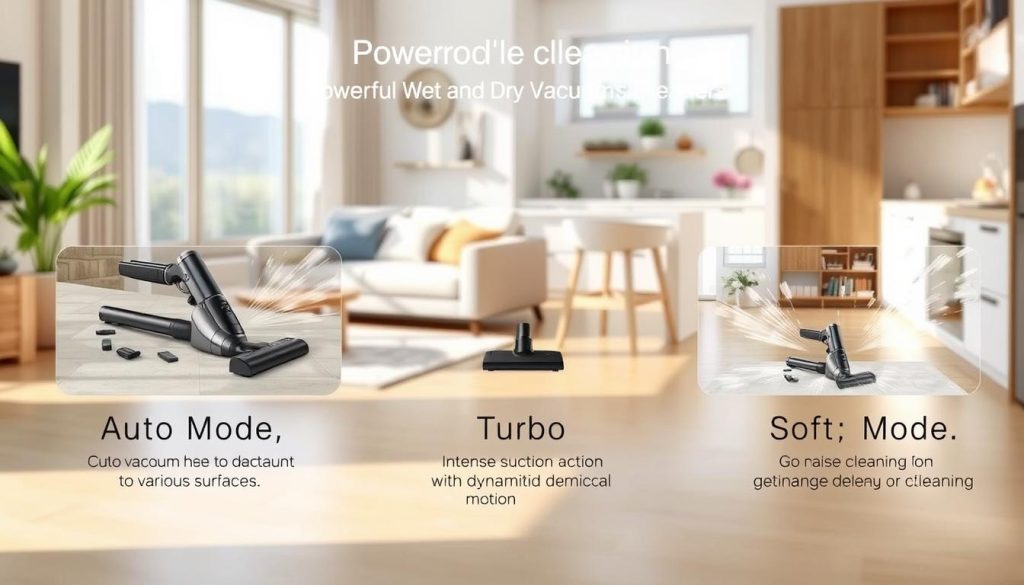
Auto mode for mixed messes: dirt sense and sensor-driven adjustment
Auto mode uses sensors such as iLoop or AI Dirt Sense to judge soil levels and adjust suction and water automatically. This is ideal for day-to-day cleaning across kitchens and living rooms with mixed debris.
High power for debris bursts and entryway grit
Use a boost setting for heavy debris at doorways or after a meal. The trade-off is faster battery drain, so reserve turbo for short, targeted passes rather than whole-flat runs.
Soft modes for sealed wood and delicate hard floors
Soft modes cut water flow and lower suction to avoid over‑wetting or rubbing marks on sensitive surfaces. For busy homes we recommend: auto for daily passes, turbo for problem spots, soft for delicate rooms, then a quick dry pass where the system supports it.
“The best mode depends on floor type, mess and how quickly you need floors to dry in a busy home.”
Conclusion</h2>
Our final verdict distils the shortlist into clear buys for common Singapore home needs.
For an all‑in‑one routine we favour models that pair sensible tank sizes with reliable suction and good edge cleaning. If grease is a frequent problem, choose the hot water specialist. For tight flats, pick the most manoeuvrable head and lighter design.
Remember that battery and runtime figures are best‑case estimates. Plan cleaning minutes around mode choice and floor condition to avoid surprises. Keep maintenance simple: empty tanks, dry the brush and follow self‑clean cycles to prevent smells and preserve performance.
In short: the right wet dry system will save you time, lift daily dust and debris reliably, and make floors feel cleaner with less fuss — especially in compact Singapore homes.

