
We present a concise shortlist for Singapore flats and family homes. Our aim is to help readers pick a model that reduces daily effort while handling spills and hair with ease.
We explain what “wet and dry” means in practice, from simple mopping pads to true two‑in‑one systems. We test real‑world cleaning on hard floors, sticky messes and typical layouts found in local apartments.
Each robot vacuum we recommend is paired with a clear use case. Some suits households with pets, others excel in multi‑room mapping or long battery runs. We focus on practical results rather than specs alone.
What we evaluate: suction power, water control, obstacle avoidance, battery life, dock stations and app scheduling. Our picks reference manufacturer data where relevant so you can compare long‑term value and convenience.
Why a wet and dry robot vacuum makes sense for Singapore homes
Keeping floors presentable in Singapore’s flats is a daily task. We face entryway grit, hair and food crumbs from frequent arrivals and small households.
Light, regular passes cut buildup and reduce the need for long manual sessions. A combined system that vacuums then mops helps with sticky residues in kitchens and dining areas.
Everyday dust, hair and crumbs in high-traffic flats
Daily cleaning prevents dust and debris from becoming embedded under furniture. Short, frequent sessions keep surfaces hygienic and safe.
Spills and sticky messes that benefit from mopping
A controlled mop uses minimal water to lift residues that suction alone cannot. We favour systems with adjustable moisture so floors dry quickly.
Humidity, drying and mould prevention considerations
In humid homes, tank hygiene and drying routines matter. Good airflow and timely emptying stop smells and mould from taking hold.
- Expectations: controlled water use, predictable coverage and reliable rug avoidance.
- Navigation: solid mapping keeps units moving through narrow paths without getting stuck.
- Routine: frequent light passes beat one heavy clean each week.
| Feature | Why it matters | Practical tip |
|---|---|---|
| Suction + mop | Removes dust then finishes with light mopping for sticky spots | Set gentle water levels for tiles and vinyl |
| Drying & tank care | Prevents odour and mould in humid climates | Empty tanks after use and air-dry parts |
| Navigation | Avoids furniture and narrow corridors | Use room mapping and no-go zones |
For step-by-step carpet care between sessions, see our guide on clean carpets.
What we look for in a robotic vacuum cleaner wet and dry
To pick models that suit Singapore homes, we set a clear performance baseline. Our tests focus on real cleaning results rather than specs alone.
Suction power and cleaning performance on hard floors and carpets
Strong suction must lift fine dust plus larger debris like cereal or rice. We also check brush design and route efficiency because suction alone does not guarantee results.
Mopping system, water volume control and no-mopping zones
Consistent contact pressure and adjustable water flow keep tiles dry fast. The ability to mark no-mopping zones around rugs saves carpets from unnecessary moisture.
Navigation, mapping and obstacle avoidance for tight spaces
Good navigation uses reliable sensors for accurate mapping in narrow corridors. That reduces repeated passes and prevents snagging on cables or shoes.
Battery life, charging time and auto return-to-dock behaviour
We expect auto return-to-dock and recharge‑and‑resume for multi-room sessions. Practical battery and charging behaviour make daily use seamless.
App control, scheduling and room-by-room programmes
Useful app control offers schedules, room programmes and quick spot cleans. This lets users tailor cleaning to daily routines with minimal fuss.
Edge-to-edge cleaning along walls, furniture and corners
Close edge reach matters. Dust lines at skirting and corners show where lower-cost models fail, so we prioritise strong edge performance.
Bins, tanks and stations for low-maintenance cleaning
| Area | What we expect | Practical tip |
|---|---|---|
| Suction & brushes | High suction power and effective brush path | Choose models with a combo of roller and side brushes |
| Mopping tank | Adjustable flow and removable tanks | Empty after use and set no-mop zones near rugs |
| Station options | Auto-empty or rinse stations reduce maintenance | Consider a station if you want fewer weekly tasks |
Top pick for wet-dry messes: Roborock F25 and F25 Ace
For mixed spills and daily debris, we picked a model that balances brute suction with gentle mopping action. The F25 series is built around a 450 RPM rotating roller and headline 20,000Pa suction power. This combo lifts hair and dust while also handling sauces, milk and red wine marks.
Practical reach and edge cleaning
The 180° lay-flat design reaches under low sofas and TV cabinets at roughly 12.5 cm clearance. That means fewer missed patches in tight Singapore layouts.
Edge-to-edge cleaning with under 1 mm side margins keeps skirting lines cleaner. Strong side reach reduces the usual dust trails along walls.
Adaptive dirt sensing and hygiene
Infrared dirt detection in the water pathway measures light intensity and triggers adaptive smart cleaning that boosts power on heavy soiling.
The roller self-cleans at 90°C for 99.9% bacterial reduction and then air-dries at 90°C in about five minutes, a useful feature in humid homes to cut odour and mould risk.
| Model | Key spec | Practical note |
|---|---|---|
| F25 | 20,000Pa; 4000 mAh; 870 ml clean tank | ~40 minutes runtime; 4 h charge; solid daily passes |
| F25 Ace | 740 ml + 100 ml detergent cartridge; app control | Auto detergent dispensing; power-assisted wheels for easier handling |
We find the F25 series best for homes that need a single system to handle both dry debris and wet spills without swapping tools. The Ace variant adds app control and adjustable detergent ratios for users who want finer control over cleaning chemistry.
Best app-led mapping and control: Kärcher robotic vacuum cleaners and mops
Precise app-led mapping makes a real difference when you want room-level cleaning without guesswork. Kärcher pairs LiDAR laser navigation with a clear app, so we see a usable floorplan and systematic routes that avoid repeated passes.
LiDAR navigation and live mapping
LiDAR builds an accurate floorplan fast. The app shows live mapping so we can confirm coverage as the unit moves through rooms.
No‑go, no‑mop and virtual walls
We set no-go zones, no-mop areas and virtual walls in seconds. This protects pet bowls, delicate rugs and play spaces without physical barriers.
Room programmes, spot and intensive passes
The app supports room-specific programmes and multiple passes for heavy messes. Spot cleaning targets quick accidents while intensive passes tackle stubborn dirt.
Carpet detection and safety
Sensors detect carpets, boosting suction in vacuum mode and avoiding rugs in mop mode. Higher-end models such as the RCV 5 add AI object detection to steer clear of shoes and cables.
Cloud updates, privacy and maintenance alerts
The cloud-connected system pushes firmware and security updates and sends app notifications for new features. Data routes to servers in Germany for users who monitor privacy.
Wear indicators remind us when brushes and accessories need replacing, keeping performance consistent.
| Feature | Benefit | Practical tip |
|---|---|---|
| LiDAR mapping | Accurate floorplans and efficient routes | Use room naming to schedule precise runs |
| Live app mapping | See progress and diagnose issues remotely | Check coverage after first runs to fine-tune zones |
| No-mop & virtual walls | Protect rugs and sensitive areas | Mark pet areas and play zones to avoid moisture |
| Carpet detection | Automatic mode switching for carpets and hard floors | Enable boost-on-carpet for better dust lift |
We recommend Kärcher when app-led mapping and tight control are priorities. For full details on models and station options, see the Kärcher range: Kärcher robot vacuums and mops.
Best entry option for vacuum-and-mop basics: Kärcher RCV 3
For buyers who want solid daily upkeep without premium extras, the RCV 3 is a sensible starting point. It pairs sensible suction power with practical runtime, making it well suited to Singapore flats where routine passes matter most.
2500 Pa suction and up to 120 minutes runtime
With 2500 Pa of suction power the unit handles dust, crumbs and light debris on hard floors and low‑pile carpets. We rate this as daily maintenance capable rather than deep‑cleaning grade.
The battery gives up to 120 minutes per charge, which usually completes a full run in small to mid flats without interruptions.
2-in-1 waste container and fresh water tank for combined cleaning
The 2‑in‑1 design uses a 330 ml combined module with a 170 ml fresh water section. A larger dry waste container option (500 ml) suits households that prioritise debris over wet mopping.
Routine upkeep is simple: refill the water tank before mopping runs and empty the waste section after busy days.
LiDAR mapping and ultra-sensitive drop sensors for safety
LiDAR mapping gives systematic coverage rather than random roaming, which we prefer in narrow HDB layouts. The app supports room programmes, schedules, no‑go zones and spot cleaning for targeted runs.
Ultra‑sensitive sensors detect steps and high drops, reducing fall risk near ledges and stairwells.
Who this suits:
- Owners of small-to-mid flats who want reliable cleaning without premium features.
- Homes with mostly hard floors and occasional low‑pile rugs.
- Users who value mapping, consistent coverage and simple app scheduling.
| Specification | Value | Practical impact |
|---|---|---|
| Suction | 2500 Pa | Daily dust and crumb removal on floors and low‑pile carpet |
| Runtime | Up to 120 minutes | Completes most small-to-mid flat runs on one charge |
| Tank / Waste | 2‑in‑1: 330 ml (170 ml fresh); dry option 500 ml | Combined cleaning with easy refill and empty routines |
| Navigation & safety | LiDAR mapping; ultra‑sensitive sensors | Systematic routes, no‑go zones, and step protection |
Best hard-floor mopping specialist: Kärcher RCF 3 robot mop
Hard floors that show footprints and food marks benefit most from a machine built around scrubbing action. The Kärcher RCF 3 targets stubborn dirt with a rolling FC system rather than a passive pad. That gives a more scrub-like finish for tiles and vinyl.
FC roller technology and carpet avoidance
FC rollers agitate grime so the surface comes away without heavy manual work. The unit automatically skirts carpets, keeping rugs dry and removing the need for constant supervision.
Twin-tank hygiene
The twin-tank setup keeps fresh water (430 ml) separate from the 115 ml dirty reservoir. This prevents re-depositing grime and improves long-term hygiene for humid homes.
Modes, voice guidance and app tips
We recommend lighter daily mops for regular upkeep and intensive passes after cooking or guests. The RCF 3 supports one-button operation, app control and voice prompts to simplify routines.
- Coverage: up to ~80 m² depending on settings.
- Runtime: up to 120 minutes in sensitive mode.
- Who we recommend it for: homes where mopping is the main cleaning goal; carpets are secondary.
Best connected all-rounder for everyday convenience: Electrolux robot vacuum cleaners
Our priority is a connected system that balances simple app-led scheduling with strong daily performance. Electrolux brings straightforward app control and timely schedules that suit weekday routines and pre-arrival cleans in Singapore flats.
Smart, connected cleaning with app control and scheduling
The app lets us set runs at lunch or before guests arrive. Live status updates and room schedules mean less manual oversight.
2-in-1 vacuum and mop with adjustable moisture levels
The two-in-one module handles light mopping while the mop flow is adjustable. It shines for daily upkeep but is not a substitute for a deep, manual wet clean.
Strong suction up to 4000 Pa and long runtime
With up to 4000 Pa suction power the unit lifts dust, hair and small debris from hard floors and low-pile rugs. A battery that runs up to 140 minutes plus auto recharge and resume reduces babysitting for multi-room sessions.
Low-profile design to clean under furniture and along edges
The slim chassis reaches under beds, sofas and sideboards to cut hidden dust. Good edge performance keeps skirting lines tidy, which makes a big daily difference.
| Feature | Benefit | Practical note |
|---|---|---|
| App scheduling | Hands-off routines | Set weekday and pre-arrival runs |
| Suction | Effective on floors | Up to 4000 Pa for dust and hair |
| Runtime | Long coverage | Up to 140 minutes; auto recharge/resume |
Best low-maintenance choice for larger homes: Electrolux 700 with Emptying Station
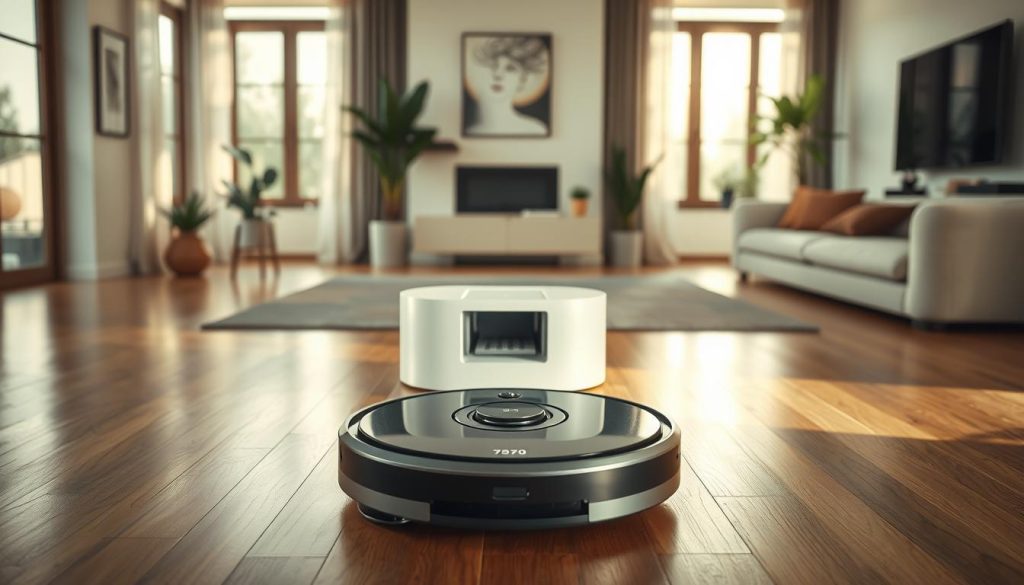
For larger apartments, a station that empties itself is the single most practical upgrade we can recommend. The Electrolux 700 with Emptying Station (EFR71222DS) reduces how often we handle dust, making frequent runs truly low-maintenance.
Why an emptying station reduces day-to-day handling
An emptying station means fewer bin visits. When the dock clears the dust automatically, we avoid daily fuss and exposure to allergens.
Consistent performance follows. A fuller bin cuts airflow and limits cleaning power. Auto-emptying keeps suction steady so results stay reliable across long runs.
Where this model fits best in multi-room layouts
The Electrolux 700 suits larger homes and multi-room flats where frequent scheduling is needed. It reaches under furniture, covers corners well, and works best when set to run several short passes each day.
- Who benefits: families, multi-room households and busy owners who want fewer chores.
- Practical placement: pick a dock spot near a socket with a clear approach path so the unit can return reliably.
- Time saved: set the schedule, then let the station handle bin emptying—this turns cleaning into a set, schedule, and forget routine.
In short, when convenience is the priority, the Electrolux 700 with its emptying station is our top pick for hands-free cleaning in larger Singapore homes.
How these robot vacuums handle different floors in Singapore
Different floor types in Singapore homes demand distinct cleaning strategies and settings. We test how systems move between tiles, vinyl and short‑pile rugs to judge real cleaning performance.
Hard floors and mopping performance for tiles and vinyl
On ceramic tiles and vinyl we look for even moisture and no streaking. Good mopping means controlled water flow, repeated passes where needed, and fast drying.
Practical tip: pick models with adjustable mop levels so tiles do not stay damp after a run.
Short-pile carpets and rugs, boost and avoidance behaviours
Short-pile carpets often need a suction boost in vacuum mode. Some units lift power on detection while others avoid rugs during mopping runs.
We recommend enabling carpet‑boost where available, and using no‑mop zones to keep pads off rugs.
Edges, corners and skirting lines around furniture
Crumbs collect along skirting and under dining chairs. Edge reach and side‑brush design matter for these tight areas.
Even the best systems may need occasional manual corner work, but strong edge performance reduces that task significantly.
- Traction and streak risk on tiles: choose low-moisture mopping modes.
- Carpet behaviour: ensure clear carpet detection or set virtual boundaries.
- Edge cleaning: prioritise models with proven side‑brush reach.
| Surface | Key behaviour | What to look for |
|---|---|---|
| Ceramic tile | Even mopping, low streaking | Adjustable water flow; repeat passes option |
| Vinyl | Quick drying, no warping | Gentle moisture and lightweight pad pressure |
| Short‑pile carpet | Boost suction or avoidance | Carpet‑boost setting; clear no‑mop detection |
| Edges & corners | Focused debris pickup | Extended side brush reach; close edge clearance |
Buyers’ note: match your choice to dominant floor type. Prioritise suction and mop control for tiled flats, or mapping and carpet‑boost for mixed layouts. That helps us achieve the best cleaning performance for Singapore homes.
Navigation and sensors that matter for cluttered rooms and obstacles
Accurate room mapping and quick obstacle response cut cleaning time in cluttered apartments. Good navigation matters more than many buyers expect, especially in tight Singapore spaces where missed zones are common.
LiDAR mapping for consistent coverage
LiDAR builds a reliable floorplan so a robot follows efficient routes and avoids repeat passes. Live mapping in the app shows coverage and helps us set no‑go zones quickly.
Object detection that avoids cables and shoes
Higher‑end models such as the RCV 5 add AI object detection to steer clear of low obstacles like shoes, toys and cables. This reduces stuck events and raises trust in automated cleaning.
Step and drop detection for safety
Ultra‑sensitive sensors detect stairs, ledges and raised thresholds. For maisonettes and raised doorways this is non‑negotiable for safe operation.
Practical tips:
- Do a quick declutter sweep before scheduled runs to improve results.
- Leave a clear approach path to the dock and allow at least 10 cm around furniture legs where possible.
- Use live mapping to tune no‑go and no‑mop zones for fragile areas.
| Feature | Benefit | Practical setup |
|---|---|---|
| LiDAR mapping | Consistent, fast coverage | Run initial mapping without toys or cables present |
| AI object detection | Fewer snags on low obstacles | Enable in-app detection and retrain if misreads occur |
| Drop sensors | Prevents falls and damage | Keep sensors clean and test near ledges |
App control features we actually use day to day
A few taps on the app keep floors tidy around work calls and school runs. We prefer simple screens that show today’s runs, last clean duration and any alerts.
Timers and schedules for weekday routines
Timers let us set weekday runs at quiet times. We schedule short passes before evening meals and longer runs overnight to suit drying time in humid weather.
Room programmes and zone control
Room-based programmes focus effort where it matters. We prioritise kitchens and dining areas, and use no-mop zones for rugs to avoid moisture on textiles.
Spot cleaning after meals
Spot mode is our most-used quick fix. A short, local run deals with crumbs and small spills without launching a full scheduled cycle.
Adjusting suction power and water volume
We change suction power and water flow based on dirt levels. Lower settings save noise and time; higher suction cleans high-traffic areas more thoroughly.
Wear alerts and consumable reminders
Replacement reminders preserve long-term performance. The app prompts us to change brushes and filters, keeping suction power steady and avoiding sudden drops in cleaning results.
| Feature | Benefit | Practical tip |
|---|---|---|
| Timer schedules | Hands-off daily upkeep | Set runs around school pickups and quiet work hours |
| Room programmes | Targeted cleaning | Prioritise kitchen and dining zones |
| Spot mode | Fast local clean | Use for meal-time crumbs and spills |
| Wear reminders | Consistent performance | Replace brushes/filters when notified |
Maintenance and hygiene: keeping suction, mops and tanks performing
Hygiene matters: heated washing and fast air drying cut bacterial growth and keep performance steady.
Self-cleaning rollers and cloth care
We favour systems that wash rollers at high temperatures. For example, the Roborock F25 uses 90°C water to reduce bacteria, then air-dries at 90°C in about five minutes.
Routine: remove and rinse pads after heavy use, and replace worn cloths to keep cleaning consistent.
Drying to reduce odours and mould
In humid Singapore, enclosed or heated drying prevents mildew. Open tanks and parts to air when possible. Heated drying shortens downtime and limits smells.
Bins, tanks and dirty-water handling
Empty promptly: we always empty dirty-water tanks after runs and rinse them to stop residue building up. Clean water tanks should be replenished with fresh water before each mop session.
“Auto-empty stations reduce contact with dust and keep airflow steady between manual clears.”
- Check brushes for hair wrap to protect suction.
- Rinse tanks and scrapers to avoid marks from trapped water.
- Use station features where available to cut maintenance chores.
| Task | Frequency | Why it helps |
|---|---|---|
| Rinse mop pads | After each dirty run | Prevents stains and odour |
| Empty dirty tank | Every wet session | Avoids residue build-up |
| Inspect brushes | Weekly | Stops hair and debris from reducing suction |
How we recommend choosing the right model for your space and routine
Choosing the right model starts with matching cleaning habits to the layout and daily traffic of your home. We focus on practical trade-offs: which features save time and which raise ongoing costs over the product life.
Small flats versus larger homes: runtime, mapping and station needs
In small spaces, reliable navigation and precise maps beat a massive battery every time. Good mapping reduces repeated passes and saves run time.
For larger homes, prioritise longer battery life and a station that empties or recharges automatically. Recharge-and-resume is often the difference between “complete coverage” and missed rooms.
Pets, hair and high-suction priorities
Homes with pets need higher suction power, tumble-free brush designs and frequent scheduled runs to avoid build-up.
We look for models with targeted brush tech and app control that lets us run short daily cleans to keep hair under control.
Homes with rugs and thresholds: what to prioritise in sensors and modes
Where rugs and thresholds are common, choose units with clear carpet detection and obstacle sensors. That prevents pads getting damp on textiles.
Modes that boost on carpet or skip rugs while mopping keep floors safe and cleaning efficient.
Balancing price, features and long-term convenience in Singapore
Price matters, but we advise valuing features that reduce friction: dependable navigation, a usable app, and low-maintenance bins or stations.
Think in terms of total convenience over life — consumables, how often you intervene, and charging behaviour all affect real cost and satisfaction.
Quick guide — if this, then that:
- Small flat with few rooms: choose strong mapping and modest runtime.
- Large multi-room home: prioritise battery life, station and recharge-and-resume.
- Pet household: pick higher suction power and anti-tangle brushes.
- Many rugs/thresholds: ensure sensors, carpet-boost or no-mop zones work well.
| Need | Top feature | Why it matters |
|---|---|---|
| Low fuss | Auto-empty station | Fewer bin visits; steady suction |
| Pet hair | High suction & brush design | Reduces tangles and residue |
| Mixed floors | Accurate sensors & modes | Protects carpets; effective mopping on tiles |
Conclusion
Practical performance — edges, under‑furniture reach and hygiene — often decides how useful a robot will be day to day.
For frequent spills pick a model with strong mop control and heated drying. For crumbs and pet hair favour high suction, anti‑tangle brushes and short scheduled runs. Mixed floors with rugs need precise navigation and clear no‑mop zones.
The main trade‑offs are simple: robust hygiene systems versus light two‑in‑one mop modules, and detailed mapping versus entry‑level simplicity. Navigation that does not get stuck, an app that fits routines, and easy maintenance are make‑or‑break.
Prioritise drying and tank care in humid Singapore to avoid odour. Choose by space, schedule and how much hands‑on upkeep you will tolerate so the robot truly saves time.
For a fuller comparison with heavy‑duty wet‑dry systems see our robot vs wet‑dry guide.

