

We present a commercial solution built for Singapore teams who need reliable, repeatable results. Our water tank cleaning vacuum cleaner pairs robust suction with a durable 30 L metal canister to handle sludge-laden waste and fine residue.
We specify clear performance: 53 L/s airflow, motor up to 1200 W, a 7 m cable and a 2.5 m hose (40 mm diameter). The unit ships with nozzle and pipe, a vacuum mop and a sweeping brush, plus a 1-year warranty.
We explain what makes this professional. Strong airflow, stable canister build and correct hose diameter reduce recontamination and shorten time on site. That matters for offices, facilities and multi-tenant buildings where downtime affects business.
What to expect: concise specs, workflow notes for integration with high-pressure jetting and dewatering pumps, accessory options and quote steps tailored to Singapore sites. We focus on duty cycle, service support and compatibility with your cleaning machine kits.
Commercial water tank cleaning in Singapore: why the right equipment matters
In busy commercial sites we focus on reliable, repeatable service that restores supply quickly and safely.
Protecting storage hygiene in high‑usage buildings
Hygiene control in multi-tenant offices and workshops needs more than general work. Frequent drawdown and replenishment raise the risk of odour, visible sediment and microbiological growth on internal surfaces.
“Fit-for-purpose equipment reduces re‑contamination and shortens time to restore normal operations.”
Reducing downtime for offices, workshops and facilities
We combine dewatering, sludge extraction, jet passes and final vacuum runs to keep outage hours to a minimum.
| Issue | Impact | Equipment response |
|---|---|---|
| Visible sediment | Odour, complaints | Targeted extraction and jetting |
| Settled sludge | Re-suspension risk | Correct suction and debris handling |
| Access constraints | Longer service time | Reach-specific tools and safety plan |
- We prioritise consistent performance to reduce call‑backs.
- Cleaner water outcomes follow from correct extraction and disinfection steps.
Our water tank cleaning vacuum cleaner for commercial tanks
For service teams that run back-to-back jobs, we built a durable suction system to keep work moving.
Our wet dry design handles both liquids and solids without swapping machines. The 30 L metal canister and up to 1200 W motor deliver constant airflow (53 L/s) for real-world pickup of sludge, grit and loose scale.
Wet & dry performance for sludge, wastewater and residue
Stable pickup matters. We ensure the unit resists clogging and holds airflow when collecting mixed debris rather than only clear liquid.
Right hose diameter and robust fittings stop blockages and speed extraction on commercial surfaces.
Built for heavy-duty tank cleaning services
We position this as a heavy duty tool for repeated site work. The kit includes nozzle & pipe, a vacuum mop and a sweeping brush, with 230V/50Hz options and a 1-year warranty for peace of mind.
- Typical use: post-jetting residue removal and fast extraction of loosened contaminants.
- Expectation: sustained suction when handling thick material, not just clear liquid.
- Service model: built for repeated jobs across multiple sites, prioritising uptime over domestic features.
| Feature | Spec | Benefit |
|---|---|---|
| Canister | 30 L metal body | Durable, easy to sanitise between jobs |
| Motor & airflow | Up to 1200 W / 53 L/s | Maintains suction on mixed debris |
| Included kit | Nozzle, pipe, mop, brush | Ready for post-jetting and final passes |
| Power option | 230V / 50Hz | Suitable for Singapore commercial sites |
To explore accessory roles and unusual uses in site kits, see our guide on wet and dry vacuum applications. We follow that with detailed specs and integration options for pressure washers and pumps in the next section.
Core specifications that drive real cleaning results
Clear specifications translate directly into faster job cycles and fewer call‑backs.
30 L metal canister: a single 30 L capacity reduces emptying frequency on sludge and wastewater collection. The metal canister design gives robust protection in transport and makes rinsing between jobs straightforward.
Motor and airflow
Power options up to 1200 W combine with 53 L/s airflow to speed pickup after high‑pressure passes. Higher motor output keeps suction stable when handling mixed residue.
Reach and hose performance
A 7‑metre cable increases working radius in plant rooms and carpark sumps. The 2.5‑metre hose with a 40 mm diameter helps move thicker debris without repeated blockages.
Included tools and service
The kit ships with nozzle & pipe for directed suction, a vacuum mop for wet runs and a sweeping brush for edges and dry debris.
| Spec | Value | Operational benefit |
|---|---|---|
| Canister | 30 L metal | Fewer stops; durable, easy to sanitise |
| Motor / airflow | Up to 1200 W / 53 L/s | Stable pickup on mixed residue |
| Cable / hose | 7 m cable / 2.5 m hose (40 mm) | Better reach; reduced blockages |
| Kit | Nozzle, pipe, mop, brush | Ready for post‑jet and finish passes |
Warranty: we provide a one‑year warranty. Commercial buyers should confirm parts availability, typical turnaround times and recommended maintenance intervals before purchase.
Spec choices affect price and total duty costs: higher airflow and larger hose diameters often reduce labour time, which can offset initial purchase cost. For full technical details see the official specification sheet.
Wet dry vacuum cleaner vs tank cleaning machine: choosing the best setup
Choosing the right kit for commercial projects affects uptime, labour and long‑term costs. We offer a simple framework to decide between a standalone unit and a full mechanised solution.
When a dedicated wet dry unit is enough
For routine maintenance or low‑to‑moderate sediment, a single wet dry vacuum cleaner gives fast, low‑cost results.
It works well when you already have dewatering pumps or a pressure washer on site. Use it for quick post‑jet passes and light sludge pickup.
When a full mechanised kit is the better investment
Recurring contracts, heavy contamination and mixed tank types justify a multi‑machine cleaning kit. A complete tank cleaning machine setup bundles dewatering, sludge extraction, high‑pressure jetting, vacuuming and disinfection into one repeatable programme.
“Mechanised workflows cut manual handling and shorten turnaround without sacrificing hygiene.”
Compatibility matters: check hose fittings, couplings and single‑phase 230–240V power to match Singapore sites.
- Modular bundling: vacuum + pressure washer + sludge sucker + dewatering pump is a scalable alternative to a single packaged kit.
- Commercial goals: reduce downtime, standardise service quality and scale teams without losing results.
Decision rule: choose the standalone unit for occasional, light work; choose the mechanised kit for heavy duty or contractual obligations.
Applications we support across Singapore
We deploy tailored solutions across a wide range of commercial sites in Singapore. Our focus is on meeting tight access, schedule and hygiene demands while keeping disruption low.
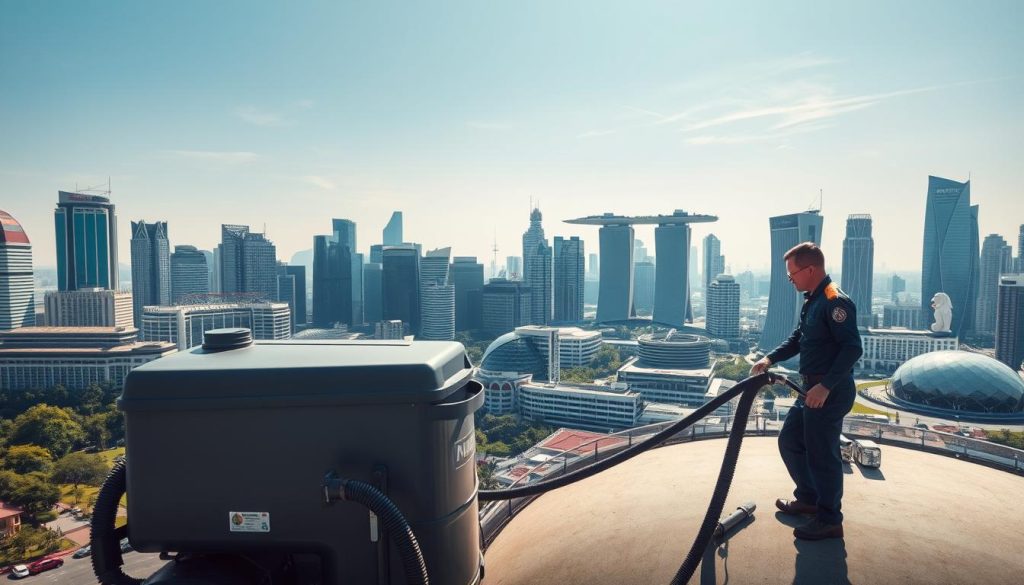
Commercial water storage tanks in offices and multi-tenant buildings
We work with building managers to coordinate shut‑offs and service windows. Noise control and fast turnarounds matter for multi‑tenant sites.
We plan: staged shut‑downs, clear tenant notices and tight service slots to avoid business impact.
Steel tank and fabricated tank interiors
Steel and fabricated interiors have seams, welds and corners that trap residue. Robust tools and controlled suction reduce missed spots.
We select hose reach and nozzle types to reach seams and avoid recontamination during final passes.
Floor tank and underground sump cleaning
Floor and floor tank work needs wet pickup and safe reach in confined spaces. Sludge handling and debris transfer are key.
- Adaptable kit: fits narrow access and tight floor levels.
- Integrated use: final water tank cleaning passes follow high‑pressure removal for clinging deposits.
- Commercial outcomes: repeatable processes for contractors serving multiple properties in Singapore.
Our proven tank cleaning workflow using professional equipment
A proven, repeatable six-stage workflow keeps projects on schedule and ensures demonstrable hygiene outcomes. We present an end-to-end method that suits overhead and underground systems and common tank materials in Singapore.
Mechanised dewatering with dedicated pumps
Step 1: We lower fluid level using submersible and transfer pumps to expose the work area below foot valves. This speeds access and reduces time spent in wet conditions.
Sludge removal from the floor
Step 2: Settled sludge is extracted with purpose-built suction and sludge tools. Removing sediment first prevents re-suspension during subsequent washing stages.
High-pressure jet washing for walls and ceilings
Step 3: We apply high pressure jets to dislodge calcification, biofilm and algae. Correct pressure and flow parameters ensure effective decontamination without damaging linings.
Vacuum cleaning to remove loosened contaminants
Step 4: After jet passes we remove loosened debris and residual runoff so surfaces finish speck-free and ready for sanitation.
Anti-bacterial spray treatment for sanitation
Step 5: A validated anti-bacterial spray is applied to meet commercial hygiene expectations and provide a documented sanitation stage.
UV radiation for final disinfection
Step 6: Portable UV units provide a final sterilisation pass to reduce remaining suspended and surface bacteria before commissioning.
“Mechanised workflows reduce manual effort, limit missed areas and make job times predictable.”
| Stage | Purpose | Key equipment |
|---|---|---|
| Mechanised dewatering | Create dry working zone | Submersible/transfer pump |
| Sludge removal | Extract settled sediment | Sludge suction tools |
| High-pressure jet washing | Dislodge adherent deposits | High pressure washer, lance |
| Debris extraction | Remove loosened residues | Industrial suction unit |
| Anti-bacterial spray | Sanitation verification | Dosage sprayer, validated agent |
| UV radiation | Final disinfection | Portable UV steriliser |
High-pressure cleaning integration for faster turnaround
Combining targeted jetting with immediate extraction shortens job cycles significantly. We pair a high pressure washer with our extraction workflow to loosen deposits quickly, then remove runoff before material resettles.
Performance targets and practical benefits
Benchmark: up to 140 bar and 11 L/min is our practical target for stripping internal films and calcification. The Kranzle K2160ts meets this at 240V single‑phase, with a 10‑metre hose and a 1‑year warranty.
Hose reach and site access
A 10‑metre hose reduces repositioning in plant rooms, overhead access and long corridors. That reach saves time and limits manual handling on ladders and platforms.
- Outcome: higher impact removes algae and persistent films, cutting manual brushing time.
- Practical power: 240V single‑phase means fewer site modifications in Singapore.
- Multi‑use: the same unit serves car and truck bays, floor work and workshop cleaning when not on service calls.
| Item | Spec | Benefit |
|---|---|---|
| Model | Kranzle K2160ts | Trolley, lance storage, cable reel |
| Pressure / Flow | Up to 140 bar / 11 L/min | Strips deposits; efficient rinsing |
| Hose | 10 m | Better reach; fewer moves |
| Power & weight | 240V single‑phase, 37 kg | Site friendly; portable on trolley |
“Jet first, manage runoff, then extract — this sequence restores a clean, dry finish faster.”
Sludge removal tools designed for tough deposits
Settled deposits demand kit that moves dense material fast and without fuss. We outline a compact, low‑maintenance option that speeds bulk extraction and reduces manual handling on site.
Steel sludge sucker accessories for sediment and waste water
Steel sludge sucker is a durable scupper with no moving parts. It suits sludge, waste water, septic applications and oil/water mixtures.
Turning a pressure washer into a “trash pump” for rapid extraction
By fitting a 1/4” quick connect tip or M22 adaptor, we convert a pressure washer into a reliable trash pump in seconds. The device uses flow dynamics to create fast extraction without complex mechanics.
- Included: 15 ft, 1″ heavy‑walled suction hose — larger diameter reduces clogging on thick deposits.
- Fitment: universal 1/4” quick connect or M22 to match common site machines.
- Workflow: remove bulk sludge first, follow with high‑pressure passes, then final suction to leave a speck‑free finish.
Practical result: this tool integrates with our modular equipment approach, giving Singapore contractors faster turnaround without immediate investment in a full mechanised kit.
Dewatering and transfer pumping options
Rapid fluid transfer is often the unsung hero of a timely service turnaround. We prioritise dewatering as the first, time‑critical step because reducing standing water shortens overall job time and improves safety for entry or remote access.
1HP stainless steel dewatering pump: capacity and practical specs
Benchmark unit: a 1HP stainless steel dewatering pump delivers up to 330 LPM. It runs on single‑phase 230V, 50 Hz, at roughly 1000 RPM and weighs about 16 kg.
Why this matters. Single‑phase operation suits most Singapore sites and the manageable weight eases transport between floors and rooftops.
“Start with effective pumping and the rest of the workflow becomes faster and safer.”
- We recommend stainless steel construction for corrosion resistance and easy sanitisation.
- Match flow rate to tank volume so pump‑down completes quickly without excess run time.
- Check motor spec, supply compatibility and stated duty cycle requirements before purchase.
| Item | Spec | Operational benefit |
|---|---|---|
| Flow | Up to 330 LPM | Fast pump‑down and transfer of runoff |
| Power / motor | 1HP, single‑phase 230V | Site‑friendly power and reliable drive |
| Weight | 16 kg | Portable between job sites |
| Build | Stainless steel | Durable; easier to sanitise |
Higher capacity pumping reduces dilution of sludge, makes subsequent extraction simpler and improves the effectiveness of high‑pressure passes. Over a contract term, reduced labour time can offset initial price when you select the right pump for the job.
Remote and confined-space cleaning with submersible crawler technology
When access is restricted, remotely operated crawlers give us precise control and reduce manual risk.
When to use remote systems: we deploy crawlers where confined access, restricted hatches or strict safety policies prevent entry. The VAC Utility Crawler suits deep storage and underground configurations that would otherwise need complex permits.
Submersible depth rating up to 50 m
The crawler is rated to 50 m, so we can inspect and work in deep tanks and some buried storage without repeat entries. That depth rating reduces downtime for verification and follow-up passes.
Portable, zero-turn operation and long runtime
It is one-person portable and features a zero-turn manoeuvre radius for precise positioning inside confined vessels.
Battery runtime reaches up to 8 hours with hybrid support for extended shifts and scheduled maintenance windows.
Visibility, sensors and tether control
A 1080p camera with pan/tilt, incline/roll/leak sensors and 900-lumen LEDs deliver inspection-grade views during cleaning and inspection runs.
The standard 75 m IP68 tether on a heavy-duty reel gives controlled deployment; optional reels extend to 400 m for larger sites.
“Remote crawlers cut labour exposure and provide consistent coverage where manual reach is limited.”
Accessories, connectors and hoses for a reliable cleaning kit
Reliability starts at the connection point: poor fittings and mismatched hose ratings are a frequent cause of site delays and lost pressure. We select accessories that keep commercial jobs moving and reduce downtime.
PVC quick release coupling options
For quick changeovers we favour half‑inch PVC quick release couplings. They speed swaps between dewatering, rinse and extraction lines and lower the chance of leaks during shifts.
Pressure washer hose pipe selection for 240V systems
Choose a pressure washer hose pipe rated for the required pressure and abrasion resistance. For 240V electric systems we recommend thicker‑walled PVC with reinforced braiding to suit commercial duty and frequent handling.
Brass hose connectors for corrosion resistance
Brass connectors (1 inch, polished finish) resist corrosion and stand up to repeated sanitisation cycles. Use them where longevity and hygiene matter most.
Practical kit tip: standardise hose sizes and connectors across your equipment to cut inventory, speed training and reduce on-site errors. Secure fittings also limit uncontrolled spray and contamination spread in plant corridors.
For assembly and basic upkeep guidance see our easy maintenance guide.
Designed for durability, hygiene and easy sanitisation
Durable materials and smart engineering keep commercial kits working through frequent site use.
Stainless steel and anodised aluminium where it counts
We specify metal where life is most demanding. The VAC Utility Crawler uses stainless steel, aluminium and high‑strength acrylic to resist corrosion and impact. Our dewatering pump option is stainless steel and the sludge sucker is steel. The main canister is metal for reliable handling on repeated jobs.
Design choices reduce weak points. Anodised aluminium shells and polished stainless parts tolerate humid Singapore conditions and contact with common disinfectants.
“Smooth, non‑porous surfaces make inspection and sanitisation faster and more consistent.”
Operational hygiene and simple sanitisation
We build kits that support good hygiene. Surfaces with few crevices allow quick wipe‑downs and visual checks between shifts.
- Fewer joints and smooth finishes speed routine sanitisation.
- Robust metals survive repetitive disinfection without degrading.
- Durable parts reduce repair time and protect duty performance over contract life.
| Component | Material | Operational benefit |
|---|---|---|
| Crawler shell | Anodised aluminium | Lightweight, corrosion resistant; easy to rinse |
| Dewatering pump | Stainless steel | Durable; tolerates frequent use and sanitisation |
| Sludge accessories | Steel | Robust against impact and abrasive deposits |
| Canister | Metal | Simple to empty and sanitise between jobs |
Cost control follows durability. Fewer repairs mean better uptime and steady pressure/suction performance across the duty cycle. For contractors in Singapore, that reliability reduces labour hours and keeps schedules predictable.
Operational safety for tank teams and facilities
Operational safety starts with the right access tools and a clear site plan. We build safety planning into equipment selection and site setup so crews work with confidence and speed.
Ladder access planning for overhead work
Choose a stable aluminium ladder that suits the job. A 12 ft telescopic ladder with 150 kg capacity, anti‑skid feet, safety step indicator and wall grip gives reliable support.
Confirm portable storage height (about 3 ft) and maximum wall support extension (12.5 ft). A secure ladder reduces slips and helps crews control jetting and extraction tools, so fewer areas are missed and rework drops.
Confined-space risk reduction with remote options
Where entry is hazardous, we favour remote systems. A submersible crawler rated to 50 m with camera, LEDs and a tether lets us inspect and work without putting staff into confined-space environments.
Remote operation cuts exposure, simplifies compliance and keeps projects on schedule.
- Keep hoses organised and power leads tidy to avoid trips.
- Isolate the working zone and manage runoff to protect occupied areas.
- Match access equipment to site conditions before mobilisation.
“Plan for access and control risks up front; it saves time and protects your team.”
If you request a quote, we will advise on access constraints and safer operating configurations for specific tank types and water tank cleaning projects.
What influences price and total cost of ownership
We believe total ownership is shaped by specifications, usage patterns and support arrangements. That framing helps buyers choose equipment that performs over multiple contracts and harsh site conditions.
Capacity, motor power and duty cycle requirements
Capacity affects emptying frequency and labour. A 30 L canister cuts stops on larger jobs, but larger tanks raise initial price.
Motor and power determine sustained performance. Higher motor output keeps airflow steady under load and shortens job time on heavy residue.
Duty rating matters: commercial duty units with reinforced bearings and cooling run longer with fewer failures.
Adding high pressure, UV and sludge extraction to the package
Adding a high pressure washer and sludge extraction tools raises upfront cost, but speeds the workflow. High pressure passes remove adherent deposits; sludge accessories move dense material faster.
UV options (18W/36W at 240V) add sterilisation capability for final disinfection and higher contract value. Combine these to build a mechanised kit that reduces repeat visits.
Warranty and service support planning
Warranties affect long‑term cost. Our base units include a one‑year warranty; crawlers carry one‑year parts & labour with optional extension.
Plan for realistic turnaround times, access to consumables and local service. Extended service contracts ease mission‑critical risk and lower downtime.
| Driver | Example | Cost impact |
|---|---|---|
| Capacity | 30 L canister | Lower labour; higher purchase price |
| Motor / power | Up to 1200 W | Fewer call‑backs; higher initial price |
| Added modules | High pressure, UV, sludge kit | Higher capex; faster jobs |
| Warranty & service | 1 year base; extensions available | Reduced downtime; predictable OPEX |
Practical budgeting model: weigh upfront price against saved labour hours per job, fewer call‑backs and the ability to win higher‑value contracts. Often a higher initial spend pays for itself through lower operational costs and steadier service outcomes.
Request a quote for Singapore commercial tank cleaning equipment
To speed a precise request, tell us the site specifics and the performance targets you need. We will use that information to recommend the right configuration for your commercial site in Singapore.
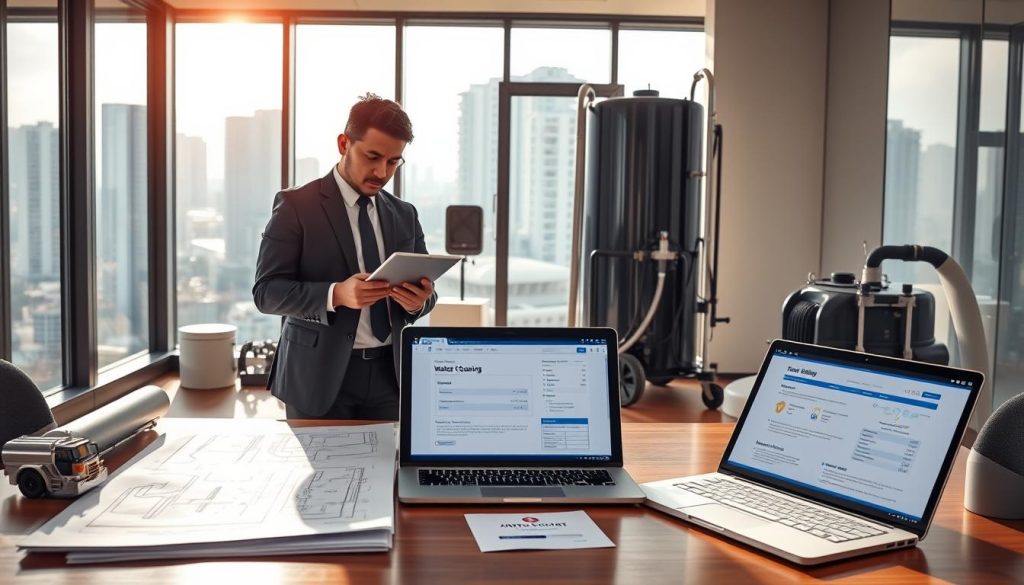
Share your tank type, material and access conditions
Tell us the context: overhead or underground, approximate volume and material (steel, fabricated, concrete or plastic).
Also note manhole size, ladder options, distance to power and any confined‑space restrictions.
Specify desired outputs: suction, pressure, hose length and tools
- State expected suction performance for sludge and wastewater and target pressure for jet passes.
- Indicate minimum hose length required to reach all working areas and preferred connector standards.
- Confirm the toolset you need: vacuum mop, sweeping brush, nozzle & pipe, sludge sucker accessory, dewatering pump, UV lamp and connectors.
Modular options: we can propose a bundled package (suction + pressure washer + sludge extraction + pumping) or a full cleaning machine kit to meet operational goals.
Submit your request with photos and a simple site sketch and we will return a tailored quote for Singapore sites within one working day.
Conclusion
A clear equipment plan helps teams finish jobs faster and keep compliance consistent across properties.
We summarise the outcome: the right wet dry vacuum and matched accessories speed extraction, deliver cleaner finishes and make hygiene outcomes predictable. Start by assessing tank and water conditions, access and contamination type.
Match suction, pressure, hose reach and sludge tools to the task. Integrating high‑pressure jetting, dewatering pumps and targeted extraction cuts labour time and shortens service windows.
For Singapore contractors, standardised equipment and parts reduce downtime, simplify training and improve repeatability. Compare a standalone wet dry unit with a full mechanised machine kit by contract volume, compliance needs and total cost of ownership before you request a quote.

