
We introduce what a backpack wet and dry vacuum cleaner is and who in Singapore benefits most from one. This guide shows how these machines work as multipurpose problem solvers for house, garden, garage and workshop use.
We explain why a single unit for both mess and water saves space in compact flats and storerooms. Our focus is practical: suction, filtration, capacity, ergonomics, accessories, noise and overall value.
We outline how everyday floor care differs from heavier work like renovation dust or car detailing, so you avoid overpaying for the wrong tool. We also flag the main trade-off: stronger wet dry performance can add bulk and noise, yet it speeds up tasks.
Finally, we signpost the guide structure so readers can jump to sections that match their home layout, cleaning frequency and typical messes. Use our criteria to shortlist models by design, features and price quickly.
Why we choose a wet dry vacuum for Singapore homes and worksites
Living and working in Singapore means we often face mixed messes that make quick cleanup essential. A single unit that handles both liquid spills and loose debris saves us steps and time.
Common mixed messes we clear in one pass
We routinely pick up sand from the beach, pet hair, kitchen spills and post-mop residue. These wet dry messes range from fine dust to small amounts of water after rain or leaks.
When a dry-only model still makes sense
For nightly tidying of bedrooms and rugs, a lighter dry vacuum cleaner wins for ease, lower noise and compact storage. If we never handle liquids, we may prefer that simplicity.
Trade-offs: noise, weight and space versus performance
Units that cope with both water and debris typically have stronger suction and larger tanks. That gives more power but adds weight, bulk and noise. We balance convenience against storage limits and tolerance for sound.
- One-pass cleaning saves time in busy households.
- Families with kids, pets or renovation projects benefit most.
- If water is rare in your home, a dry model is often more practical.
Backpack wet and dry vacuum cleaner: what makes it different
When the canister sits on our back, chores in narrow corridors become quicker and more precise.
Compact spaces, stairs and longer sessions
Wearing the unit frees our hands to steer the hose around furniture and up staircases. This design shines in Singapore flats with tight hallways and small stairwells.
For long cleaning minutes we check strap padding and weight distribution. Poor straps cause fatigue fast, so comfort is a buying factor not an afterthought.
Capacity trade-offs when the tank is carried
Carried tanks usually have smaller capacity than drum formats. We balance capacity against ergonomics: a large tank reduces refill frequency but increases strain.
When other formats suit better
Drum models suit heavy workshop debris or large volumes of water because they park in one spot and carry more. Cordless stick options suit quick daily floor care and nimble mobility.
- Choose a shoulder model for stairs and tight layouts.
- Pick a drum for large-volume jobs and workshop use.
- Opt for a cordless stick for fast, light upkeep.
| Format | Best for | Typical capacity | Mobility |
|---|---|---|---|
| Shoulder-mounted | Stairs, tight flats | Small–medium | High |
| Drum | Workshops, large spills | Large | Medium |
| Cordless stick | Daily quick clean | Small | Very high |
To shortlist models, match layout (stairs vs open plan), cleaning frequency and typical mess type. For mixed spills and stubborn dirt, see our practical guide on cleaning techniques here.
Where we’ll use it: floors, cars, workshops, and water clean-up
We need a single unit that moves easily between tiled entrances, car interiors and workshop benches. This keeps our cleaning routine simple and cuts the time spent swapping machines.
Hard floors, rugs and entrances
For tiled or vinyl hard floors we pick a soft floor head to avoid scattering grit. On rugs we switch to a brush tool that lifts trapped dirt without snagging edges.
Car interiors and tight spots
Extension wands and narrow brushes reach between seats, under mats and into door pockets. These accessories make car detail cleaning efficient and precise.
Renovation dust and workshop use
When sawing or sanding we attach a suction tool at the source to cut airborne dust. That reduces cleanup time and keeps larger work areas tidy.
Water spills, puddles and high volume pickup
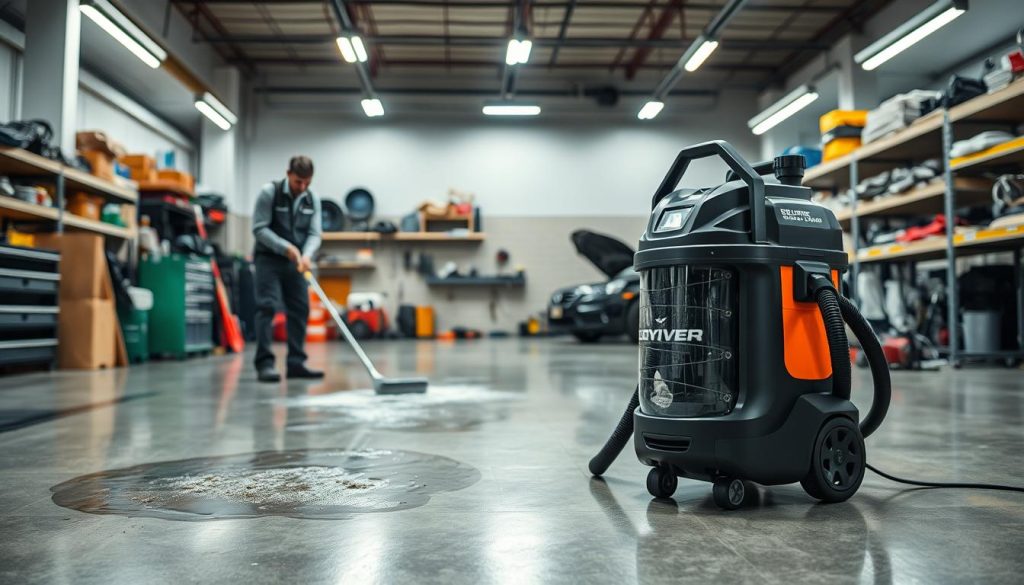
Robust containers and wet pickup modes manage small spills up to larger puddles with fast suction. For bigger volume jobs we look for easy-empty tanks and secure seals.
Outdoor cleaning and blower use
Patios, driveways and service areas benefit from a blower to move leaves and gravel before we vacuum. This two-step approach speeds cleaning across outdoor floors.
- Versatility: Accessories expand one machine for indoor, car and garden tasks.
- Safety: Source suction during sanding lowers dust exposure.
- Capacity: Robust tanks handle higher water volume without frequent emptying.
| Use case | Recommended tool | Key benefit |
|---|---|---|
| Entrances & tiled floors | Soft floor head | Prevents scattering, picks grit efficiently |
| Car interiors | Extension wand + brush | Reaches tight gaps and crevices |
| Renovation & workshop | Suction attachment at source | Controls dust, improves air quality |
| Spills & puddles | High-capacity tank mode | Handles larger water volume quickly |
For a broader selection of professional options, see our note on professional wet-and-dry vacuum cleaners to compare suction, accessories and capacity.
Suction power and cleaning performance that actually matters
Strong suction makes the difference between a one-pass job and repeated cleaning. We look past motor watts and focus on what suction power delivers in real use: lifting grit from entrances, pulling fine dust from skirting boards, and keeping pickup steady as the tank fills.
How to judge suction across models
Check the full system, not just the motor rating. Hose diameter, seals and tool design decide whether motor power becomes usable suction at the floor.
Specs vary: Pa, Air Watts and input watts appear across product sheets. Use them as rough comparators, then verify with short tests at home or in-store.
Energy efficiency alongside usable power
We prefer models that pair high suction with sensible energy use. Brands that promise “superior suction power” with good efficiency deliver faster cleaning without frequent overheating or high running costs.
“Suction that lasts is more valuable than a high peak figure that fades as the tank fills.”
- Test edge pickup with rice or sand on tile.
- Try a damp debris pass for mixed messes.
- For workshops, prioritise sustained suction over short bursts.
Filters, dust, and hygiene: choosing the right filtration system
Choosing the right filter can make the difference between clear air and repeated sneezes. Filtration is non-negotiable in small Singapore flats where fine dust quickly degrades indoor air quality.
Standard filters versus HEPA for fine particles
Standard filters handle larger debris well and suit routine cleaning of floors and mats. For renovation dust, pet allergens or allergy-prone households, we prioritise HEPA filters.
“HEPA filters capture finer particles that ordinary filters miss.”
Practical filter designs that cut contact with dirt
Some brands use quick-seal cartridges and bagless housings that minimise hand contact during changes. Kärcher-style innovations reduce mess at disposal and improve overall hygiene.
Microfilter, antibacterial features and cleaning solution use
Microfilter technology helps trap very fine dust between major filter stages. Electrolux models also offer antibacterial water tanks and self-cleaning functions for frequent liquid pick-up.
When using a cleaning solution in wet modes, check manufacturer compatibility to avoid residues or damaged seals. Compatible solutions can control odour and improve results.
- Routine: Rinse washable filters, dry fully before reuse.
- Replace: Follow replacement intervals to keep suction steady.
- Inspect: Check seals and pre-filters after heavy jobs.
Capacity, water tanks, and run time: matching the vacuum to your space
Choosing the right tank size shapes how often we stop to empty, refill or recharge during a cleaning session.

Capacity matters in small Singapore flats. Smaller tanks are easier to store and lighter to handle. Larger tanks reduce interruptions for whole-floor jobs and speed up removal of spills.
Clean water and dirty water separation
Models with separate clean and dirty tanks keep wash performance consistent. Separation improves hygiene and cuts cross-contamination when we mop and extract in one pass.
Small tank convenience versus larger tank efficiency
Small tanks suit quick spot cleans and tight stairs. Larger tanks suit bigger floors and repeated wet passes, so we refill less and save time overall.
Corded reach versus cordless freedom
Corded models give steady run time with no stops. Cordless choices free us on stairs and awkward corners but need battery planning. Expect roughly 30–70 minutes depending on mode; plan by room count and minutes available.
- Studio / 2-room flats: small tank, cordless for stairs.
- Larger homes: larger tank, corded or long-lasting battery.
- Small worksites: high capacity and easy drain for faster water pick-up.
Accessories and features we look for before we buy
Accessories and smart features determine whether a purchase simplifies our routine or becomes cupboard clutter. We prioritise parts that turn machine power into useful results.
Multi-surface nozzles, carpet heads and edge cleaning
Multi-surface nozzles suit tiled entrances and rugs without swapping entire setups. A dedicated carpet head lifts fibres while a soft floor tool protects surfaces.
Edge-cleaning tools matter for skirting lines and corners. Good nozzle design lets strong suction reach tight gaps and reduces repeat passes.
Onboard storage and compact design for Singapore homes
We favour units with built-in storage so brushes and wands tuck away neatly. Compact design saves scarce closet and service yard space.
Integrated holders also cut setup time and stop lost bits from delaying cleaning.
Self-cleaning, easy-empty systems and workshop power integration
Self-cleaning functions for wet heads prevent residue build-up and reduce odour. Easy-empty drains or quick-release bins keep our hands clean when disposing of waste.
For workshop use, selected models include a power outlet that starts suction when a tool runs. That feature links tool power and extraction as one useful system.
“Accessories are part of the performance system — great suction needs matching nozzles to work well.”
- Essential: multi-surface nozzles, edge tools, tidy storage.
- Very useful: self-clean cycles and easy-empty drains.
- Nice to have: built-in power outlet for tool-triggered extraction.
Price, value, and how we compare models in Singapore
Smart buying starts with matching what we actually clean to what each price band offers. We use local price points to set realistic expectations before comparing models.
Typical price bands in Singapore and what you get
Entry-level machines offer decent dry performance and basic filtration. Mid-range units add stronger suction, higher capacity tanks and better seals.
Premium models often include HEPA filters, longer warranties and useful accessories. Electrolux listings span several price tiers during promotions, which anchors our expectations.
Format value: drum, backpack, stick and robot by use case
Drum formats give the best capacity for heavy debris. Portable shoulder-style units help on stairs and narrow flats while stick and cordless options trade tank size for agility.
Robot vacuum options suit maintenance cleaning but do not replace a wet dry vacuum for spills or workshop dust.
What to check in promotions
- Confirm delivery fees and timing.
- Check 0% instalment plans and warranty terms.
- Verify included accessories and nozzle sets.
We always compare model-to-model on filters, tank capacity, replacement costs and bundled tools. For step-by-step care tips, see our guide on clean the carpet at home.
Conclusion
Practical use, not specs alone, decides which model we keep reaching for on cleaning day.
When we face mixed messes at home, a wet dry unit often gives the best all-in-one value. Choose by real pickup: test usable suction power, check filters for hygiene, and match capacity to your routine.
Ergonomics matter. A backpack style helps on stairs and tight flats, while drum or stick formats suit large volumes or quick tidy sessions. Be honest about water handling — robust tanks and easy emptying matter when spills happen.
Finally, compare models by accessories, maintenance effort and total cost. The best vacuum cleaner is the one we use regularly — quiet, simple to empty, and able to cope with the dirt and messes we see every week.

