

We test household machines for Singapore homes, where humidity and frequent chores make dust and odour control an ongoing concern.
In this hands-on introduction we set expectations for what clean air claims mean in practice. We focus on exhaust quality as much as visible floor results.
Our review centers on the Kärcher DS6. The maker’s headline — filters 99.95% of the dust out of the air — is treated as a target to verify, not a promise for every home.
We summarise the concept: the system binds dust and dirt in liquid so less escapes back into the room. We outline what we tested, what surprised us and who will benefit most.
Later we ask whether the price and the practical task of changing and rinsing the tank fit typical local routines. For full specs and options, see this water-filtration model.
What we looked for in a vacuum cleaner that uses water as a filter
We looked for measurable changes in room air quality and for practical handling routines suited to Singapore homes. Our focus was both on visible results on the floor and on tiny particles that trigger allergies.
Clean air performance for urban, allergy-prone households
We judged whether exhaust air felt noticeably fresher in bedrooms and living rooms. The DELPHIN “smell test” was part of this: any obvious odour from the exhaust can hint at fine dust escaping.
How this system differs from bagged and dry designs
Unlike bagged models, the rotating water column binds sucked-in dirt in a liquid bath and avoids dust clouds on emptying. That can help allergy sufferers who find bag changes messy and irritating.
Multi-stage expectations
We expected the water core to trap larger debris, an intermediate washable stage to catch finer material, and a HEPA stage to tackle microscopic pollen and spores. We looked for clear HEPA performance rather than only marketing claims.
Everyday practicality and value
- Ease of filling and emptying the tank, and how messy the process felt.
- Time added by post-cleaning maintenance versus conventional models.
- Versatility of nozzles for tile, vinyl, rugs and upholstery.
- Fair value: strong pickup, steady suction and no ongoing bag buys, balanced against water changes and periodic filter care.
“Smelling the exhaust during use can reveal whether fine particles are being expelled back into the room.”
For background on how water-based systems perform overall, we linked our broader primer here: what is water filtration.
Our hands-on review of water-filter vacuum performance and clean air results
We tested how effectively the rotating water bath captures airborne particles during everyday cleaning.
Filtration claims in context
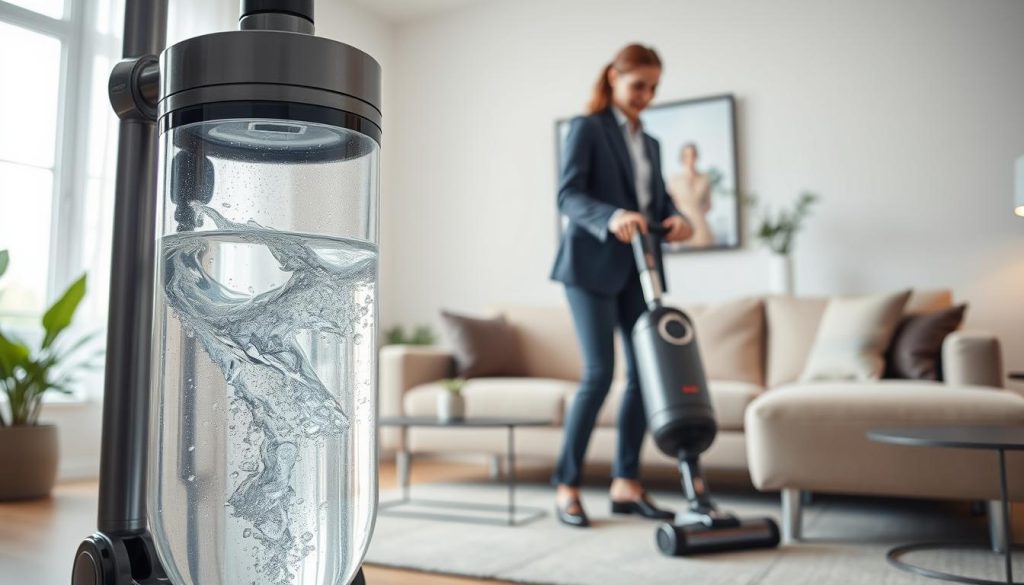
The Kärcher concept binds dust in a rotating water column so debris stays in liquid rather than a dry bin. We watched the bath during runs: larger grit sank quickly while finer material gathered in the intermediate stage.
Exhaust air quality targets
Manufacturers cite figures such as 99.95% for exhaust air. We treated this as an operational target and looked for fewer floating specks and a less dusty sensation after cleaning.
The “smell test”
We smell where exhaust air leaves the unit. No strong odour usually signals fewer fine particles escaping. This is not a lab metric, but it is a useful household check.
Real-world pickup
On Singapore floors we tested tracked-in grit, hair and crumbs. The system handled grit and crumbs well; hair and deep carpet dust sometimes needed extra passes.
Air-washing effect and motor behaviour
As the device pulls room air through the bath, airborne particles drop out while you clean. We noticed fresher air in closed rooms during use.
Motor stability matters: steady suction and consistent exhaust airflow keep performance reliable even as the tank becomes visibly dirty.
Essential oils and end-of-session routine
Adding a few drops of essential oil can freshen the exhaust. It helps with scent control but may not suit sensitive households or pets.
Emptying and rinsing the tank is straightforward but adds a little time to the cleaning cycle. For guidance on upkeep and washable components see our easy care guide: cleaning the pet filter.
| Test area | Observed result | Practical note |
|---|---|---|
| Exhaust odour | Usually neutral or faint scent with oils | Smell test useful but not conclusive |
| Floor pickup | Strong for grit and crumbs; hair needs repeat passes | No bag changes, but some spot work required |
| Air-washing | Reduced airborne specks during use | Noticeable in enclosed rooms and bedrooms |
| Maintenance time | Extra minutes to empty and rinse | Simple routine; rinse recommended after heavy use |
Features, specifications, and ease of use we checked for value for money
Our focus was on which specs and conveniences actually reduce time and hassle during routine cleaning.
Key numbers matter for Singapore flats. We verified a 650 W rated input, a 2 L water capacity and a 10.2 m operating radius. Those figures determine refill frequency and how often you change sockets.

Performance and motor efficiency
The maker’s motor claim — as strong as a 1,400 W device while drawing less energy — translated to steady suction in our runs. That balance helps keep running costs sensible.
Included tools and final-stage protection
Included were a switchable dry floor nozzle, crevice and upholstery nozzles, HEPA 13, motor protection screens and FoamStop. These cover hard floors, edges and sofas and help trap fine particles and dust.
Handling, storage and ownership
At 7.5 kg and a compact footprint (532 x 289 x 344 mm) the unit moves reasonably between rooms and stores easily. Automatic cable rewind, on-board accessory storage and a parking position add day-to-day convenience.
| Spec | Value | Practical note |
|---|---|---|
| Rated input | 650 W | Good balance of power and efficiency |
| Water capacity | 2 L | Refill after heavy sessions |
| Operating radius | 10.2 m | Fewer socket changes |
Ongoing costs: no bag purchases, but you do spend water and time on upkeep. Prices vary across retailers, and typical voucher mechanics can cut them further.
Conclusion
To close, we set out who benefits most from this model and what to check before you buy.
, The Kärcher DS6 claims 99.95% dust removal from the air and ships with HEPA 13, a 2 L water tank, 650 W input and bagless operation. It targets households seeking fresher exhaust and reduced dust handling.
Who should consider it: families with allergies and flats where cleaner air matters most. The main trade-off is extra emptying and rinsing of the tank after use versus no bag changes and simpler debris handling.
Value notes: HEPA protection, cable rewind and onboard tool storage strengthen the case but the unit sits at a premium. Before buying, check tank capacity, storage space, included nozzles and parts availability to match your routine.
Decision framework: choose water-based systems for better air and dust control; choose a simpler dry model when speed and minimal post-clean-up upkeep are the priority.

