

We set clear expectations about what this method can and cannot achieve. In Singapore homes, humidity and frequent air-conditioning affect drying and odour. We show when a quick refresh is enough and when deeper extraction is needed.
Our approach is practical and safety-first. We instruct readers to identify fabric type, test heat sensitivity, and follow care labels. Always test an inconspicuous area before using a steam cleaner or probe treatment.
We guide you through a simple step flow: prepare the surface, work in controlled passes, treat spots with a detail nozzle angled correctly, then dry and maintain. Lift dirt without soaking to avoid water marks and slow drying.
These instructions sit within a broader method that includes vacuuming, cloth work and aftercare. We include concise tips for fast drying and safe handling so readers can tackle light soiling with confidence.
Why we recommend regular sofa cleaning in Singapore homes
In Singapore’s humid environment, regular upkeep stops small issues becoming big problems. Fabrics in the living room trap moisture and microscopic debris far faster here than in drier climates.
What builds up in upholstery in a warm, humid climate
Fine dust and grit settle into nap and seams. Body oils and perspiration darken fibres and make surfaces feel grimy.
Dust-mite debris and tiny organic particles collect where humidity holds. Left unchecked, mould and mildew can gain a foothold.
How steam helps with dust mites, allergens and odours
High-temperature steam uses heat to reduce dust mites and many allergens. The process also loosens trapped odours so we can lift them away.
“Heat helps sanitise and makes removal of trapped residues easier.”
How routine care extends the life of upholstered furniture
Regular maintenance prevents abrasive dirt from rubbing deeper into fibres. That slows staining and preserves colour and texture.
- Loosens stubborn dirt and pet hair.
- Limits discolouration from daily use, snacks and spills.
- Reduces the need for early replacement of upholstered furniture.
Before we start: identify your sofa fabric and check the care label
Before any work begins, we confirm the fabric type and study the care label closely. This step tells us which approach is safe and which to avoid.
Understanding common upholstery cleaning codes
Care labels use simple codes. We translate them into clear actions so we follow the right instructions.
- W – use water-based cleaners only.
- S/W – solvents or water-based products are both acceptable.
- S – solvents only; avoid water or wet methods.
- X – vacuum only; do not apply liquids.
Why we always test on an inconspicuous area first
We always test a cleaner or shampoo on a hidden area and wait. This shows colour transfer, texture change or watermarking before we treat visible parts.
Labels matter even for “natural” remedies. Vinegar, baking paste or detergents can still harm delicate fibres. By identifying fabric and checking the code, we prevent accidental damage—especially on expensive fabric sofa pieces or fine weaves.
What we need for sofa steam cleaning at home
We gather a small, reliable kit before we begin so each pass is efficient and safe. A modest selection of tools makes the process quicker and reduces the chance of damage to fabric.
Attachments that work best on upholstery
Detail nozzles are ideal for seams and edges. Wider heads suit seat panels. Choose the nozzle to match the part you are treating.
Vacuum tools for surface dirt and pet hair
Use a vacuum cleaner fitted with upholstery tools. Where available, an air-powered turbo upholstery nozzle lifts pet hair and embedded grit first.
Cloths, water and simple products
We keep microfibre cloths to catch loosened grime during treatment and clean white cloths for testing stains without colour transfer.
Use clean water to avoid mineral residue that dulls fabric. Select mild cleaners and products only when the care label allows.
“A well-chosen nozzle and a clean cloth make the difference between a quick refresh and a problem that needs extraction.”
Optional helpers for deeper work
- Soft brush for dried debris.
- Extraction-style cleaner when deep rinsing is needed.
- Spare cloths and distilled water to reduce spotting.
| Item | Purpose | When to use |
|---|---|---|
| Steam cleaner with detail nozzle | Lift spots in seams and edges | Spot treatment and tight areas |
| Vacuum cleaner with turbo nozzle | Remove crumbs, pet hair, embedded grit | Before any wet work |
| Microfibre & clean white cloths | Capture loosened dirt; test stains | During and after passes |
| Extraction machine (optional) | Deep rinse and remove residue | When fabric has heavy embedded soiling |
Prep work that makes steam cleaning safer and more effective
Careful pre-work reduces the risk of muddy marks and speeds drying once we start. Removing loose debris first keeps heat treatment from turning dry soil into stubborn residue.
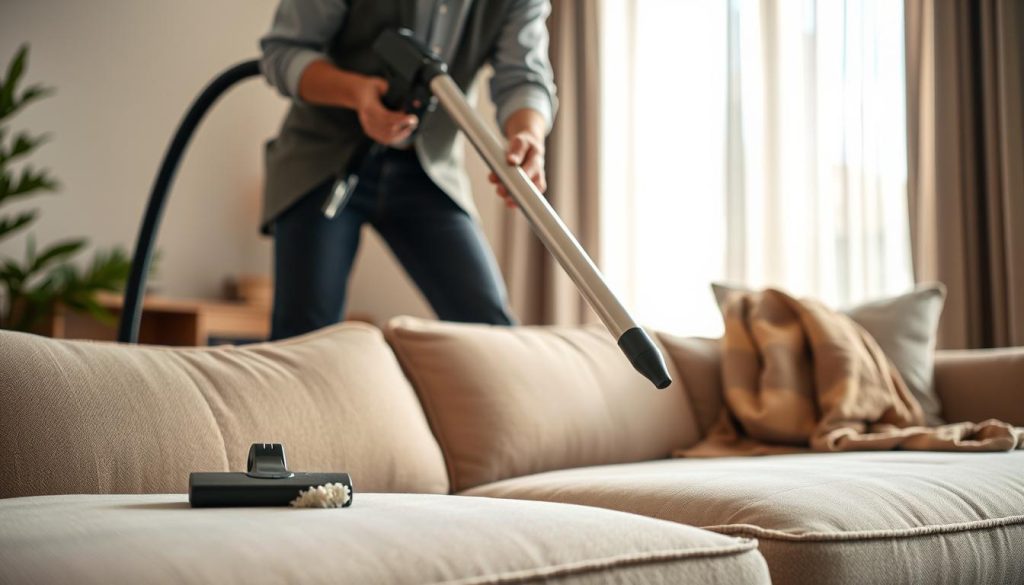
Vacuuming the entire surface, seams and parts
We begin by vacuuming the whole surface slowly and evenly. This lets us lift crumbs and pet hair without rubbing them into fibres.
Next we focus on seams, piping and joins. We treat each part in turn: backrest, arms, seat and cushions, including undersides, so results are even across the piece.
Loosening dried-on debris without damaging fibres
If spillages are solid, we remove excess with a vacuum rather than rubbing. For dried debris we use a very dry stiff brush to loosen particles, then vacuum again.
Use a light hand and short strokes. This prevents pushing dirt deeper and avoids fibre distortion.
Protecting nearby areas in the living room
We move side tables, lift cables and put towels under edges to catch any drips. This keeps the room tidy and prevents water marks on floors or fabrics nearby.
- Why prep is non-negotiable: it stops dry soil turning into mud when heat or moisture is applied.
- Practical tip: households with pets or children benefit most from extra vacuuming before we start; hair and grit build up fast.
Sofa steam cleaning: our step-by-step cleaning method
Our stepwise routine focuses on control: small passes, steady motion and immediate capture of dislodged soil.
Positioning the nozzle to lift dirt without soaking fabric
We hold the detail nozzle at an angle, never straight down. Short, controlled bursts loosen grime while minimising moisture penetration.
Tip: keep the head moving in steady strokes to avoid local saturation.
Working in sections for even results
We treat one cushion or panel at a time. Cleaning connected surfaces evenly prevents patchy tones and tide marks.
Using a cloth to capture loosened dirt
We place a microfibre cloth beside the nozzle to catch soil as it lifts. This reduces spread and speeds drying.
When to repeat passes and when to stop
Repeat a step only if you see soil transfer, streaking or lingering odour. Stop when the fabric feels warm, damp or the colour shifts.
Avoiding heat and moisture damage on sensitive upholstery
On delicate fabric we cut output, increase distance, or switch to vacuum-only. Always test an inconspicuous spot first.
“A clean sofa shows even tone, no sticky residue and a neutral, fresh smell after drying.”
How we remove stains before and after steaming
A quick, measured response is often the decisive factor between liftable marks and set-in damage. We begin by deciding whether a mark is water-soluble or not. That choice guides all later steps and stops a poor method from making a stain worse.
Fresh spills: blot with a clean, dry cloth
For fresh wet spills we soak up liquid immediately with a clean, dry cloth. Never rub; rubbing pushes fluids deeper and makes removal harder.
Press and lift repeatedly, moving to a dry area of the cloth as it absorbs the spill. Fast action makes the mark much easier remove.
Water-soluble marks: test with lukewarm water
About 90% of marks are soluble in water. We test by dabbing a white cloth with lukewarm water and checking for transfer.
If colour moves, we use slight rotating motions from top to bottom to lift the dye. This reduces abrasion and protects the nap.
Non-water-soluble marks: use a cleaner on cloth first
For oil or solvent stains, we spray a universal stain cleaner onto a colour-fast cloth and dab gently. We never spray directly onto fabric.
After treatment, we may rinse residue with a damp white cloth and let the area dry before any heat work. Treat big or deep marks before steaming to avoid setting them.
- Why speed matters: the sooner we act, the easier remove becomes.
- Blotting technique: press and lift; do not rub.
- Classification: water-soluble vs non-water-soluble decides the method used.
- Sequencing: treat heavy marks before thermal passes; light residues can be addressed after lifting.
| Situation | Immediate action | Why |
|---|---|---|
| Fresh liquid spill | Blot with clean, dry cloth | Prevents deeper penetration |
| Coloured dye or ink | Test with white cloth + lukewarm water; rotate gently | Checks solubility and avoids abrasion |
| Grease or oil | Apply cleaner to cloth; dab and lift | Avoids over-wetting and solvent damage |
Household solutions we use for common sofa stains
For many common marks, everyday pantry items give reliable results. We always check the fabric label and test an inconspicuous area first.
Baking soda for odours and spot treatment
Sprinkle bicarbonate of soda lightly over odours and leave overnight, then vacuum. For targeted marks, make a baking paste (1 tbsp powder + 1 tbsp water), apply, allow to dry fully and vacuum off.
Vinegar and water for general spot work
Mix equal parts white wine vinegar and water. Use a slightly damp white cloth and dab gently. Rinse the cloth often to avoid moving soil, then blot dry.
Red wine, mineral water, salt or cornflour
Pour mineral water carefully to dilute fresh red wine and dab. For absorption, cover with salt or cornflour, let sit until dry, then vacuum. For set marks, use lemon or vinegar for about 15 minutes, then dab with cold water.
Lemon juice and salt for dried blood
Make a lemon and salt paste, leave about 30 minutes, remove and dab with cold water. Avoid warm water—it can set protein stains.
Washing-up liquid for grease
Use warm water with a small amount of grease-fighting washing-up liquid. Work from the edge inward, then rinse with clean warm water to remove residue.
“Always test first and proceed in small steps—speed matters, but so does care.”
| Problem | Household fix | Timing |
|---|---|---|
| Odour or light soiling | Sprinkle bicarbonate of soda overnight | Overnight |
| Targeted mark | Baking paste (1:1 powder to water), dry then vacuum | Until dry (~minutes to hours) |
| Fresh red wine | Mineral water then dab; salt/cornflour to absorb | Immediate; absorb then vacuum |
| Dried blood | Lemon + salt paste, remove, dab with cold water | 30 minutes |
For more on treating upholstery marks see how to treat upholstery marks.
Deep cleaning alternatives when steam alone is not enough
When surface methods miss embedded grime, an extraction-based approach lets us pull soil from deep within fibres. We use spray extraction when spot work or thermal passes cannot remove old residues or detergent build-up.
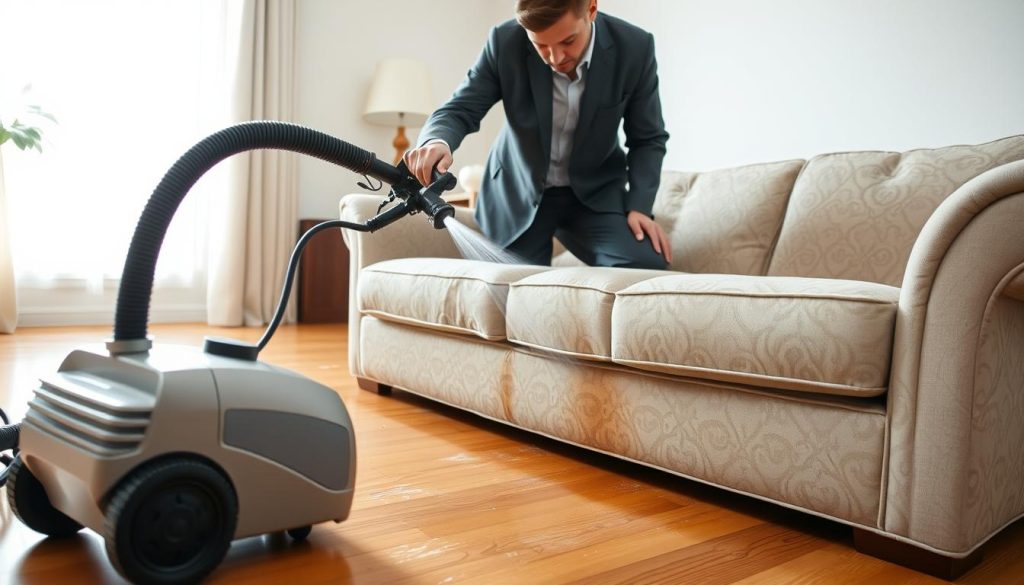
How spray extraction works
First we vacuum to remove loose dirt. Then we fill the machine tank with water and add a measured amount of detergent per the dosing instructions.
We hold the spray head about 10 cm from the fabric and spray evenly. A short dwell time helps loosen particles. After this, we make slow suction passes to lift moisture and suspended soil.
Reducing water marks and shortening drying time
To avoid tide marks we wet connected surfaces evenly rather than spot-wetting. This prevents colour variation and lines across panels.
We extract thoroughly and avoid over-application of liquid. Good extraction plus ventilation shortens drying time in humid Singapore conditions.
Rinsing to remove detergent residue
Rinsing once or twice with clear water removes leftover cleaner and softens fibres. A final ventilated dry and a vacuum when fully dry restore the nap.
Tip: applying a textile impregnator afterwards helps fabric resist re-soiling and extends intervals between deep work.
| Step | Action | Why it matters |
|---|---|---|
| Pre-vacuum | Remove loose dirt and hair | Improves extraction efficiency |
| Spray (10 cm) | Water + detergent; even coverage | Loosens deep residues without streaks |
| Slow suction | Multiple passes until clear | Reduces moisture and shortens drying |
| Rinse | Clear water pass(es) | Removes detergent residue and softness returns |
Spray extraction machines and dedicated cleaner solutions often remove detergent residue left after manual stain work. For more on alternative methods see our guide on how to clean a sofa without a steam.
Drying and aftercare we follow to keep sofas fresh
Good ventilation and a clear aftercare plan finish the job and protect your investment. After any wet work, we focus on airflow rather than heat to avoid over-stressing fibres.
Ventilating the room and allowing ample drying time
We open windows where possible and run fans or dehumidify modes on air-conditioning. This accelerates drying without raising temperatures that can distort fabric.
Expectation: lightweight upholstery may dry in a few hours; dense cushions can take 12–24 hours in humid Singapore conditions.
Vacuuming again once dry to lift the nap and remove residue
Once fully dry, we vacuum the surface to raise the pile and remove any dried residue. This restores a uniform finish on clean fabric and improves appearance.
Using textile protection to help the sofa stay clean for longer
We often finish with a textile impregnator. Applied on dry material, these products add repellency and simplify future upkeep.
Care reminders: keep pets off until dry, avoid sitting on damp cushions, and rotate cushions to promote even wear.
For detailed step-by-step equipment guidance and alternatives we recommend our short guide on using a carpet extractor for upholstery: clean your couch with a carpet.
How often we steam clean a sofa in Singapore
We set a practical frequency so maintenance fits busy Singapore homes. Regular light work keeps fabrics healthier and limits the need for major interventions.
Weekly or bi-weekly vacuuming for regular maintenance
Vacuum weekly or every two weeks as a baseline. This removes grit that abrades fibres and dulls colour.
Spot cleaning as soon as stains happen
Attend to spillages and marks immediately. Quick, local action reduces the chance of permanent discolouration and makes later work easier.
Annual deep cleaning to remove embedded dirt and allergens
We recommend a full deep clean at least once a year. That removes embedded soil and trapped allergens that routine upkeep misses.
When we clean more frequently for pets, children or allergies
Increase frequency if you have pets, young children, frequent guests or household allergy sufferers. In humid or dusty conditions, shorter intervals keep sofas fresher and healthier.
Practical tip: combine simple weekly care with planned deep work so fabric stays presentable and lasts longer. Treat this as an ongoing routine, not a one-off fix.
When we recommend professional sofa cleaning services
Some issues require a heavier approach than home methods can safely provide. We advise professional assistance when simple upkeep no longer restores appearance or hygiene.
Signs it’s time for industrial-grade extraction and sanitising
Recurring odours, widespread staining, allergy flare-ups or a sticky feel after attempts at home indicate deeper residue. In these cases we suggest specialist intervention.
What industrial-grade work usually involves
Industrial-grade extraction often uses a 2-in-1 wet-extraction machine that shampoos, sanitises and extracts embedded dirt. This is commonly followed by high-temperature steam to reduce dust mites and pathogens.
Material-specific considerations
For fabric, over-wetting can cause watermarks or shrinkage. We treat delicate weaves cautiously and document care labels first.
For leather, we remove dust with a cloth or careful vacuuming, use neutral soap in lukewarm water and avoid grease-removing detergents. Regular conditioning prevents drying and cracking.
PVC loses shine when residue builds up; tailored products and gentle rinsing preserve finish.
When uncertainty means call the professionals
If you are unsure about which products or way to treat a mark, stop and seek help. Using the wrong cleaner or method can cause permanent discolouration.
| Trigger | Professional action | Why it matters |
|---|---|---|
| Persistent odour or allergy symptoms | Industrial extraction + sanitise | Removes deep biological residues and allergens |
| Widespread staining or greasy feel | 2-in-1 shampoo + extraction | Outperforms household machines for embedded dirt |
| Unclear fabric code or sensitive material | Specialist assessment and tailored products | Prevents shrinkage, drying or dulling |
Conclusion
We finish by tying every step together so you can reproduce the routine with confidence.
Check instructions, prepare the area, work in small, controlled passes and treat marks correctly with a clean, dry cloth. For many stains test with lukewarm water and a white cloth before applying stronger methods.
Remember that steam is one tool within a wider method. Vacuum first, perform careful spot work, then allow ample drying and ventilate well in humid Singapore conditions.
For delicate fabric or leather take extra care or seek professional help. Consistent maintenance is the single habit that keeps sofas looking their best and prevents permanent wear.

