
We open by clearing up why Singapore shoppers often mean different things when they say water filter in a bagless context. Some machines trap grit in a bowl of liquid. Others rely on cyclone action and HEPA-like screens. Still others are wet‑dry mop combos with a separate dirty tank.
In this guide we tested a 2025 shortlist that includes Samsung Bespoke Jet AI Ultra, Airbot Supersonics Pro, Dyson V12s Submarine, Dreame H15 Pro Heat, Philips AquaTrio 9000, Xiaomi G20 and Shark Stratos Upright. We judged each by cleaning performance, sealed dust handling, ease of emptying and realistic battery life for compact Singapore homes.
Our method balances power and upkeep, not just raw suction. We also weigh maintenance effort and overall price-to-value.
Finally, we preview which pick suits hard floors, pet owners, allergy households, busy families and those with tight storage. Use this introduction to find a shortlisted option fast, then dive into specs and buying advice tailored to your habits and surfaces.
Why bagless water filtration is trending in Singapore homes right now
Rising concern about indoor air quality has made sealed and liquid-based collection more appealing. We see buyers prioritise HEPA-grade filtration and whole-machine sealing to keep fine dust and allergens from recirculating.
Smaller flats favour models with fewer consumables and simple day-to-day cleaning. Fewer spare parts means less storage and quicker upkeep. That ease of use is a major purchase driver for busy households.
Cleaner air priorities in compact spaces
In tight floorplans, dust can stay airborne longer if filters or seals fail. Homes with children, pets or heavy cooking gain most from systems that trap grime reliably.
Where wet-dry vacuum-mops fit into “water-based” cleaning
- Dirty water tanks lock debris so emptying releases less dust.
- They simplify hard floors and mop cycles, but add tank rinsing and drying time.
- We compare three main types: cordless sticks, uprights and wet-dry mop systems to show which option suits each routine.
What is the best bagless water filter vacuum cleaner for our needs?
We split shortlist advice into quick household profiles so you can pick a suitable model in under a minute.
For hard floors in HDB flats and condos
Soft rollers and wet capability win on tile, vinyl and laminate. Laser dust detection on some models helps you see fine grit that a naked eye misses.
Key feature: edge pickup and a lie‑flat head for skirting lines.
For pet hair and long hair management
Anti‑tangle brush bars and removable brush rolls make hair maintenance quick. Pick a design where the roll can be detached and rinsed without tools.
Tip: look for brush geometry tuned to lift fur from seams and under furniture.
For allergies, dust and fine particles
Whole‑machine sealed filtration and HEPA/E13 systems reduce exposure during emptying. Auto‑empty docks or low‑dust ports cut airborne dust at disposal time.
For speed‑cleaning and daily maintenance
We recommend lightweight cordless sticks with handheld modes for crumbs, sofas and cars. Balance suction power against run‑time and noise so quick laps remain practical.
- Quick match: hard floors → soft roller, laser detection
- Pet homes: anti‑tangle roll, brush detachability
- Allergy households: sealed HEPA, auto‑empty option
- Busy homes: light cordless, decent run‑time
How we compare and test: performance, usability and filtration
We ran a consistent set of hands‑on trials to judge cleaning across common Singapore surfaces. Our approach mirrors a Good Housekeeping style: repeatable pickup passes, standard debris mixes and timed runs so results remain comparable.
Pick-up tests across tile, vinyl, sealed wood and carpets
We measure large and fine debris with fixed passes over tile, vinyl and sealed wood. Carpets get multiple, consistent sweeps using grit and meal-sized bits to score real-world performance.
Edge cleaning and under‑furniture reach
Edge results reflect tight corridors and skirting lines common in Singapore flats. We note how well heads seal to baseboards and how low they slide under sofas.
Brush roll anti‑tangle, battery and maintenance
Anti‑tangle testing uses long hair simulation to time wrap rate and removal effort. Battery tests pair stated minutes with actual coverage for typical HDB and condo floors, including charging time and swaps.
Emptying and odour control: we score dustbin hygiene, washability and drying, plus odour control for wet-dry systems to reflect everyday upkeep.
| Test area | Metric | Why it matters |
|---|---|---|
| Pickup on hard floors | Large/fine debris capture (%) | Shows real mess removal after cooking or guests |
| Carpet passes | Sustained suction over 3 runs | Reflects performance on different pile depths |
| Edge & reach | Baseboard line score / under‑sofa clearance | Crucial for tight Singapore layouts |
| Hair handling | Wrap time & cleaning effort | Reduces maintenance for pet and long‑hair homes |
Key specs that actually matter when choosing a bagless cleaner
Practical specs beat marketing claims. We focus on the handful that predict daily satisfaction in compact Singapore homes.
Suction power explained: kPa, Pa, AW and watts
Manufacturers list numbers in kPa, Pa, AW or watts. Compare figures only within the same unit to avoid apples‑to‑oranges decisions.
For context: Samsung cites up to 400W, Airbot lists 25,000 Pa, Dreame shows 22,000 Pa and Xiaomi gives 25 kPa / 150AW. A headline suction figure means little without good airflow and a well‑designed floorhead.
Dustbin capacity and hygienic emptying
Bin size dictates how often you empty. Small cups like Xiaomi’s 600ml fill quickly in dusty flats; Airbot’s 0.8L holds more.
Hygienic emptying looks like one‑touch release, minimal plume and washable parts. Auto‑empty docks or sealed ports reduce airborne dust and fuss.
Weight, manoeuvrability and storage footprint
Consider carrying between floors, tight corners and small service yards. A lighter model turns quicker and stores easier, but check head sealing and run time so suction stays effective on carpets and hard floor alike.
We prioritise these few specs so you pay for real benefit, not shiny but useless features. For deeper technical context see our detailed guide.
Filtration and allergens: HEPA, E13 and sealed systems
We focus on how filtration performance translates to real indoor air improvement for families.
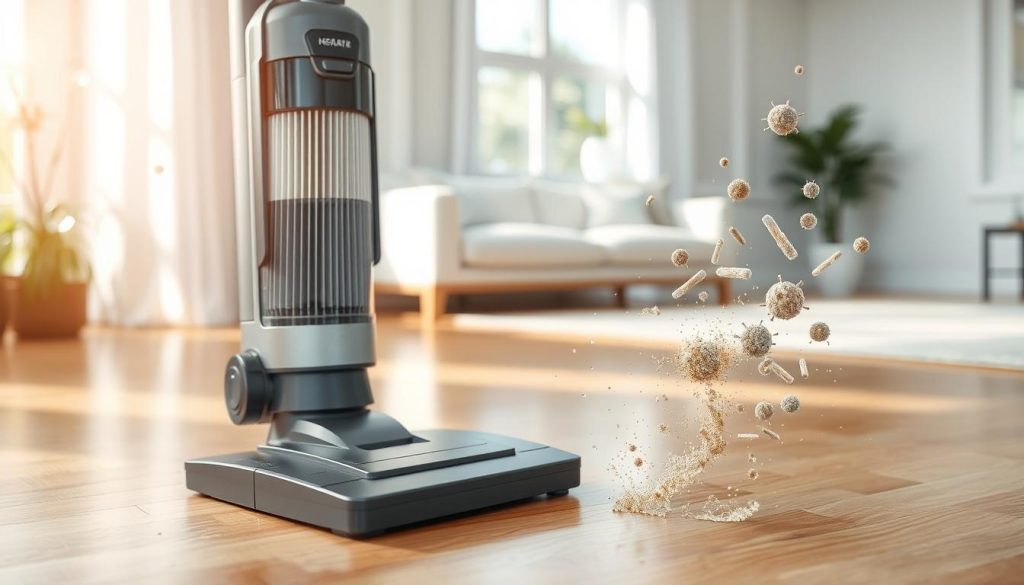
HEPA benchmarks seen in top Singapore models
Airbot uses an E13-grade HEPA element that captures about 99.97% of fine dust. Dyson claims whole‑machine capture near 99.99% for particles down to 0.3 microns.
Shark Stratos combines HEPA with a sealed body to limit escape during use and emptying. These figures matter most in flats with children or allergy sufferers.
Multi-stage cyclone versus sealed designs
Multi‑stage cyclone heads split larger grit away so suction holds up over time. That keeps performance higher on busy floors.
Sealed systems favour containment: great filters lose value if leaks let dust return to the room.
- Usability: wash and dry intervals affect odour risk; reinstall damp parts and smell can follow.
- Who benefits most: asthma sufferers, babies and elderly relatives should prioritise sealed HEPA or E13 solutions.
- Cost note: higher upfront spend can cut long‑term fuss and improve daily air quality.
| Design | Key advantage | Containment | Maintenance |
|---|---|---|---|
| Airbot (E13) | High particle capture | Very good | Filter washes; periodic replacement |
| Dyson (whole‑machine) | Near total particle capture | Excellent | Low frequent servicing; check seals |
| Multi‑stage cyclone | Stable suction for debris | Moderate without sealed HEPA | Empty bowls often; clean cyclones |
Cordless stick vacuum vs wet-dry vacuum-mop: which format we recommend
Choosing between a cordless stick and a wet-dry mop often comes down to daily habits rather than raw specs. We outline the practical trade-offs so you can match an option to Singapore living patterns.
When a cordless stick is the smarter buy
Cordless stick models win for fast, everyday cleaning. They are light, store easily in small flats and often convert to a compact handheld for sofas and cars.
Attachments boost versatility for shelves, curtains and tight corners. For crumbs and quick passes, a stick vacuum saves time and fuss.
When a wet-dry vacuum-mop replaces both vacuuming and mopping
Wet-dry systems vacuum and wash in one pass. That matters for frequent spills, greasy kitchen floors and busy households that want a single tool for floors.
Hidden costs: tank rinsing, roller drying and dock space raise upkeep and storage needs compared with stick vacuums.
“Pick the format that matches routine: light daily passes or consolidated wash-and-vac sessions.”
| Format | Best for | Maintenance | Space |
|---|---|---|---|
| Cordless stick | Daily crumbs, quick touch-ups, above-floor tasks | Empty dustbin, wash filters | Compact storage, small footprint |
| Wet-dry vacuum-mop | Spills, greasy tiles, full floor washes | Empty tanks, rinse rollers, dock drying | Larger dock; needs drying space |
Decision rule: if your home needs frequent mopping and spill control, choose wet-dry. If you want speed, lightness and handheld flexibility, pick a cordless stick.
Best premium pick: Samsung Bespoke Jet AI Ultra
For those willing to pay for convenience, this premium model layers automated emptying and smart surface sensing into a single package.
Performance at a glance: the motor delivers up to 400W of suction, and AI Cleaning Mode 2.0 shifts power and head behaviour between hard floors, carpets and corners so we do not fiddle with settings mid‑clean.
Sealed emptying that reduces dust exposure
The All‑in‑One Clean Station uses sealed dust bags to trap debris at disposal. For allergy‑sensitive households this feels cleaner than tipping an open cup.
Battery system and realistic run times
Dual swappable batteries give up to 160 minutes total in low mode. Expect much less time on Boost or intensive modes; heavy carpets and high suction drop usable minutes.
- Why buy: maximum convenience, near‑total containment (99.99% multi‑layer filtration) and adaptive mode make it suited to mixed Singapore homes.
- Trade-offs: higher price and a dock footprint to plan for in compact flats.
- Practical notes: some users report the floorhead feels stiff on dense carpets and occasional hair wraps on the brush roll.
Our view: this model rewards buyers who prioritise low‑dust emptying and long run cycles. If footprint and price fit your plan, it is a strong premium choice for regular, fuss‑free upkeep.
Best value pick: Airbot Supersonics Pro Cordless Vacuum Cleaner
We chose a value pick that pairs strong suction with practical visibility for hidden grime in small flats. The Airbot Supersonics Pro offers up to 25,000 Pa and a centred LED and laser floor brush that reveals fine dust on hard floors and along edges.
High suction and smart floor visibility
The laser helps us spot dust under beds and in narrow corridors. The LED brush lights work with laser cues so you do not miss pale grit on dark tile.
Filtration that suits budget households
The multi‑stage cyclone and E13‑grade HEPA capture ~99.97% of particles. Filters are washable and reusable, which keeps running costs down if we stick to regular maintenance.
Eco versus Boost: practical battery trade-offs
Runtime runs to about 45 minutes in Eco and roughly 10–15 minutes in Boost. We recommend Eco for everyday passes and Boost for spot jobs or dense pet hair clumps.
Full charging takes ~4 hours, so swap routines to match cleaning time and battery cycles.
| Spec | Value | Why it matters |
|---|---|---|
| Suction | 25,000 Pa | Strong pull for quick pick‑ups on tile and low pile rugs |
| Dust cup | 0.8L washable | Holds more for typical HDB rounds; emptying a few times weekly |
| Weight | 1.2 kg (handheld) | Easy to carry between floors and store in tight spaces |
| Battery | 45 min Eco / 10–15 min Boost | Balance run time against boost power for spot cleaning |
Who should buy: small‑to‑mid flats that need a capable cordless option without premium dock costs. For its price, this unit gives strong suction, visible dust detection and low upkeep through reusable filters.
Best for hard floors with wet capability: Dyson V12s Detect Slim Submarine
When light‑coloured tiles and vinyl hide fine grit, visibility can change cleaning outcomes. We find this model useful where clear results on hard floors matter most.
Laser dust detection for fine dust on hard floors
The laser in the floor head highlights tiny dust that our eyes miss on pale surfaces. That makes each pass more effective and cuts repeat cleaning.
Anti-tangle brush bar benefits for hair
An anti‑tangle brush reduces wrap from long hair and pet fur. It lowers maintenance time, though some manual cleaning of the brush roll remains necessary after heavy use.
Whole-machine filtration and practical expectations
Whole‑machine filtration captures particles down to 0.3 microns at near 99.99%, which helps contain fine dust in compact flats.
Run time reaches up to 60 minutes on low power, so a single charge covers routine passes. Expect shorter battery life on high suction modes and when using wet-floor support.
| Spec | Detail | Why it matters |
|---|---|---|
| Run time | Up to 60 minutes | Daily maintenance without frequent charging |
| Filtration | 99.99% to 0.3 microns | Better containment of fine dust and particles |
| Wet-floor use | Supported | Combines dry pickup and occasional wash in one tool |
Who should choose this unit: households that value engineering, laser visibility and neat results on floors, and who accept a higher price for those gains.
Best hot-water hygiene option: Dreame H15 Pro Heat Wet and Dry Vacuum Cleaner
For homes focused on hygiene, a hot‑water approach changes how grime and odours are handled. We position this unit as a hygiene‑led pick for greasy kitchens, sticky spills and faster drying after cleaning.
ThermoRinse hot-water cleaning and fast-drying results
ThermoRinse heats the roller to about 85°C to loosen oils and break down dirt. That hot rinse cuts lingering smells more reliably than cold rinses and reduces manual scrubbing.
GapFree edge coverage and 180° lie-flat reach
The GapFree AI arm offers 0mm front gap edge coverage, so crumbs that hide along cabinets get picked up. The head lies flat to 180°, letting us reach under sofas; measure ~14cm clearance before buying.
Self-cleaning and drying base for odour control
The dock runs a hot‑water self‑clean and drying cycle up to 100°C to reduce mildew risk. Runtime reaches up to 70 minutes, and while weight sits near 6kg, the self‑propelled design eases daily handling.
- Performance: up to 22,000 Pa suction for strong debris pickup.
- Maintenance: hot drying limits odour; dock size and ~74 dB noise are trade‑offs.
- Practical note: use a softer mode on delicate timber floors.
“Our testing found heated rinsing and quick drying make a real difference in kitchens and high‑traffic areas.”
Best all-in-one vacuum and wash system: Philips AquaTrio PerfectCare 9000 Series
For households that want one device to handle spills, dust and above-floor jobs, this Philips unit covers three distinct modes and saves cupboard space.
Three-in-one modes: vacuum, vacuum & wash, handheld
We like that you can switch from dry pickup to a combined vacuum-and-wash pass without swapping heads. The handheld mode fits sofas and curtains and works with simple attachments for quick spot work.
AquaSpin high-speed brushes for mixed messes
The AquaSpin brushes spin at ~4000 RPM. That action lifts up dust and loosens small spills so the same pass tackles dry debris and liquid marks.
Claimed removal: up to 99.9% of dust, dirt, stains and liquids in one go. LED nozzle lights help reveal pale grit on dark tiles.
Auto-clean dock and practical maintenance
The Auto-Clean dock runs a repeatable rinse and dry cycle. That shifts fiddly scrubbing into a set-and-forget routine and cuts upkeep time week to week.
At ~4.2kg it sits heavier than a stick, but swivel steering keeps it easy to push. One battery gives ~45 minutes; add a second for up to 90 minutes and coverage near 185 m².
“Occasional hair snags may trigger error codes, but reported cases are typically resolved under warranty.”
| Feature | Spec | Practical effect |
|---|---|---|
| Modes | Vacuum / Vacuum+Wash / Handheld | All-in-one floor and above-floor routines |
| AquaSpin brushes | ~4000 RPM | Removes dust, dirt, stains and small spills in one pass |
| Battery | 45 min (one) / 90 min (two) | Covers typical Singapore flats without frequent recharge |
| Weight | ~4.2 kg | More stable, manoeuvrable via swivel; not ultra-light |
Best compact, everyday cordless stick for smaller budgets: Xiaomi Vacuum Cleaner G20
Daily tidying in tight apartments favours a model that balances suction, battery life and attachments.
We view the Xiaomi G20 as a practical, affordable cordless stick for routine dust and crumbs. It delivers 25 kPa (up to 150AW) of suction power, which translates to reliable pickup on hard floors and light rugs.
25 kPa suction and attachment versatility
The unit ships with multiple attachments for sofa seams, skirting and shelves. These tools make short work of above-floor spots and narrow gaps in a compact home.
Dustbin size considerations for regular cleaning
Its 600 ml dustbin holds enough for day-to-day passes in small flats, though dusty corridors or pet-heavy homes will need more frequent emptying.
- Battery: up to 60 minutes standard runtime; plan your cleaning route to avoid mid-task charging.
- Weight: light and easy to carry between floors.
- Price: keenly positioned for first-time buyers, offering value without a dock.
| Spec | Detail | Practical effect |
|---|---|---|
| Suction | 25 kPa / 150AW | Good on tile and low pile rugs |
| Dustbin | 600 ml | Daily passes without constant emptying |
| Battery | Up to 60 min | Covers most small Singapore homes on a single charge |
Who should buy: first-time owners, small flats and anyone after a simple, lightweight model at a keen price.
Best for sealed, allergy-friendly cleaning in a bagless upright: Shark Stratos Upright Vacuum
Upright machines still earn a place in Singapore flats where carpets, high traffic and allergen control matter most. The Shark Stratos Upright pairs a sealed HEPA system with robust brush heads to keep dust and particles locked in during use and disposal.
HEPA filter and sealed system for dust containment
Sealed HEPA filtration captures very fine particles and helps reduce airborne allergens when we clean. That containment matters for homes with children, sensitive occupants or persistent dust problems.
Dual-brush roll edge cleaning and hair pick-up
The dual brush roll design targets edges and corners, letting us sweep along skirtings and around table legs without repeated passes. A self-cleaning roll reduces tangles from pet hair and long strands.
Who should consider it: carpeted flats, allergy households and pet owners who value strong, steady performance over ultra-light portability.
| Feature | Effect | Notes |
|---|---|---|
| Sealed HEPA filtration | Better containment of dust and allergens | Great for allergy-sensitive homes |
| Dual brush roll | Improved edge and deep-pile pickup | Self-cleaning reduces hair wrap |
| Performance on floors | Strong across wood, tile, vinyl and carpets | Consistent suction, stable cleaning |
| Weight | ~17.2 lbs (bulky) | Store in a nook; needs space to manoeuvre |
There are trade-offs. Its weight and footprint make it less suited to very tight corridors, yet we find it worthwhile where containment and sustained performance trump nimbleness.
Shark Stratos upright details help determine fit for your floor plan and storage.
Best handheld options for car interiors and quick clean-ups
For quick touch-ups and tight spots, a small handheld unit often does more work than you expect. We favour models that balance weight, run time and ease of emptying so short sessions remain fast and low‑fuss.
Eufy Clean HomeVac H20 for in-car detailing convenience
Why we like it: the Eufy H20 packs 40AW of suction into a ~0.65kg body. That low weight keeps wrist strain down during car detailing and spot jobs.
Runtime reaches up to 30 minutes and it ships with car-focused attachments plus an in-car charging lead. For interior seats, mats and tight trunks, its form and fittings suit quick, precise cleaning.
Shark WandVac System for above-floor mess and tight spaces
Why we choose it: the WandVac WS632 converts from handheld to wand and above-floor tool. It weighs roughly 1.4kg and offers one‑touch emptying for minimal dust blowback.
We use it for shelves, curtains and sofa crevices where reach and fast clearing matter most. The design favours short, repeated passes rather than long sessions.
Black+Decker Dustbuster for lightweight, everyday debris
Why it fits budgets: the 16V MAX Dustbuster has a 600ml bin, built-in crevice tool and flip-up brush. Its washable bowl and filter keep running price low.
This unit handles daily debris and small spills. With a larger bin, we empty less often and save time on routine tidying.
Handhelds are not a replacement for deep carpet work, but they slash daily cleaning time and keep cars and above-floor areas presentable between full cleans.
| Model | Suction / Weight | Runtime / Battery | Key advantage |
|---|---|---|---|
| Eufy HomeVac H20 | 40AW / ~0.65kg | Up to 30 min / rechargeable | Car attachments; in-car charging |
| Shark WandVac WS632 | Compact / ~1.4kg | Short bursts / cordless battery | 3-in-1 use; one-touch empty |
| Black+Decker 16V MAX Dustbuster | Budget light / ~0.9kg | Moderate / removable battery | 600ml bin; built-in crevice and brush |
What we recommend based on surfaces, pets, and cleaning habits in Singapore
Our recommendations map common Singapore routines to models that suit each cleaning pattern. We anchor advice to real strengths: Samsung’s auto‑empty dock, Philips’ auto‑clean wash station, Dreame’s hot‑water hygiene, Shark’s sealed HEPA, Dyson and Airbot laser visibility, and Xiaomi’s everyday value.
Tile and vinyl-heavy homes
Prioritise wet‑dry rollers, strong edge reach and quick tank emptying so floors dry fast and stay streak-free.
Good fit: Philips AquaTrio or Dreame H15 for combined wash and rinse cycles, plus GapFree edge coverage.
Homes with carpets
Focus on sustained suction and a well‑engineered floorhead. Peak numbers matter less than consistent airflow over pile.
Good fit: Shark Stratos or Samsung Bespoke Jet for steady power and sealed containment.
Pet households
Look for anti‑tangle brush roll design and strong filtration to cut allergens and simplify hair removal.
Good fit: units with self‑cleaning rolls and HEPA/E13 stages such as Airbot or Shark.
Busy households and time savings
Self‑emptying docks and auto‑clean stations remove friction from routine upkeep and keep us cleaning more often.
Good fit: Samsung and Philips docks repay price premiums by saving time and reducing airborne dust during disposal.
| Home type | Recommended model | Key benefit |
|---|---|---|
| Tile / vinyl | Philips AquaTrio / Dreame H15 | Vacuum + wash, edge reach |
| Carpets | Shark Stratos / Samsung Bespoke Jet | Sustained suction, sealed filtration |
| Pets / allergens | Airbot Supersonics Pro / Shark | Anti‑tangle roll, HEPA containment |
| Busy households | Samsung Bespoke Jet / Philips Auto‑Clean | Auto empty, docked cleaning |
Budget guidance: spend more for docks if time and low‑dust emptying matter. For tight budgets, a Xiaomi or Airbot cordless stick plus handheld covers daily passes at lower price and upkeep.
Conclusion
Our final takeaway: practical containment and usable run time beat headline suction numbers. We back this from tests that show sealed HEPA containment (Shark), whole‑machine filtration and laser visibility (Dyson), value E13 HEPA plus laser (Airbot), premium AI with auto‑empty sealed bags (Samsung), vacuum‑and‑wash with auto‑clean (Philips) and hot‑water hygiene (Dreame).
Choose by floors and upkeep tolerance. If you prize low dust exposure, favour sealed filtration. If you want quick passes, prioritise sensible suction and steady battery life over top specs.
Match a model to your home layout, storage and furniture clearance before you buy. Shortlist two options, compare local price promotions and pick the one we will actually use regularly to save time and upkeep.
Final step: test fit in your store or check dimensions online, then decide with confidence.

