

We introduce a clear, practical guide for buyers in Singapore who need robust machines for mixed spill and dust tasks. Our aim is to focus on performance, safety and total cost rather than headline power alone.
We explain how a single, well-built unit can simplify procurement and training across sites. This helps facilities, workshops, construction teams and hospitality operations keep pace with hygiene and speed expectations.
We outline key categories and the technical points that matter: suction versus airflow, filter design, overfill protection and service strategy. This gives a fast way to shortlist by work patterns and long-term operating cost.
Why industrial sites in Singapore choose wet & dry vacuums over standard vacuum cleaners
On busy Singapore sites, one robust unit that handles spills, moisture and fine debris saves time and reduces equipment clutter. We favour solutions that let teams clear mixed messes without swapping tools or pausing work. This keeps operations moving and lowers routine overhead.
One machine for liquid spills, damp dirt and dry dust
These wet dry machines pick up liquids, damp grime and fine dust in a single pass. That removes the need for separate mops or dry vacuum cleaners during many day-to-day tasks.
Workplace hygiene, safety and productivity in fast-paced operations
Hygiene matters in high-traffic zones such as loading bays, kitchens and plant rooms. Rapid water pickup reduces slip risks and helps us meet site safety targets.
Built for daily use: robust housings, castors and power cables
We choose units with tougher housings, stronger castors and reinforced cables because workshops deliver heavy wear. These features extend service life and cut replacement costs.
- Handles mixed fines, chips and damp residues without changeovers.
- Speeds cleaning to reduce downtime and maintain compliance.
- One machine covers most day-to-day needs, while specialised units remain for high-volume water or hazardous dust.
What a wet dry vacuum is and where it fits in industrial cleaning
Here we describe a robust tool that collects liquids, slurry and dry debris without motor damage. In practice, this unit combines sealed suction, a strong tank and protective float or bypass systems to allow safe collection of mixed waste.
Where we use it
- Workshops and fabrication bays for metal filings and coolant spills.
- Construction floors for mortar, water and fine dust during works.
- Automotive service areas for oil, interior dust and rinse water.
- Facilities plant rooms for condensate, granular waste and routine housekeeping.
When a dry vacuum is not enough: any spot with moisture, slurry, frequent changeovers or large liquid volumes requires a combined unit. Domestic models fail here because they lack hose diameter, tank capacity, continuous duty design and mobility for heavy workloads.
“A single robust unit reduces downtime and stops cross-contamination between zones.”
| Site | Common waste | Why a combined unit suits |
|---|---|---|
| Construction | Cement dust, mortar, water | Handles slurry and fine dust without motor faults |
| Workshop | Metal chips, coolant, oil | Large tank and tool extraction options |
| Automotive | Water, interior dust, grease | Fast spill response and floor drying |
We position these units as productivity tools. They cut time spent drying floors after mopping and limit dust spread between areas. This links directly to specifications buyers must check next: liquid handling, fine dust control and changeover ease.
Choosing the right wet and dry industrial vacuum cleaner for your applications
We start by mapping common site demands to the three machine classes used in trades and construction.
Liquids and large water volumes: flood pickup and spill response
Standard class machines suit high-volume water, leaks and washdown residue. Fast recovery depends on stable suction, safe tank filling and robust mobility on site.
Fine dust and material residues: sanding, cutting and grinding
NT Tact models are built for continuous fine dust work. Sustained suction power matters more than short peaks when filters load during sanding or cutting.
Mixed debris on floors and surfaces: changeovers
Ap class units handle mixed water, moist dirt and medium-fine dust. Look for washable filters, quick-change floor nozzles and easy-empty tanks to cut shift downtime.
On-tool extraction: chip and dust suction at the source
Vacuuming at the tool reduces airborne dust and cleanup time. Check hose diameter, durable connectors and auto-start power sockets for tool integration in Singapore trades.
| Workload | Best class | Key features |
|---|---|---|
| High-volume water | Standard | Large tank, stable airflow, robust mobility |
| Continuous fine dust | NT Tact | Auto filter cleaning, high sustained suction power |
| Mixed floor debris | Ap class | Washable filters, quick-change nozzle, easy-empty |
“Choose by risk and operating cost: the right unit lowers downtime and labour while improving hygiene.”
Understanding wet pickup performance and overfill protection
To assess spill response, we break down how suction and tank systems work together. This helps buyers judge real-world performance beyond headline motor figures.
How liquid transport works inside the unit
A bypass blower creates a steady vacuum that pulls water through the hose into the container. The airflow, not just motor size, keeps the fan safe and maintains effective pickup.
Float devices and automatic cut-off systems
Many machines use a mechanical float that rises with the liquid and blocks the suction channel when a limit is reached.
Other designs use conductive contacts that trigger an electronic shut-off to stop the vacuum motor before the tank floods.
- Look for predictable shut-off behaviour and simple restart steps after emptying.
- Check for easy tank drainage and clear operator signals on full level.
- Train staff in proper wet pickup procedures to reduce downtime and protect equipment.
“Reliable overfill protection stops costly motor damage and keeps spill response fast.”
Understanding dry pickup performance: dust separation, filters and suction power
Dry pickup depends less on motor size and more on how debris is separated before it reaches the filter. For dry dirt, a bypass blower creates the vacuum that drives airflow through the hose and into the tank.
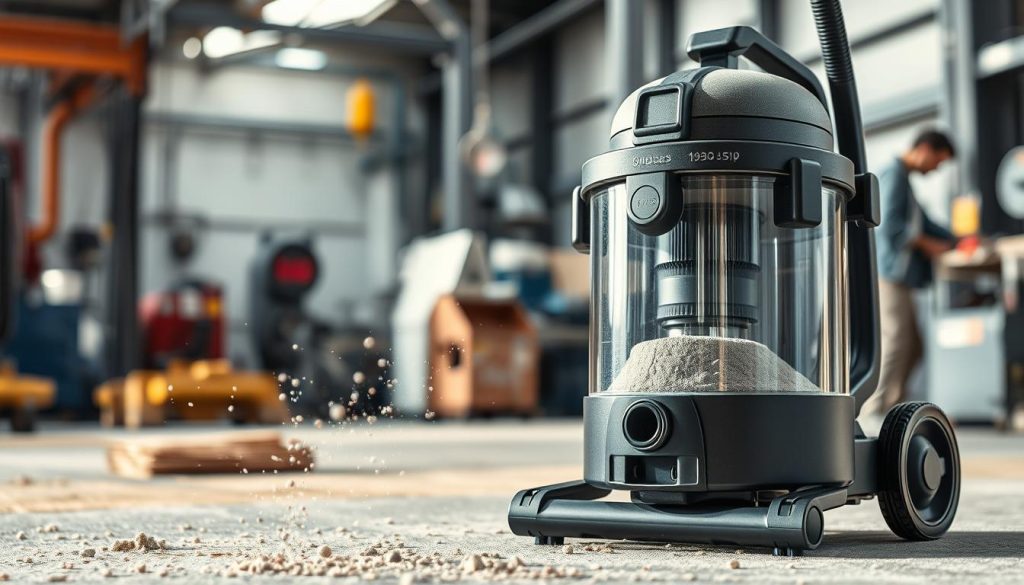
Cyclone-style separation for coarse debris
We look for hose ports shaped to induce rotation so heavier grit and chips spin out and fall to the container base. This cyclone action protects the filter and keeps usable capacity higher during shifts.
How clogged filters reduce suction power
Fine dust behaves differently from chips. It loads media fast and cuts suction power even when the motor still runs strong.
We therefore judge sustained performance, not only peak pickup. Semi or fully automatic cleaning helps maintain suction over time.
Flat pleated versus cartridge filter choices
Flat pleated filters give large surface area and easy access for quick maintenance. Cartridge designs often offer deeper media and better sealing for very fine dust.
Match the filter type to tasks: sanding and concrete work need higher-grade media and more frequent cleaning than general housekeeping.
“Choose units by sustained suction, separation efficiency and filter serviceability.”
Filter cleaning systems that keep suction consistent
Built-in cleaning cycles prevent clogging so teams keep working without frequent stops. Integrated systems maintain the working surface of the filter while the machine runs. This reduces contact with dust and lowers maintenance time.
Why integrated cleaning saves time and reduces downtime
We avoid tasks that require removing the element mid-shift. Regular automatic blasts or short manual cycles keep airflow steady and limit exposure to airborne dust.
Semi-automatic cleaning (Ap class approach)
The Ap method is operator-triggered. Press the button three times quickly with the hose port closed. This clears the media on demand and balances noise, performance and workflow.
Fully automatic Tact approach
Tact uses powerful air blasts to regenerate the cartridge during work. For L-class the interval can be set (60s to 15s). For M/H the unit uses differential pressure to pick 7/15/60s or pause when not needed. The result is high suction power throughout long runs.
Cost and efficiency gains without filter bags
Bagless workflows cut consumable spend and let teams use full tank volume. That saves time emptying and improves onsite efficiency for dust-heavy tasks.
“Consistent filter regeneration reduces downtime, improves safety and keeps performance reliable.”
| Feature | Ap (semi-auto) | Tact (fully auto) |
|---|---|---|
| Trigger method | User button triple-press | Timed blasts / sensor-driven |
| Best for | Mixed site work with planned breaks | Continuous fine-dust extraction |
| Maintenance benefit | Less manual cleaning, predictable cycles | Minimal interruptions, steady suction power |
| Cost advantage | Lower noise, controlled use of energy | Higher uptime, fewer consumables |
To choose between models, ask: do we need controlled cleaning breaks or truly continuous suction for tool extraction and cleanup? That answer guides which cleaners and configuration suit our sites in Singapore.
Industrial vacuum ranges and where each one performs best
Our approach is to match each model to the site rhythm: continuous tool dust, mixed shifts or spill response.
High-demand fine dust work: NT Tact models for uninterrupted use
NT Tact models use a patented Tact system to deliver steady suction and near-continuous operation for large fine-dust loads.
This range suits sanding, grinding and long on-tool extraction where sustained power matters most.
All-round cleaning: Ap class for liquids, moist dirt and medium-fine dust
Ap class models are the practical all-rounders. They cope with mixed tasks and offer semi-automatic filter cleaning.
That controlled regeneration keeps performance reliable when teams switch between spill pickup and dust work.
High volume liquids and coarse dirt: robust standard class machines
Standard class machines focus on coarse debris and large liquid volumes. They are built for heavy daily use by contract teams.
These models favour simple drains, tough housings and easy handling to speed site recovery after major spills.
- We list the three main range types so buyers shortlist fast by what dominates their day.
- Match models to shift length, manpower and whether tasks are episodic or continuous.
- Certain ranges are also available in safety configurations for hazardous dust classes.
“Choose the range that fits your work pattern to keep suction stable and downtime low.”
For a full buying checklist and deeper technical detail, see our complete guide.
Safety vacuum cleaners for hazardous dust and compliance-driven sites
When hazardous particles are present, machine selection must start from exposure control and traceable certification.
We advise treating safety as the baseline requirement for any work with respirable fine dust or known carcinogens. Choosing the right equipment keeps operators safe and reduces project risk.
When operators face respirable fine dust or health-endangering materials
Any site where airborne fibres or powders can reach breathing zones needs a certified solution. In those cases a standard unit is not optional.
We insist on sealed handling, designated disposal routes and PPE to limit exposure during emptying and service.
Asbestos and carcinogenic dust handling: what dust class H means in practice
Dust class H denotes the highest filtration level for highly hazardous particulates such as asbestos, lead and toxic mould.
Class H filters trap carcinogenic particles and keep them contained during collection and disposal. Use certified flat-pleated elements and dedicated disposal bags where regulation requires.
Explosion-risk environments: ATEX Zone 22 considerations
Where combustible dust may appear occasionally, choose ATEX Zone 22 rated machines. Explosion-proof designs remove ignition sources and include earthing and specialist seals.
- When mandatory: sites with respirable hazards or legal exposure limits.
- Buying checks: certification, correct filter set, sealed disposal and safe service procedures.
- Operational outcome: fewer incidents, better compliance and reduced stop-work risk in Singapore projects.
| Hazard | Required feature | Commercial benefit |
|---|---|---|
| Carcinogenic dust | Class H filter, sealed bags | Reduced liability, safer handling |
| Combustible dust | ATEX Zone 22 rated unit | Lower ignition risk, uninterrupted work |
| Respirable fine dust | Certified filtration, controlled service | Protects health, avoids enforcement action |
“Select by hazard assessment, not headline power. The right safety features save time, cost and lives.”
Dust classes L, M and H: selecting the right protection level for construction dust
We translate dust classification into clear procurement choices for site supervisors and safety officers. This helps pick machines that match the real materials and risks encountered on construction sites in Singapore.
Class L: baseline for moderate-risk materials
Class L covers moderate-risk dust such as chalk, plaster and softwood. Permeation is ≤ 1.0% (MAC > 1 mg/m³), which means the filter and containment limit leakage to a low level.
Class M: the common construction requirement
Class M is suitable for many site materials: concrete, brick, ceramics, hardwood and painted panels. Permeation is < 0.1% (MAC ≥ 0.1 mg/m³). In practice, M is the minimum legally required class for use on construction projects.
Class H: for highly hazardous particulates
Class H protects against carcinogenic and pathogen-containing dust such as asbestos, lead and harmful mould. Permeation is < 0.005% (MAC < 0.1 mg/m³), so filtration and sealed handling are essential.
Why this matters: fine dust can reach deep into the lungs and cause long-term harm. Choosing the correct class reduces exposure, improves worker health and supports client confidence.
- Match procurement to the highest-risk material you expect, not the average debris.
- Use Class M at minimum for routine construction tasks; specify H where hazardous materials may appear.
- Correct classification lowers regulatory risk and strengthens site safety practices.
“Selecting the right dust class protects people, reduces liability and keeps projects on schedule.”
| Class | Permeation | Typical materials |
|---|---|---|
| L | ≤ 1.0% | Chalk, plaster, softwood |
| M | < 0.1% | Concrete, brick, ceramics, hardwood |
| H | < 0.005% | Asbestos, lead, mould, toxic metals |
Filter types and media: choosing the best option for dust, water and durability
Choosing the right media for a filter has a direct effect on uptime and site hygiene. Our choice affects performance, maintenance time and whether teams can switch between wet dry tasks without delay.
PTFE-coated cartridge options
PTFE-coated cartridges (M+L certified) deliver about 99.9% separation. They resist moisture and rot and reduce clogging under heavy dust loads.
We pick these where sustained suction matters and when service intervals must be long.
Cleanable H-class and HEPA-level separation
Cleanable H-class PTFE media gives HEPA-level performance (99.995%) and is certified for class H dust. That allows large fine-dust runs without a bag, provided the correct safety filter set and disposal bags are used.
This arrangement improves containment and extends service life on hazardous tasks.
PES and paper options for practical trade-offs
PES filters (M+L certified) tolerate moisture and frequent switching between wet dry work. They save time by avoiding lengthy drying cycles.
Paper filters are a budget choice for dry-only work. They offer good initial efficiency but must be dried after any water exposure to remain safe.
Colour-coded cues to prevent errors
We recommend clear colour coding on filter housings: brown for wood/fibre, red for HEPA, black for the toughest use, blue for general purpose, green for cost-effective dry work.
Colour cues stop incorrect swaps and reduce cross-contamination when multiple teams share equipment.
| Media | Separation | Best for | Key note |
|---|---|---|---|
| PTFE-coated cartridge | ≈99.9% | High dust loads, moist conditions | Low clogging, longer intervals |
| Cleanable H-class PTFE | ≈99.995% (HEPA) | Hazardous fine dust (Class H) | Requires safety set and disposal bags |
| PES | High, M+L certified | Frequent task switching | Moisture resistant, quick turnover |
| Paper | Good for coarse dry dust | Budget, dry-only sites | Must dry after any water exposure |
“Select filters as part of the whole system: match dust class, expected moisture and the machine’s cleaning method to protect performance.”
For practical guidance on handling mixed tasks and cleaning routines, see our guide on how to clean an air purifier.
Key buying criteria beyond suction: power, capacity and tool compatibility
Real-world performance depends on airflow, usable capacity and the tools you attach to the machine. We separate marketing metrics from buyer needs so decisions match site routines in Singapore.
Suction power vs airflow: matching performance to debris type
Peak power numbers matter less than how airflow moves material through the hose. High suction power helps lift heavy debris; steady airflow clears fine dust without frequent clogging.
Container volume and net usable capacity without filter bags
Bagless setups let us use most of the tank. That raises net usable capacity and reduces emptying frequency on long shifts.
Nozzles and floor tools for different surfaces and materials
Choose the right nozzle width and insert for smooth concrete, textured tiles or workshop floors. The correct floor tool speeds cleaning and stops residues.
Power tool integration and auto start sockets for dust capture
On-tool extraction works best with auto start sockets. These keep the vacuum active only when a power tool runs, improving safety and operator visibility.
- Match hose diameter to tool ports.
- Confirm nozzle fits common surfaces and materials on site.
- Check tank volume for your longest shift without bags.
- Verify auto-start compatibility with existing power tools.
| Checklist | Why it matters |
|---|---|
| Airflow vs suction power | Right pick for debris type |
| Net usable capacity | Fewer interruptions |
| Nozzle and floor tool set | Faster, cleaner results on varied surfaces |
| Auto start socket | Cleaner work zones at tool source |
“Choose tools and tank size that match the day’s work, not only the headline motor rating.”
Mobility, ergonomics and rugged design for daily industrial cleaning
Mobility and ergonomic design decide how quickly teams move between tasks on large sites.
We prioritise durable features that keep machines moving and operators safe. Large metal castors, robust bumpers and secure handholds protect both the unit and site fixtures during heavy use.
Metal castors, bumpers and handholds for harsh environments
Metal castors handle rough floors and thresholds with less wear than plastics. Bumpers absorb knocks and stop damage to walls and equipment.
Handholds placed for safe lifting cut strain and make service tasks faster.
Hose, cable and accessory storage to reduce breakage and loss
Built-in reels and side pockets keep hose and power cable tidy and lower trip hazards. Stable tool sleeves mean crevice nozzles and accessories stay with the machine.
We prefer dirt-resistant bayonet fastening for quick, secure hose changes that reduce downtime.
Quick-change floor nozzle inserts for faster changeovers
Wide floor nozzles with snap-in inserts let teams swap between wet dry tasks and dry dust pickup in seconds. This speeds cleaning across mixed surfaces.
Ergonomic bends with soft handle areas improve control when moving across ramps or uneven tiles.
“Good design reduces damaged parts, replacement costs and lost time on site.”
| Feature | Benefit | What to test on site |
|---|---|---|
| Metal castors | Longevity on rough ground | Roll across thresholds and wet tiles |
| Bumpers & handholds | Protects machine and walls; safer lifting | Lift and turn on stairs or lifts |
| Hose/cable storage | Reduces trips and losses | Check reel ease and accessibility |
| Quick-change nozzle inserts | Faster changeovers, less downtime | Swap inserts and time the change |
Site trial checklist: manoeuvrability across 20 m; ease of hose bayonet release; time to swap nozzle inserts; storage security when unattended. These simple tests predict total cost and uptime for long-term use.
Maintenance planning: keeping performance high and extending machine life
Regular upkeep prevents small faults becoming costly stoppages. We set out a simple maintenance plan that saves time and keeps suction consistent across long shifts.
Filter care schedules: drying after wet work and safe cleaning practices
Dust clogs a filter over time and reduces suction power. We schedule checks every shift for heavy work and weekly for moderate use.
Paper filters must be dried after any liquid exposure to avoid media damage. Where possible, we favour machines with integrated cleaning to reduce operator contact with collected dust.
Emptying routines and disposal options for dust and hazardous debris
Empty tanks before they reach the float limit to prevent overfill. For hazardous debris, use sealed disposal bags or a certified safety set and follow local waste rules in Singapore.
We document each emptying event to support audits and traceability.
Preventing odours and maintaining hygiene in tanks and hoses
Rinse tanks after mixed use and run airflow through hoses to dry. Short drying cycles between shifts reduce microbial growth and lingering odour.
We include a hygiene check on the weekly log to keep machines ready and safe.
“Planned maintenance reduces breakdowns, protects filters and cuts long‑term cost.”
Matching the machine to industry use cases in Singapore
Our aim is to link everyday work patterns with practical specifications so purchase choices reflect actual site demands.
Construction sites: controlling respirable crystalline silica and fine dust
We prioritise high dust-class filtration and on-tool extraction where cutting or grinding creates respirable silica. Short bursts of high airflow plus Class M or H filters reduce exposure and keep projects moving.
Workshops and fabrication: sawdust, metal debris and continuous use
For workshops we favour robust separation, large capacity and cartridge systems that regenerate during long shifts. This improves uptime and protects filters from abrasive particles.
Facilities, hotels and restaurants: fast liquid pickup and slip-risk reduction
Front-of-house spaces need rapid spill response to cut slip risk. Standard class machines with quick drains and wide floor tools speed recovery and maintain hygiene.
Automotive and fleet areas: mixed dirt, moisture and interior detailing
Ap class all‑rounders suit vehicle bays where dirt, moisture and fine dust mix. Flexible nozzles and tool sockets help with interior detailing and floor cleanup without swapping units.
- Use-case to spec: match primary waste, duty cycle, dust class, capacity and mobility.
- Choosing by task reduces labour, avoids tool switching and shortens response time.
| Use case | Primary waste | Duty cycle | Dust class | Key spec |
|---|---|---|---|---|
| Construction | Fine dust, silica | High | M / H | On-tool extraction, HEPA-capable |
| Workshops | Sawdust, metal chips | Continuous | M | Cyclone separation, cartridge regen |
| Facilities & hospitality | Water, spills | Intermittent | L | Large nozzle, fast drain |
| Automotive | Mixed dirt, moisture | Medium | M | Flexible tools, auto-start socket |
“Match machine features to the real tasks on site, not the brochure figures.”
Value, total cost of ownership and what to prioritise when comparing products
We measure value by how a machine lowers ongoing cost while keeping site routines moving. Value is purchase price plus downtime, labour, consumables, repairs and the risk of falling performance.
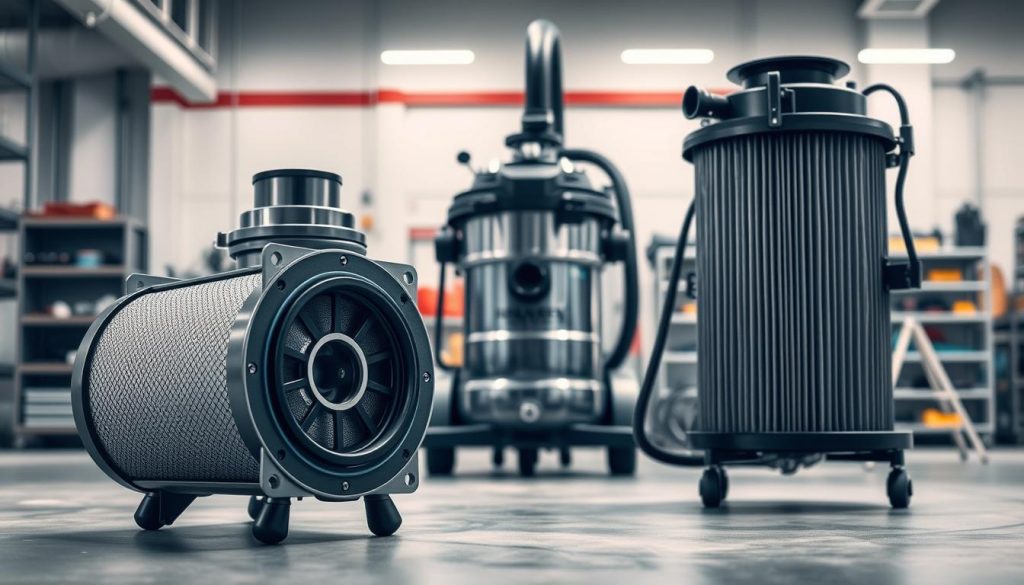
Downtime reduction through automatic filter cleaning
Automatic filter cleaning keeps suction steady and avoids removing elements mid-shift. This saves work time, cuts exposure to dust and reduces stops for manual maintenance.
Consumables strategy: filter bags versus bagless workflows
Bagless systems let us use full container volume and empty less often, lowering consumable spend. Bagged setups remain needed where sealed disposal is mandatory for hazardous waste.
Durability and lifespan: why industrial‑grade build quality pays back
Robust housings, metal castors and reinforced cables reduce breakage and extend service life. That durability translates into fewer repairs and a faster payback.
“Define value by total cost of ownership, not only by headline power.”
- Align duty cycle, dust class and tool compatibility first.
- Then compare sustained performance, service support and maintenance burden.
- Prioritise safety compliance, consistent suction and expected lifespan when buying products.
Conclusion
Conclusion
Our final point is practical — validate any choice with a short site trial under Singapore conditions. Start by matching your common tasks to the correct class of machine, the right filtration level and a maintenance plan that preserves suction and uptime.
Liquids or coarse dirt need high‑volume machines. Mixed work favours all‑round models. Continuous fine dust requires automatic filter regeneration and higher safety class where hazards exist.
Decide dust class by hazard, not convenience. Check the complete system — filters, nozzles, floor tools, hoses and tool integration — because performance is the sum of parts.
Finally, favour the product that lowers total cost of ownership by cutting downtime, protecting people and keeping cleaning reliable. For a fuller checklist see our complete guide.

