
We set out practical advice for facilities teams, contractors and workshop managers in Singapore. Our goal is to help you choose a machine built for site work rather than a domestic model dressed up as industrial.
In this guide we explain how on-site performance differs when dealing with mixed debris, dust and liquids. We focus on measurable outcomes: suction, filtration, tank capacity, durability and total downtime on site.
We also signpost where compliance and safety matter, such as dust class selection and hazardous materials handling, so you specify correctly from the start. That saves time and prevents costly mistakes.
Finally, we outline how we will compare machine classes — fine-dust focused, all-rounders, standard wet-first and safety units — to match real applications. This keeps the shortlist tight and prevents overpaying for unused features.
Why a commercial wet dry vacuum beats standard dry vacuum cleaners
On busy sites a single robust unit that handles both particulate and spills saves time and avoids kit duplication. We favour machines that cope with mixed contamination without swapping tools.
One machine for dust, dirt and liquids across daily commercial use
Wet dry units collect fine dust, coarse dirt and liquids in one pass. That reduces procurement costs and storage needs in tight Singapore facilities.
Switching modes is simple, so teams respond faster to spills and keep public areas safe.
Where wet dry vacuums deliver higher durability than general vacuum cleaners
These machines use tougher housings, heavy-duty castors and reinforced power cables for repeated site use. Durability means fewer breakdowns and less down-time.
- One unit cuts interruptions from filter swaps and overloads.
- Built-for-purpose parts survive knocks and abrasion.
- A robust design gives predictable performance during daily work.
What we mean by “wet and dry vacuum cleaner commercial” in Singapore
We define what counts as a site-grade machine in Singapore and why that distinction matters for daily operations.
Commercial use here means frequent operation across multiple floor types, higher uptime expectations and ready parts support. Buyers assess performance, size, ease of use and how a unit handles common materials on site.
Typical buyer profiles in Singapore
- Facilities management and hotel housekeeping who need reliable cleaners for public areas.
- F&B operators and car-care outlets needing fast spill response.
- M&E contractors, renovation teams and workshops that face heavy fine dust and debris from construction.
Common cleaning tasks that drive the spec
Typical cleaning tasks include sawing, drilling and sanding dust, plaster or concrete debris, wet slurry and rapid spill recovery. These tasks dictate whether you prioritise fine-dust control, high liquid pickup or mixed-debris versatility.
“Match the machine class and accessory kit to the application, not the other way round.”
| Buyer | Priority | Key spec |
|---|---|---|
| Facilities teams | Uptime | Service support, filter options |
| Renovation teams | Fine dust control | High suction, dust-class certification |
| F&B & hotels | Spill response | Tank size, fast emptying |
Where these machines are used most
Choosing the right machine starts with where it will spend most of its time. We outline the settings that give the best return on investment and the main constraints that shape specifications.
Construction sites and workshops with heavy fine dust
On construction sites and in workshops, fine dust from cutting, sanding and grinding is the main risk. We recommend NT Tact models for uninterrupted performance and strong filter cleaning.
Hotels, restaurants and building cleaning for liquids and spills
Hospitality teams need rapid liquids pickup to cut slip hazards and prevent floor damage. A wet vacuum or standard class unit with fast emptying saves time and reduces downtime.
Automotive and industrial spaces with mixed debris
Garages and factory bays handle grit, swarf-like fragments and damp dirt. Ap class machines suit this blend because they balance suction, durability and tool take-off options.
| Environment | Main challenge | Recommended class |
|---|---|---|
| Construction sites | Fine dust, compliance | NT Tact (high filtration) |
| Hotels & restaurants | Fast liquids pickup | Standard class (large tank) |
| Automotive / Industrial | Mixed dirt and debris | Ap class (versatile, robust) |
We will later match these applications to specific filter choices and accessory kits to avoid downtime from clogged filters or slow emptying.
How wet and dry vacuuming works
We explain the airflow and separation that let a single machine handle liquids and particulates without constant fuss. Clear paths for air and dirt reduce interruptions on site.
Liquid pickup and overfill protection
Liquid collection relies on a bypass blower that keeps motor cooling air separate from the tank. The container creates the suction that pulls water into the drum.
Overfill protection is either a mechanical float that rises to block the suction channel or an electronic cut-off triggered by conductive contacts. Both stop intake before water reaches the motor.
Coarse separation and fine filtration
For solids the inlet often induces a cyclone-like rotation so larger dirt settles in the container. Finer particles then pass to flat or cartridge filters for capture.
Why filters clog and how we keep suction high
Clogged filters show as falling suction power, slower pickup and extra passes. That hits productivity.
- Manual cleaning: remove and tap filters.
- Semi-automatic: brief reverse airflow to dislodge dust.
- Automatic: timed pulses from the clean side for continuous work.
| Stage | Function | Benefit |
|---|---|---|
| Inlet / Cyclone | Separate coarse dirt | Less filter load |
| Tank / Float | Hold water, stop overfill | Protects motor |
| Filter / Cartridge | Capture fine dust | Maintain suction power |
Suction power and airflow performance we prioritise
We judge a machine by usable suction at the nozzle and steady airflow through the filter. That is the metric that turns raw motor rating into faster pickup and fewer passes on site.
High suction power for fine dust versus coarse debris
High suction power matters most for fine dust. Stable suction and good filtration stop fugitive dust and keep visibility clear on site.
For coarse debris, airflow and nozzle design often matter more than peak suction. Wide inlets and well-shaped hoses move larger fragments without clogging.
Blowing function and nozzle versatility
A blowing function extends reach for clearing corners, loosening debris before pickup, and prepping surfaces. It can save time when access is tight.
- Use crevice, floor and brush nozzles to cut changeover time.
- Wet inserts or splash guards let crews switch tasks without extra machines.
Power tool take-off and source capture for dust control
We favour units with secure tool sockets and automatic start options so extraction begins when the tool runs. This reduces airborne dust and improves safety.
“Extraction at the source is the single most effective way to control dust during cutting or sanding.”
| Metric | Why it matters | What we look for |
|---|---|---|
| Suction power | Drives fine-particle pickup | Consistent at nozzle, stable under load |
| Airflow | Moves coarse debris | High l/min with wide hose path |
| Tool integration | Source capture | Secure connector, auto-start socket |
Filter cleaning systems that keep suction consistently high
A robust filter-cleaning strategy stops performance drop-offs during extended fine-dust work. We treat cleaning as a core productivity feature, not an add-on. Good systems preserve suction power and reduce downtime on site.
Semi-automatic cleaning for small to medium fine dust
For Ap-class tasks we favour semi-automatic setups. The operator triggers a pulse (for example, pressing a button three times) when suction falls. This is ideal for mixed jobs and short runs.
Automatic cleaning for uninterrupted work
Automatic systems pulse at set intervals to hold suction power steady. They suit long shifts where stopping to remove filters would cost time. This keeps teams working without manual intervention.
Triggered air cleaning (Tact) and sensor-led intervals
Tact reverses the air briefly through the filter to knock out lodged dust. L-class units allow set intervals (60s to 15s). M/H units use differential pressure sensing with selectable 7/15/60s cycles or none.
Operational benefits and when to use bags
Benefits: fewer stops, no direct contact with dust, less inhalation risk, and full container volume in bagless setups. Bags remain useful for regulated disposal, wet pickup modes or workflows that require sealed removal.
| Cleaning type | Best for | Key benefit |
|---|---|---|
| Semi-automatic | Short runs, mixed tasks | Operator-controlled pulse, cost-efficient |
| Automatic | Uninterrupted work | Consistent suction power, no pauses |
| Tact (triggered air) | High fine-dust loads | Sensor-led intervals, reduced exposure |
Choosing the right dust class for compliance and safety
A clear risk-based approach to dust class choice saves time, money and keeps workers safe on Singapore sites. We recommend matching class to the material risk, not guessing. That avoids regulatory failure and reduces exposure incidents.
Dust class L for moderate-risk dusts
Class L is for lower-risk materials such as lime or plaster. Permeation is ≤ 1.0%, suitable where MAC values exceed 1 mg/m³. Use L for routine janitorial and low-hazard tasks.
Dust class M as the minimum for construction site use
Class M offers permeation
Dust class H for hazardous or carcinogenic dust
Class H delivers the highest protection (permeation
Special requirement: asbestos control
Asbestos demands strict containment, sealed handling and disposal workflows. For asbestos we require certified H-class machines, correct bags or sealed systems, and trained operators.
ATEX Zone 22 considerations
Where combustible dust or explosive atmospheres exist, specify ATEX Zone 22 rated units. Explosion-proof solutions change equipment choice, grounding practice and risk controls.
- We choose dust class by risk assessment, not convenience.
- Follow local rules on construction sites and log the selected class.
- Document special requirements for asbestos and explosive material use.
Filters and media we look for in commercial wet dry vacuums
Choosing the right media makes the biggest difference to uptime and worker exposure. A unit is only as good as its filter because filtration stability governs suction, exposure control and cleanup time.
PTFE cartridge filters for M and L classes
PTFE cartridges are our default for M and L dust tasks. Certified at 99.9% separation, they resist clogging and keep nozzle suction steady during long runs.
Cleanable H (HEPA‑grade) filters for hazardous control
For hazardous dust and asbestos risk we mandate cleanable H filters. These offer HEPA‑grade protection (99.995%) and allow on-site cleaning without sacrificing safety.
PES filters for frequent switching
PES media cope with moisture and repeated switches between wet and dry use. They reduce downtime from damp filters and suit teams with mixed tasks across shifts.
Paper filters for cost‑effective dry work
Paper options are economical for dry jobs but must be thoroughly dried after any liquids. If left damp they block airflow and raise operating costs.
- Our logic: match class to materials, favour fewer interruptions and lower replacement costs.
- Result: better containment, fewer changeovers and improved site safety.
Capacity and tank size planning for large volumes
Capacity is often the practical decision that shapes day-to-day efficiency. We plan litres around task rhythm so teams stop less and work more.
How to match litres to your work rhythm and emptying frequency
More litres can mean fewer stops, but only when emptying remains straightforward. Map typical shifts, spill likelihood and staff numbers before upsizing the drum.
For liquids and water recovery, frequent emptying becomes a hidden labour cost if the tank is too small for the job profile.
Example size bands seen in the market
Common bands are around 55L, 75L and 95L. A 55L unit suits short runs and tight access. A 75L is a balanced choice for mixed tasks.
For large volumes and prolonged spill work we consider 95L models or wet dry vacuum options to reduce stoppages.
Balancing net container volume with manoeuvrability
Net usable volume matters more than gross litres. Bagless operation can increase usable capacity for fine dust, while bags help with regulated disposal of hazardous material.
We weigh manoeuvrability in lifts and narrow corridors against the benefit of extra litres so the machine supports cleaning without slowing teams down.
| Size band | Best for | Notes |
|---|---|---|
| 55L | Short runs, tight access | Easy to move, more emptying |
| 75L | Mixed tasks | Balanced capacity and handling |
| 95L | High spill risk, large volumes | Fewer stops, needs stronger handling plan |
Handling and ease of use on real job sites
Ease of movement and storage often decide which machines stay in daily use, not peak suction figures. We look for a sensible range of features that save time on Singapore sites and cut routine strain for crews.
Castors, bumpers and robust containers for tough environments
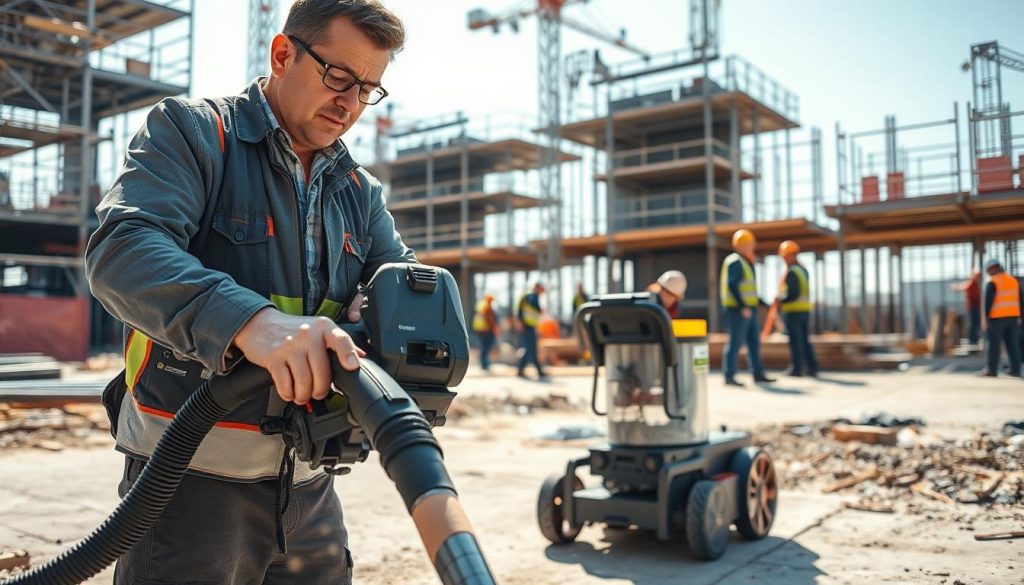
Sturdy castors and impact bumpers protect the container and keep a cleaner rolling across thresholds and rough floors. We favour large, sealed wheels and handholds that let staff move a machine with one person when corridors are tight.
Hose, cable and accessory storage to reduce downtime
Smart stowage keeps hoses, power leads and nozzles with the unit so cleaners are job-ready. Side clips and dedicated trays reduce lost parts and speed deployment, which raises effective power on the task.
Ergonomics: bends, quick-change nozzles and bayonet fittings
Comfortable bends, clear handles and quick-change floor nozzles cut fatigue over long shifts. Dirt‑resistant bayonet hose fastenings stay secure and reduce changeover time when teams swap tool extraction for floor work.
Our point: the best-performing vacuum cleaners fail if they are awkward to handle. Simple, intuitive design reduces training needs and keeps machines working across shifts.
Surface types and toolkits for better cleaning outcomes
Different floors demand different tools. We match heads and brushes to surface finish so teams spend less time on repeat passes. Choosing the correct nozzle has as much impact as machine power for day-to-day cleaning needs.
Floor nozzles for wet and dry applications
Wide nozzles with quick-change inserts let crews switch between liquid pickup and dust control in seconds. This reduces delays when a spill occurs during routine dust work.
For mixed flooring in Singapore premises, select a head that combines a soft seal for tiled lobbies with a hard insert for rougher bays. Confirm whether fittings are standard across models so spares fit multiple units.
Brushes and connectors for special floor requirements
Absorbent brushes, rubber squeegees and narrow connectors improve pickup in grout lines, textured tiles and workshops with fine grit. The right brush protects surfaces while removing more dirt on the first pass.
Before purchase check included tools, upgrade choices and connector standards. For a quick overview of accessory options see our vacuum tools guide.
| Surface | Recommended head | Benefit |
|---|---|---|
| Polished tile | Soft-seal wide nozzle | Gentle, high pickup for spills and dust |
| Textured tile / grout | Absorbent brush | Targets embedded dirt without damage |
| Workshop floor | Hard insert, squeegee option | Moves debris and liquids quickly |
Picking the right class of machine for your application
Selecting the correct class of machines starts with the tasks you face every shift, not the spec sheet.
NT Tact machines for demanding fine dust and uninterrupted use
NT Tact models deliver patented Tact cleaning for long runs with large amounts of fine dust. They keep suction consistent and cut downtime when work is continuous.
Ap class all-rounders for mixed dirt, damp debris and medium-fine dust
Ap class vacuum cleaners suit mixed jobs. Semi-automatic filter cleaning handles medium-fine dust plus moist debris and moderate liquids with minimal stops.
Standard class machines for coarse dirt and high liquid volumes
Standard units favour large tank sizes (55L/75L/95L) for frequent liquid pickup. For heavy spill work a wet vacuum option speeds recovery and lowers labour time.
Safety vacuum cleaners for asbestos and health‑endangering dusts
Safety machines meet M/H certification for respirable hazards, including asbestos. Use certified filters, correct disposal and trained operators to protect staff.
Special‑purpose machines with disposal pumps or niche use cases
Special models include built‑in disposal pumps and ATEX-rated air‑compressed units for explosive dust zones. We match the class to the application so the chosen machine delivers the power and service life you need for commercial use.
Construction dust risk and how we reduce exposure
Dust created on site is not merely untidy; it can cause lasting health problems if uncontrolled. Frequent exposure to fine particles raises long‑term respiratory risk for teams and bystanders in Singapore sites.
High‑risk materials: silica, wood dust, plaster and more
Typical construction materials that generate respirable particles include crystalline silica from concrete, brick, tiles and mortar.
Wood dust from hardwoods, MDF and plywood plus plaster, limestone, marble and dolomite also produce hazardous dust during cutting and sanding.
Prevention tactics: wet methods, source extraction and low‑dust products
We recommend three simple controls. First, bind dust with water where suitable to reduce airborne spread.
Second, connect a vacuum to the power tool to capture dust at source. Where tool extraction is not possible, use low‑dust products such as mortar pellets or ready‑mixed plaster to limit generation.
Why correct filtration protects operators and bystanders
Correct filters stop re‑aerosolisation. Stable suction and effective cleaning cycles keep capture rates high so dust does not leak past PPE or settle back into rooms.
- We explain: construction dust is a health risk, not a nuisance.
- High‑risk materials: silica, wood sheet goods and plaster‑based powders.
- Prevention: wet methods, source extraction and low‑dust products.
- Buy with purpose: choose dust class and filter cleaning that suit routine tasks; if you use vacuum at the tool, select models with reliable suction and certified filters.
“Capture at the point of generation is the most effective way to reduce exposure on site.”
Wet pickup priorities for spills, floods and deep cleaning
Large volumes of liquid can halt services quickly unless a purpose-built machine is ready. We prioritise fluid recovery because standing water creates immediate safety and operational risks in Singapore premises.
Fast removal reduces slip hazards, limits floor damage and shortens shutdown time in public areas. For routine spill response the right kit restores access quickly and protects finishes.
Slip hazards and fast liquid removal in commercial premises
We focus on reliable, quick pickup. Rapid action cuts incident reports and reduces liability for facilities teams.
Key features to check: stable suction power, dependable shut-off to protect the motor from overfill, easy emptying systems and dedicated wet-floor tools that speed recovery.
When a wet-first machine is the better investment
Where liquids are routine — kitchens, wash bays, workshops with coolant or frequent spill zones — a standard‑class, wet‑first unit is often the smarter buy.
These models handle small to large fluid volumes with less downtime. We plan tank size to match expected cycles so crews spend more time working and less time emptying.
- Prioritise fast emptying and clear overfill protection.
- Match litres to typical incident frequency and staff numbers.
- Choose wet‑floor heads and squeegee tools for faster pickup on tiled surfaces.
In short, select equipment by primary use and routine applications — where water and liquids dominate, invest in a wet-first option for reliable, repeatable results.
Spec checklist we use before buying
To avoid surprises on site we confirm a small set of measurable criteria before any unit gets approved. Our checklist helps teams compare models fairly and defend the purchase to procurement.
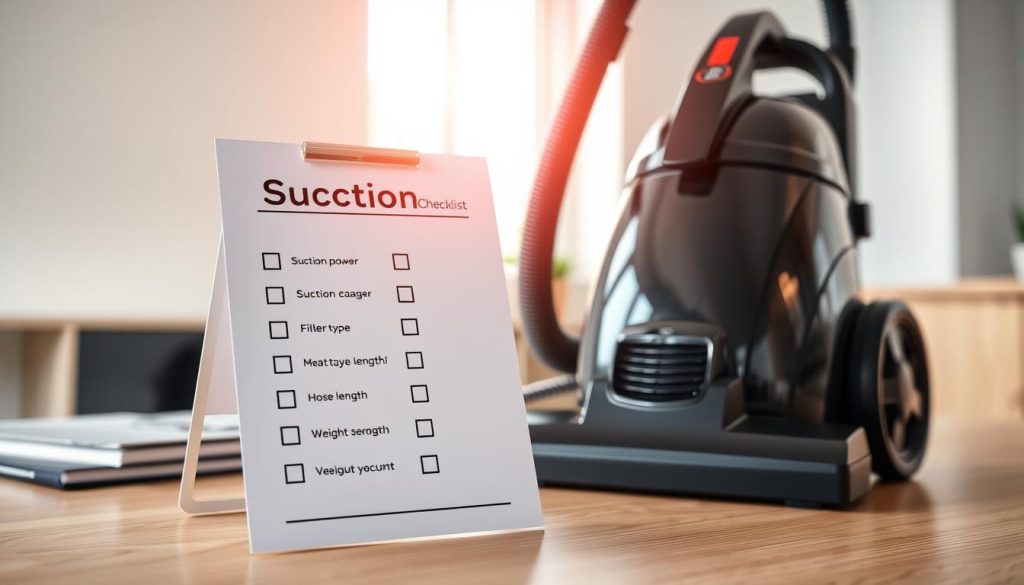
Performance: suction, accessories and versatility
We verify suction at the nozzle, check suction power stability under load and confirm the accessory kit covers floors, crevices and tool extraction. A blowing function and nozzle versatility raise task coverage without extra machines.
Size: cleaning path width and dirt capture rate
Match cleaning path width to corridors and bays so work finishes faster. We also test dirt capture rate on typical substrates to measure real-world capacity versus headline litres.
Ease of use: handling system, wheels and cord management
Assess handling, castor quality and cable stowage. Quick-change connections and clear tool storage cut setup time and reduce trips back to the van.
Surfaces to clean: matching attachments to special requirements
Check included heads for tiles, grout, textured bays and absorbent zones. Confirm connector standards so spares or specialist brushes fit across models.
Your needs: liquids volume, dust type and frequency of use
Quantify expected litres, dust severity and shifts per week. That informs the dust class, filter media and capacity choice so the unit suits daily use.
Finally, we confirm the model supports tool extraction and that filters and consumables fit your operating budget before signing off.
Conclusion
We choose the right wet dry solution by starting with actual applications, then confirming dust class, filtration and usable power rather than buying on headline price.
Fine‑dust tasks demand strong filter cleaning and steady suction. Heavy liquid work requires capacity, reliable shut‑off and fast emptying. Safety and compliance come first where hazardous dust, asbestos or explosive environments exist; the correct class protects people and operations.
Handling, storage and accessories directly affect productivity — downtime often stems from missing tools or slow changeovers. Our buying path is simple: shortlist by machine class, validate capacity and filters, then confirm the accessory range matches daily work.
Document dust type, liquids volume, frequency and surfaces so your selected vacuum cleaners deliver consistent results. For practical kit choices see our Lura ordering checklist at Lura wet‑dry vacuum options.

