

We explain what “vacuum cleaner water suction” means for everyday homes in Singapore and why it has moved from niche tech to a key buying factor. Wet and dry models now tackle spills and debris in one pass, though they can be noisier, heavier and more bulky than standard units.
Our roundup is for families, pet owners and residents of HDB flats and condos. We test each model on liquid pick-up, residue left behind, and how quickly floors dry. We also note noise, upkeep and storage needs so you can weigh trade-offs at glance.
What you get: an at-a-glance shortlist, deep reviews and a practical buying guide that turns specs into real-world performance. We help you match the right model to floor type, home size and tolerance for noise and maintenance, so you can spend with confidence.
Why water suction matters in Singapore homes right now
In Singapore’s humid climate, quick liquid pick-up is now a practical must for many households. We see sudden showers, wet umbrellas at entryways and damp corridors that demand fast action.
Everyday wet messes: spills, rain and kitchen accidents
Knocked drinks, soup or cereal milk can spread and leave marks on hard floor surfaces. Fast pick-up reduces slip risk and stops moisture from damaging grout or floor finishes over time.
Families, kids and pets: why wet dry models beat a dry vacuum cleaner
For homes with children or pets, crumbs mix with damp paw prints and spilled bowls. A wet dry device handles both debris and liquid in one pass, saving us precious time on busy weekdays.
Practical note: even the best wet dry systems are not flood pumps. They manage puddles and spills typical in a home, not large-scale flooding.
- Use strong pick-up if your flat has mostly hard floors and frequent wet incidents.
- Prioritise easy-empty tanks and simple filters for routine cleaning.
What a wet dry vacuum is and how it differs from dry vacuum cleaners
We define the hybrid concept in plain terms.
A wet dry vacuum is a single system designed to pick up solid debris, damp patches and small puddles without harming internal parts. It uses separate tanks for clean and dirty liquid and seals to prevent overfill. This design lets us handle dust and spilled drinks with one device rather than switching tools.
How it differs from dry-only machines: dry vacuum cleaners focus on filtration and dry dust capture. Wet dry designs add liquid routing, float shut-offs and stronger motors to manage mixed messes safely. Because of added tanks and seals, the unit can feel heavier and louder than a standard dry unit.
Where to use them
- Hard floors, sealed timber and tile: excellent for crumbs and damp marks.
- Small rugs and mats: suitable if brush heads match the surface.
- Mixed homes (tile kitchen + laminate living room + rugs): one system covers most daily tasks, though very delicate timber may need gentler care.
| Surface | Performance | Note |
|---|---|---|
| Tile / Vinyl | High | Good for spills and grit |
| Sealed wood | Moderate | Avoid excessive liquid |
| Rugs | Variable | Check brush compatibility |
How we choose the best models in our roundup
We test each model under real household conditions to judge lasting performance and day-to-day ease.
Our scoring priorities reflect Singapore living: steady suction power, how clean floors look after a pass, and how often the unit forces stops to refill or empty.
Suction power, tank design, and cleaning performance over time
We measure suction power for sustained results, not just peak figures. That means checking whether performance falls as the filter loads or the dirty tank fills.
Tank design gets equal weight. We check separation of the clean and dirty tanks, ease of removal, leak resistance and balance when full. A useful clean water tank is noted in every product sheet.
User-focused features: manoeuvrability, noise, and maintenance
We judge manoeuvrability around furniture and edge reach. Noise character matters as much as loudness.
Maintenance includes how easy it is to clean the brush and the single filter we test for clogging and access.
Value in Singapore: price, availability, and warranty considerations
We check local listings, spare-part access and warranty support. Price is weighed alongside running costs to show real value and viable option choices for users.
Vacuum cleaner water suction essentials: what to look for before you buy
We outline the practical checks to make buying easier. Consider how metrics and parts affect daily cleaning, maintenance and noise.
Suction power explained: Pa vs Air Watts
Pa (pressure) and Air Watts describe different things. Pa shows force at the inlet; Air Watts indicate actual air movement and cleaning power.
Use both figures to compare models. High Pa helps lift wet debris from textured tile. Air Watts matter for pulling fine dust from fibres.
Clean water tank vs dirty water tank capacity
A larger clean water tank extends run time between refills. But dirty tank capacity limits how much mess you can collect.
Practical tip: match capacities for fewer interruptions. For a 4-room flat, aim for at least 700–1,000 ml clean and similar dirty capacity.
Filter system basics
Standard filters handle everyday dust and grit. HEPA is worth it if allergies are a concern.
Check filter access and replacement cost. Easy-to-remove filters keep performance steady over time.
Noise and noise reduction technology
Stronger motors can be louder. Look for devices that advertise active baffling, insulated housings or silent modes.
Read user reviews for real-world decibel numbers during wet and dry modes.
Cordless vs corded: reach and runtime trade-offs
Cordless gives freedom for quick jobs around HDB flats. Corded models offer steady power for long sessions.
Compare runtime and charge time if you pick cordless. For extended use choose corded or a long-run cordless model.
Brush head and design
Edge-cleaning heads, flat-folding chassis and narrow profiles improve access under sofas and along skirting boards.
Check bristle type and rotation speed for mixed floors. A good head reduces streaks and residue.
Accessories and attachments
Look for multi-tool kits with crevice nozzles, pet heads and soft rollers. These turn a floor washer into a versatile tool.
| Feature | What to check | Why it matters |
|---|---|---|
| Suction metrics | Pa and Air Watts listed | Shows force and airflow for wet/dry performance |
| Tank sizes | Clean vs dirty capacities (ml) | Determines coverage per fill and frequency of stops |
| Filter | Standard or HEPA; access | Controls dust capture and allergy protection |
| Noise tech | Baffling, insulated motor, quiet mode | Improves comfort during use in flats |
How wet and dry suction systems work for liquid pick-up
Efficient liquid capture starts with coordinated air flow and a reliable shut-off that guards the motor. At a homeowner level, the system uses pressure differences to draw liquid through the intake and into a sealed tank. A bypass blower keeps the motor cool while transporting fluid away from the fan.
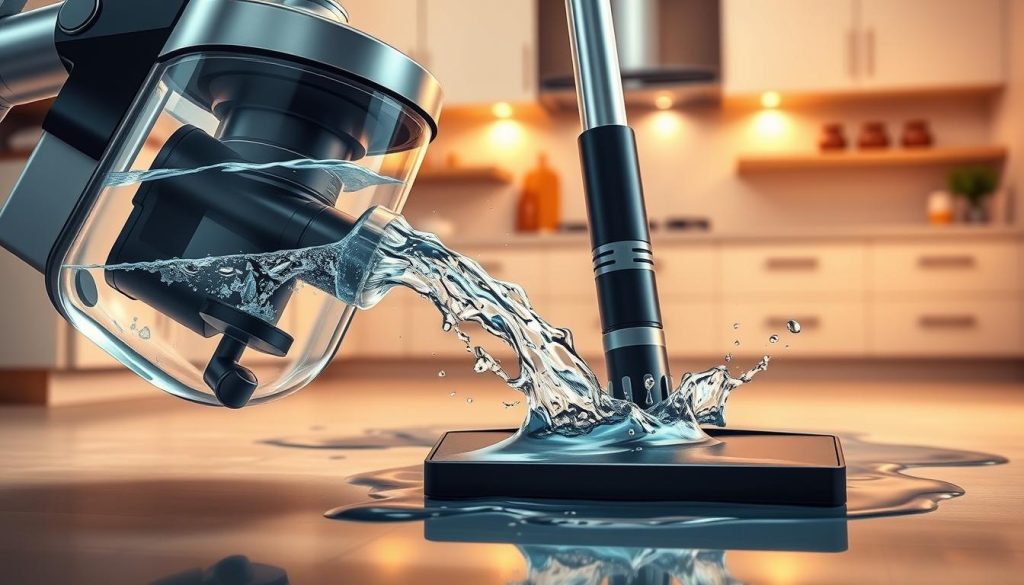
Float shut-off and overfill protection
The float is a simple mechanical safeguard. As the dirty tank fills, a float rises and blocks the suction channel or triggers an electronic cutoff. Users notice a sudden change in sound and weaker suction — a clear sign the device has protected itself, not failed.
Air flow and water flow coordination for wet vacuum cleaning
Good designs separate air and liquid so neither disrupts the other. Poor separation causes sputtering or reduced pick-up and can push mess around instead of collecting it.
- Buying tip: choose models with clear fill markings, robust shut-off and easy-empty tanks.
- For small spills common in Singapore flats, fast pick-up and reliable overfill protection matter most.
“A dependable shut-off extends machine life by keeping liquids away from the fan.”
For locally available wet-duty options, see our guide to wet-duty models.
Filtration and filter cleaning: keeping suction power consistent
Consistent airflow depends on how well the filter handles fine dust from daily life.
Fine dust — skin cells, textile fibres and tiny grit — lodges in flat and cartridge filters over time. That build-up restricts airflow and reduces power, so the unit needs more passes and more time to reach the same result.
Users often report a device “losing strength” even when the motor is unchanged. The real cause is clogged media, not the motor. Clearing or renewing the filter restores constant suction and performance.
Cleaning approaches: semi-automatic vs automatic
Semi-automatic systems let us trigger cleaning cycles or bursts to shake off dust. They work well for regular upkeep and cost less.
Automatic systems use timed reverse-air blasts or sensors that detect pressure drop. These mimic pro-grade technology and keep suction steady without frequent manual intervention.
Practical maintenance and allergy guidance
Rinse washable filters every 2–4 weeks in Singapore’s humid climate and allow full drying to avoid mildew. Replace cartridge filters per the maker’s schedule.
- Allergy note: choose HEPA if household members have allergies; standard filters suffice for routine dust and dirt.
- Ask sellers about automatic filter-cleaning technology when comparing models.
Our top picks at a glance for wet dry vacuum shopping in Singapore
To help you shortlist fast, we list four top models that meet common Singapore needs: balance, pet hair, budget and tight spaces.
Overall best for most homes — Tineco Floor One Switch S7 Stretch
Best at: smart sensing and consistent cleaning. Not ideal if you want the lowest price. Suits medium to large family flats.
Best for pet hair — Bissell CrossWave X7 Cordless Pet Pro
Best at: Turbo pet mode and hair handling. Not ideal for very long cleaning sessions without a charge. Suits pet households.
Best budget option — Simplus Cordless Wet-Dry Vacuum Cleaner
Best at: value and compact design. Not ideal for heavy-duty mess. Suits small flats and tight budgets.
Most manoeuvrable — Narwal S20 Pro
Best at: edge cleaning and tight turns. Not ideal if you prioritise the lowest maintenance. Suits homes with many narrow gaps.
| Pick | Why it wins | Price position |
|---|---|---|
| Tineco S7 Stretch | Smart sensing, balanced performance | Premium |
| Bissell X7 Pet Pro | Turbo pet mode, hair pickup | Mid‑range |
| Simplus Cordless | Compact, flat‑folding reach | Budget |
| Narwal S20 Pro | Manoeuvrable, edge cleaning | Premium‑mid |
“Choose based on your floors, common messes and tolerance for upkeep.”
We recommend checking local price, availability and warranty before you buy. These models give a quick way to match features to your cleaning priorities.
Best overall: Tineco Floor One Switch S7 Stretch review
We find the Tineco Floor One Switch S7 Stretch brings smart controls and large tanks into a compact, user-friendly package. It is our starting recommendation for most Singapore homes because it balances strong pull and useful features without being over-complex.
Key specs:
- 22,000 Pa performance for confident wet picks and dry dust lift.
- 1,000 ml clean water tank and 720 ml dirty tank for longer runs between refills.
- Weight 4.7 kg; runtime 50 minutes as a floor washer, 70 minutes in stick mode; 4.5 hours charge time.
Smart iLoop sensor technology
The iLoop sensor detects mess levels and auto-adjusts pull and liquid flow so you do not over-wet floors or waste solution. An LCD shows when the floor reads as clean, which helps speed up routine cleaning.
Design, edge reach and multi-use convenience
The dual-side brush roller reaches about 0.5 cm from the skirting, so crumbs and grime along kitchen edges get cleared in one pass. Switch the head and attachments and it becomes a stick model for quick dry jobs across mixed floors.
Practical verdict: 22,000 Pa and large tanks mean fewer interruptions for a full-home session. Runtime and 4.5-hour charging suit daily use, though storage space, ongoing tank upkeep and the premium price are trade-offs to consider.
Best for pet hair: Bissell CrossWave X7 Cordless Pet Pro review
Pet households demand tools that handle fur, muddy paws and spills without a long follow-up session. The CrossWave X7 is built for that quick, practical outcome in Singapore flats.
- Up to 20,000 Pa suction and Turbo Pet mode for heavy fur lift.
- 820 ml clean tank and 420 ml dirty tank; weight 4.8 kg; 30-minute runtime and 4-hour charge.
- Designed for hard floors and small rugs common in local homes.
Where it shines
Hair clumps when wet and can wrap on the brush head. The CrossWave’s brush and Turbo Pet setting reduce redepositing and lift embedded dirt in one pass.
A wet dry vacuum approach beats doing a dry pass then mopping when we need results fast. Muddy paw prints and mixed messes clear quicker with the right combination of roll and suction power.
Practical notes: plan 30 minutes for spot or high-traffic zones first. Watch for hair tangles and empty the dirty tank after heavy pet use to avoid odour. Regular brush checks keep performance steady.
Best budget: Simplus Cordless Wet-Dry Vacuum Cleaner review
For budget-conscious buyers we judge value by real-world performance, not just the sticker price. The Simplus cordless unit aims to give strong wet dry results for smaller Singapore flats without a premium tag.
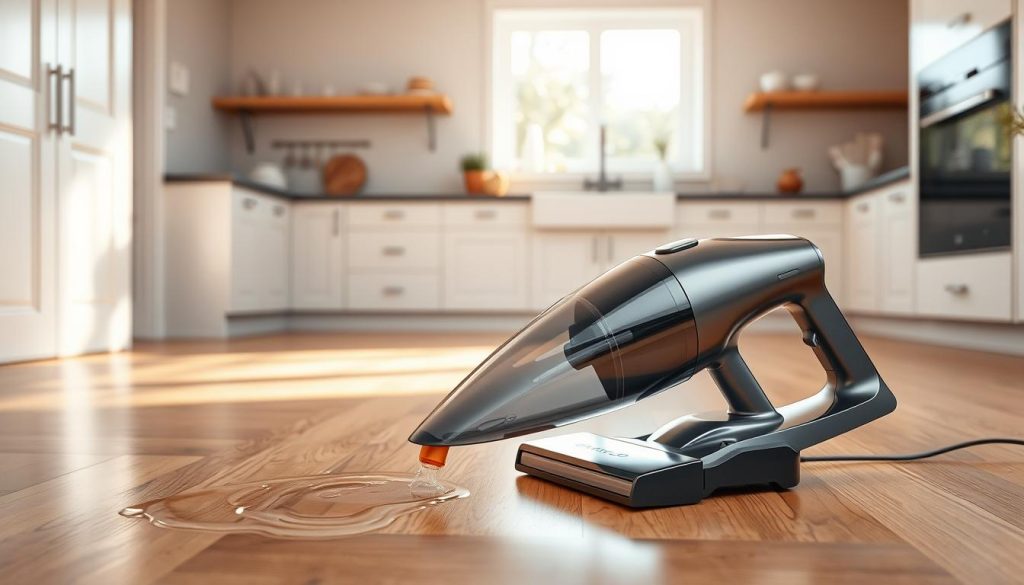
- 21,000 Pa power and up to 50 minutes runtime.
- 500 ml clean water tank and 550 ml dirty tank for short full-room sessions.
- Weight 4.4 kg; 4.5 hours charge time.
The 180° flat‑folding design helps reach under sofas and low TV consoles, cutting the time spent on awkward spots. A wider 6.5 cm brush head covers more open floor per pass, though it can need extra care around chair legs.
Practical value notes: this model balances compact design and decent tanks, making it suitable for HDB rooms where messes are frequent but areas are modest.
Before you buy: check local warranty and spare parts availability in Singapore, and whether included accessories match your cleaning routine. For tips on floor care without a mop, see our guide on how to clean the floor without a.
Most manoeuvrable: Narwal S20 Pro review
Everyday homes need a model that feels light in hand and steers smoothly between furniture. The Narwal S20 Pro aims to do that with a compact, flat-folding design and a low 4.27 kg weight.
Key specs and what they mean for daily use
Specs: 20,000 Pa, 790 ml clean / 720 ml dirty tanks, up to 60 minutes runtime and 3.5 hours charge time. Hot water mopping adds cleaning heat for greasy stains.
In practice, the runtime and modest charge time let us finish quick whole-room passes without frequent stops. The tank sizes match shorter sessions common in HDB flats.
Smart cleaning modes and AI Dirt Sense
AI Dirt Sense adjusts intensity based on detected dirt, so we avoid over-wetting light soils and save time on repeat passes. Five modes let us pick gentle care for sealed wood or more robust action for tiled kitchen floors.
Edge performance and practical design
Triple-sided edge cleaning targets grime along skirting lines and corners where residues collect. This design feature matters more than raw suction when tidying edges.
“Smooth steering and adaptive technology turn frequent spot cleaning into a low-effort habit.”
Best for stubborn stains: Dreame H15 Pro Heat review
Sticky spills and oil marks demand more than a quick wipe; they need heat and extraction to vanish. The Dreame H15 Pro Heat pairs 85°C hot mopping with strong extraction to loosen, then remove, greasy residues that cold rinsing often leaves behind.
Key specs and real-world performance
Specs: 22,000 Pa rated power, 800 ml clean and 650 ml dirty tanks, 6 kg weight, up to 70 minutes normal runtime and 25 minutes in hot-mop mode. Charge time is four hours.
What this means: the 85°C mopping loosens oily stains; the high-rated pull then lifts loosened grime instead of smearing it across floors. Expect targeted heat use for spots, not whole‑home hot sessions, due to the shorter heated runtime.
Design and handling
The flat-folding design and auto-traction wheels cut the effort of pushing a heavier 6 kg unit. Triple edge cleaning helps reach skirting and corners where tracked-in dirt collects.
Who should avoid it
We advise caution if you have delicate wooden floors; heat and extra moisture can harm finishes. Also, the machine’s weight and size may not suit buyers with tight storage or limited mobility.
| Aspect | Detail | Practical tip |
|---|---|---|
| Hot mopping | 85°C peak | Use on stubborn oil and grease; avoid delicate timber |
| Rated power | 22,000 Pa | Pairs with heat to remove loosened residue |
| Tank sizes | 800 ml / 650 ml | Good for spot work; plan refills for larger jobs |
| Runtime | 70 min normal / 25 min hot mode | Reserve hot mode for problem areas to save time |
| Handling | Flat-fold, auto-traction wheels | Reduces push effort despite heavier weight |
“Use heat for targeted stain lifting, then rely on strong extraction to remove residue — both steps matter.”
Best low-maintenance pick: Shark HydroVac WD210SM review
When regular deep maintenance is impractical, a low-maintenance option keeps homes fresh between major cleans. The Shark HydroVac WD210SM aims to cut routine fuss by combining compact form with hygienic parts that resist odour.
Antimicrobial brush rollers to reduce odours and bacterial build-up
Antimicrobial rollers lower the chance of lingering smells and bacterial growth on the brush head. In humid Singapore, damp parts can develop odours quickly; these rollers slow that process.
Practically, that means fewer immediate deep-cleans and less time rinsing brush parts after everyday spills.
Key specs overview: tank sizes, runtime, and where it fits best
We compare specs to set expectations. The unit has a 500 ml clean tank and a 360 ml dirty tank. It weighs 3.9 kg, runs for about 30 minutes and needs roughly 4 hours to charge.
| Spec | Detail | Best for |
|---|---|---|
| Clean tank | 500 ml | Short whole-room passes |
| Dirty tank | 360 ml | Quick daily spots |
| Rated pull | 2,700 Pa | Light wet messes and dust maintenance |
| Weight & runtime | 3.9 kg / 30 min | Small flats and fast touch-ups |
At 2,700 Pa the unit is not aimed at heavy-duty debris. We recommend it as an option for users who put a premium on ease of use rather than peak force.
- Low-maintenance meaning: fewer smells, faster post-use routines, and predictable upkeep.
- Care tips: rinse and fully air-dry the filter and tank after use to reduce mould. Check rollers weekly if you handle wet pet messes.
“For quick daily upkeep in humid flats, antimicrobial parts make a real difference to odour control.”
Dyson wet and dry vacuum options in Singapore: are they worth the price?
Dyson’s handheld-first designs aim to combine light handling with strong air flow for quick spot work around Singapore flats.
Why they cost more: Dyson invests in research and development, cyclonic airflow systems and advanced filter technology. That adds to the retail price, but it also brings refined ergonomics, cordless convenience and longer-lasting parts.
Dyson V12s Origin Submarine — light and long run time
The V12s Origin Submarine weighs about 2.2 kg and claims a 60-minute runtime. It uses root cyclone technology and rates 130 Air Watts, making it strong for dry tasks and spot wet work when paired with the right wet-dry attachment.
V12s Detect Slim Submarine — HEPA and the Fluffy Optic head
The Detect Slim adds a HEPA filter and the Fluffy Optic head to reveal fine dust on floors. It lists 140 Air Watts and keeps the same 60-minute run. For allergy-prone homes, the upgraded filter systems are a real benefit.
Digital Slim Submarine — compact trade-offs
The Digital Slim is the most compact option. Storage is easy, handling is excellent, but runtime falls to roughly 40 minutes. That shorter time is the trade-off for a smaller body and sleeker fit in tight flats.
“Dyson can be worth the higher price for ergonomics and filtration, but other wet dry vacuums offer larger tanks and stronger wet-cleaning focus for less.”
In short, Dyson excels at lightness, air-driven cyclonic performance and superior filter tech. If you prioritise tank capacity and raw wet-work value, compare alternatives before you pay the premium price.
More wet-dry models to consider: Dibea H8 vs Dibea HC26
We compare two practical Dibea models that suit different home sizes and routines.
Dibea H8: balanced tanks and a self-cleaning system for routine use
The H8 pairs modest rated pull with a sensible tank balance: 500 ml clean water tank and 600 ml dirty capacity. It weighs 3.7 kg and runs about 38 minutes in auto mode, or 30 minutes on high.
Why it stands out: a built-in self-cleaning system reduces brush maintenance and hands-on rinsing after wet jobs. Modes for wood, marble and ceramic tiles make it versatile across mixed floors.
Dibea HC26: larger capacity and longer reach for bigger areas
The HC26 offers 700 ml / 700 ml tanks to cut refill stops across wider floor areas. Runtime is similar at 38 minutes and it charges in around 4.5 hours.
Practical gains: a longer handle (568 mm vs 538 mm) improves posture and reach during longer sessions. It is slightly lighter and more manoeuvrable, which helps in larger open layouts.
| Model | Clean/dirty tank (ml) | Runtime (min) | Handle (mm) |
|---|---|---|---|
| Dibea H8 | 500 / 600 | 38 auto / 30 high | 538 |
| Dibea HC26 | 700 / 700 | 38 | 568 |
Buying note: Dibea is a strong also-consider brand when promotions appear locally. We advise focusing on real pickup results, residue left behind and clogging behaviour rather than headline numbers alone.
“Match the model to your home: H8 for regular tidy-ups and mixed floors; HC26 for larger areas and fewer stops.”
How to choose the right wet dry vacuum for your floors, space, and cleaning routine
Start by matching the machine to the rooms you use most and the messes you face daily.
Match tank capacity to home size and cleaning frequency. Small flats or single rooms do well with 500–700 ml tanks. For 3–4 room flats pick 700–1,000 ml to avoid frequent stops.
When you clean weekly, smaller tanks suffice. If you tidy daily or have pets, choose larger dirty and clean tanks so you refill or empty less often.
Choosing the right suction for different messes
Choose strength by mess type. Fine dust needs steady air flow and a good filter to avoid redepositing. Heavier dirt or larger debris requires stronger pull and a wider head to avoid clogging.
Tip: mixed wet and dry spills demand reliable shut-off and a design that separates liquid from dust to protect the motor.
Picking filtration for allergies and cleaner air
For allergy-prone households, prioritise HEPA or equivalent filters. Standard filters work for routine dust if cleaned often.
Maintain filters by rinsing washable media and replacing cartridges per the maker’s schedule to keep performance steady.
Practical checks: weight, design, noise and the solution ecosystem
Test the machine in hand for manageable weight and a compact design that fits your utility corner. Check noise levels for evening use and whether the brand needs proprietary cleaning solution — that affects running cost.
Confirm warranty and spare-part availability in Singapore before you buy.
“Shortlist by floor compatibility, tank size, filter type, maintenance effort and after-sales support.”
Conclusion
A practical buy in Singapore blends tank sizing, filtration and manoeuvrability to suit your floors and routine.
If spills, damp entryways or pet marks are common, a wet‑dry system gives real daily gains over dry‑only options. For most flats we recommend the Tineco S7 Stretch for balance, the Bissell X7 for pets, the Simplus for budgets and the Narwal S20 Pro for tight spaces.
Focus on tank capacity that matches how often you clean, a filter that handles household dust and realistic maintenance you will keep up with. Paying more can be worth it when it buys ergonomics, smarter tech and steadier results, but matching features to needs delivers the best value.
Next steps: shortlist two models, check local availability and warranty, then decide based on floors, storage and weekly use. A final test in store or a close read of local reviews will help you choose with confidence.

