

We begin with a clear promise: this shortlist explains what a genuine, test-backed pick means in practice for beds in Singapore.
Steam cleaning pairs high heat and pressure to reduce germs, bacteria and allergens without leaving chemical residue. That makes it a useful, chemical-free option to refresh a sleep surface and cut odours.
We outline who each product suits — heavy-duty jobs, value options, handheld seam work, long sessions and scrubbing-heavy tasks. Our picks focus on heat-up speed, reach across a queen or king bed, and how controlled the steam output feels on fabric.
Safety matters: we flag drying time and moisture control so readers avoid over-wetting a mattress in our humid climate.
Finally, our recommendations rest on test-based criteria: effectiveness, ease of use, portability and overall value. We aim to help you choose a model that fits your flat size, storage needs and typical cleaning jobs beyond the bed.
Why we rate steam cleaning for mattresses in Singapore homes
Using hot vapour lets us target surface bacteria and allergens while avoiding synthetic residues on bedding. This method appeals in Singapore where high humidity can make musty smells harder to shift and keep back.
High-temperature action on microbes and allergens
High heat in vapour form can reduce common germs on surfaces. We see it as an effective hygiene step when fabrics are only lightly soiled, not deeply saturated.
Refreshing odours and lifting light stains without residue
Heat and moisture soften grime and help lift small stains while leaving no chemical residue. That matters if you prefer a low‑scent approach to bedroom cleaning.
Where this method fits with regular care
We recommend layering this into a routine: regular vacuuming to remove dust, frequent bedding changes and protector use, then targeted hot‑vapour work for refreshes.
“Steam plus high temperature can help eliminate germs, bacteria, and allergens, and can deep clean without leaving residue.”
- Useful in flats with limited airflow, but drying technique is vital.
- Not a substitute for fixing deep saturation, structural damage or infestations.
What to know before you steam clean a mattress
Before you use hot vapour on bedding, there are a few practical risks and room prep steps we must consider. We favour a cautious method so cleaning wins do not become moisture problems.
Why memory foam is a no‑go
Memory foam soaks up water like a sponge. That trapped moisture dries slowly and raises mould risk in humid Singapore conditions. Heat and water can also distort foam cells, causing lumps and uneven support over time.
Moisture, mould risk and drying time
Control the amount of vapour. Use low, short bursts and keep ventilation running. Some devices need cool‑down minutes before a refill; plan your session to avoid interruptions.
Safe technique and seam warning
Keep the nozzle moving. Labels, piping and creases trap moisture, so use a flat fabric attachment and avoid lingering on seams.
Materials and a quick stop checklist
Avoid unsealed wood, bedside electronics, thin plastics and paper. If you notice damp patches, stop, blot with a dry cloth and increase airflow. We treat the steamer as a precise tool, not a soak‑and‑forget fix.
“Heat and moisture can help hygiene, but only with careful technique and full drying.”
How we tested steam cleaners for mattress-style jobs
We applied a repeatable, data-led approach to judge how well each unit manages small-zone cleaning and tight areas.
What we call mattress-style jobs are tasks needing controlled heat, close handling and fine detail work — seams, piping and spot marks. We did lab runs that mimic real usage in Singapore flats.
Effectiveness and metrics
Effectiveness checks looked at stain loosening and grime lift without drenching fabric. We tested window tracks, caked-on mud on tile/grout and dye stains on glass to compare results against a household baseline.
Usability, weight and design
We measured weight both dry and filled, and assessed handheld comfort, balance and trigger ergonomics. Good design reduced hand fatigue during long hover sessions.
Heat time, tank capacity and interruptions
Key metrics tracked were heat time from cold start, how quickly output stabilised, and whether refill pauses disrupted a run. We note the water tank capacity trade-offs: larger tanks give longer runtime but add weight and storage needs.
Attachments and value
The right nozzle, extension wand and fabric tools often made the biggest difference. We weighed performance against the actual usefulness of accessories rather than sheer accessory count.
“A focused test shows which models handle seams and spots without over-wetting — that is the real win.”
Best steam vacuum cleaner for mattress: our selection criteria
When choosing a model for bed upkeep we prioritise steady output and sensible controls over headline heat figures. We want machines that refresh fabric without over-wetting or stressing fibres.
Consistent pressure and output
Pressure and a constant flow matter more than peak temperature. Controlled delivery loosens grime while lowering soggy patches.
Handheld weight and balance
By handheld-friendly we mean low wrist strain, good balance and an easy trigger layout. A poorly balanced unit makes whole-bed work tiring and uneven.
Water tank trade-offs
Smaller water tank sizes keep weight down but force frequent refills. Larger tanks extend runtime yet add bulk; wheeled canisters help move heavier loads.
Cord length and practical range
Longer cords reduce outlet switches and improve range across queen and king beds. In Singapore flats we note how many plug points you typically have near the bed.
Accessories that matter
- Flat fabric tools and microfibre covers to cut surface wetting.
- Detail nozzles for seams, piping and labels.
- Extension wands to reach the whole bed without awkward stretching.
“If it is awkward to manoeuvre over a mattress, we rule it out — handling beats floor performance in our shortlist.”
For more on technique and safety, see our cleaning guide.
Top pick for heavy-duty steam cleaning with strong accessories
For deep-clean chores that span fabrics and tiles, a high-capacity machine with quick-fit heads keeps us moving. We picked a unit that handles long runs and swaps tools fast so sessions stay efficient in flats with limited drying time.
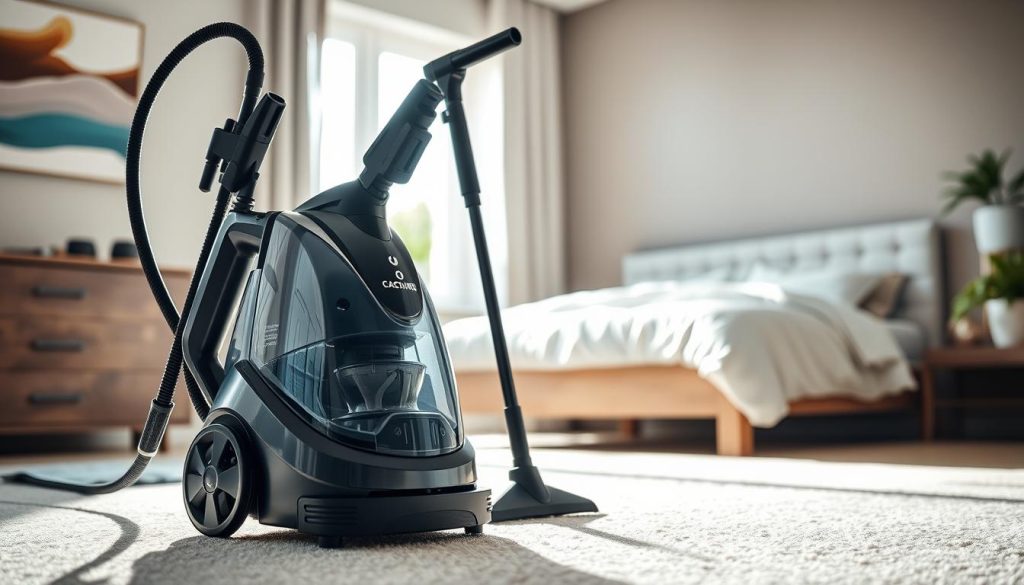
McCulloch Heavy Duty Steam Cleaner MC1275
Why we like it: the MC1275 delivers a steady output and rapid attachment changes. That makes it useful when we shift from flat fabric tools to detail nozzles without breaking our rhythm.
Key specs
- Water tank: 48 oz capacity
- Accessories: 18 included heads and brushes
- Heat-up time: roughly 12 minutes before steady output
Where it shines beyond the bed
It performs strongly on bathroom soap scum, kitchen crevices and window tracks, and it tackles tile and grout with confidence. In Singapore flats, that multi-room ability means one machine covers most heavy jobs.
Keep in mind
The unit runs hot; we use light, moving passes on fabrics to avoid over-wetting or heat stress. The handle can warm during longer runs, so plan short breaks and use heat-resistant gloves when swapping hot attachments.
Maintenance is practical but not perfect: the tank can be awkward to drain, so we factor a short cooling and emptying step into our routine to avoid stale water. For a wider comparison of options, see this detailed list.
“A heavy-duty unit with solid accessories saves time when you need one machine to cover many surfaces.”
Best value pick for small homes and quick refresh jobs
We recommend a compact unit when storage and speed matter most in Singapore flats. A model that reaches working temperature fast and leaves little residual damp helps avoid long drying times in humid rooms.
PurSteam 10-in-1 Steam Mop
Why it works: the PurSteam heats in about 30 seconds and produces steam that rarely leaves excess water behind. That makes touch‑ups and short spot passes simple and quick.
Key specs
- Weight: 4.4 lb — easy to lift and store.
- Tank: 12.8 oz capacity, user‑friendly refill.
- Attachments: 9 heads for upholstery, fabric headboards and small areas.
Where it’s best and its limits
We use it on upholstery, sofa arms and quick spot work across bedding surfaces rather than long, full‑bed runs.
Limitations are clear: the smaller tank interrupts longer sessions, and some handheld angles feel awkward near seams and edges.
“If you favour speed, light weight and easy refills over long runtime, this model fits small homes well.”
Best handheld steam cleaner for tight seams and edges
A compact hand unit helps us reach narrow joins and tight corners that larger machines struggle to access. In bedrooms where plug points are limited, reach and agility matter as much as raw output.
Bissell SteamShot Deluxe
Why we’d choose it: the Bissell SteamShot Deluxe is a light, handheld option with a long 20‑foot cord. That range reduces cable stretching across a bed and lets us work quickly without hunting for sockets in a compact Singapore flat.
Key specs
- Weight: ~4 lb — easy to lift for detail work.
- Tank: ~0.2 L design with quick ~30 second heat time.
- Range: 20‑foot cord improves practical reach in small rooms.
Keep in mind
Plan short sessions. You must unplug and wait about five minutes to cool before refilling the tank. That makes this unit ideal for spot jobs rather than long runs.
| Feature | Spec | Practical note |
|---|---|---|
| Weight | 4 lb | Low wrist strain for seams and edges |
| Tank | 0.2 L | Short bursts, quick heat-up |
| Cord | 20 ft | Good range in bedrooms with few sockets |
“Pair a detail nozzle with brief, controlled bursts to target grime without soaking nearby fabric.”
Where it shines: hard surfaces around the bed frame, skirting edges and tight crevices that larger machines miss. For broader guidance on choosing between handheld and other types, see our practical tips on when to use a handheld unit.
Best for longer sessions when you don’t want frequent refills
A larger canister shifts the balance from frequent top-ups to longer, uninterrupted cleaning sessions. We favour machines that let us cover a bedroom and nearby wet areas in one run.
McCulloch Deluxe Canister Steam Cleaner MC1385
Why we like it: the MC1385 pairs a wide water tank capacity with a useful nozzle and an extension wand. That combo reaches behind headboards, along skirting and into narrow gaps without awkward bending.
Key specs
| Spec | Value | Practical note |
|---|---|---|
| Water tank capacity | 64 oz | Long runs across rooms with fewer refills |
| Accessories | 23 pieces | Multiple heads for fabric, grout and hard surfaces |
| Heat time | ~5 min 17 s | Relatively quick for a canister unit |
| Extension / nozzle | Included | Good reach for edges and mouldy grout |
Where it fits: we recommend this unit when you plan a longer cleaning block that may include bathrooms and bedrooms. In Singapore flats, a larger tank can be more efficient if you tackle mildew and soap scum as part of the same session.
Watch-outs: it needs more storage space and you should wipe excess moisture as you go. Also, attachments can detach on high settings, so use secure fits and moderate output for detailed edge work.
“A bigger tank lets you work continuously — treat the MC1385 as a session machine, not a five‑minute touch‑up tool.”
Best for caked-on messes when you need extra scrubbing power
When stains have hardened and simple passes fail, a robust steam mop handheld hybrid gives the extra agitation we need.
Bissell Power Steamer Heavy Duty 3-in-1 Steam Mop
Why it stands out: this unit heats in about 30 seconds and pairs concentrated vapour with solid brush action. It holds an 11.8 oz tank and ships with 26 accessories that change angle and texture quickly.
Where it fits: tougher cleaning jobs beyond the mattress
We view this product as a multi-room workhorse rather than a daily fabric refresher. It excels on caked-on kitchen spills, sticky entryway dirt and tracked-in grime where scrubbing speeds results.
- Versatility: many heads let us match a tool to the stain.
- Hybrid use: a steam mop handheld design is handy if you want one device to tackle floors and occasional bed passes.
- Technique: use light, moving strokes and a fabric-safe attachment to avoid over-wetting soft surfaces.
“Power matters, but attachment choice and gentle technique decide whether you remove grime or harm fabric.”
Mattrress-focused accessories that make the biggest difference
Choosing the right heads and nozzles controls dampness far more than raw power does. We focus on attachments that spread heat evenly and limit water on fabric.
Flat fabric tools and microfibre covers
Flat fabric heads and microfibre covers disperse vapour across a wide surface. This reduces drenching and leaves the top layer only lightly damp.
Detail nozzle and concentrator
A narrow nozzle or concentrator is essential to reach piping, labels and stitched seams. We use short bursts to lift debris without soaking the area.
Brush heads for spot stains
Soft brush heads help agitate stains while protecting fibres. Use light pressure and brief passes so the fabric does not roughen.
Extension hoses and wands
An extension hose or wand gives reach across a queen or king bed so we avoid dragging the main unit onto the surface.
- Safety: some attachments heat up; pause or use gloves when swapping heads.
- Buy smart: prefer a compact set of mattress-relevant accessories over many unused extras.
For a complementary tool that handles wet and dry work, see our recommended wet-dry option.
“Right-sized attachments beat raw output when controlling moisture and reaching seams.”
Key specs to compare at a glance
When we shortlist machines, a few headline figures tell us whether a model suits bedroom work in a Singapore flat. These quick checks help us cut through marketing and match a tool to the job and the space.
Heat time and session rhythm
Heat time ranges from around 30 seconds on fast handhelds (PurSteam, Bissell SteamShot) to over 12 minutes on larger canisters (McCulloch MC1275 at ~12m 32s). Faster heat-up saves time, but longer warm-up often signals a larger tank and steadier long-run output.
Weight and handling
Weight matters because we hover and manoeuvre across a bed. Handheld builds stay light and agile. Canister units are heavier when full and usually need wheels or a trolley-style design to move comfortably.
Water tank capacity and runtime
Water tank capacity affects how often we stop to refill. Small tanks give agility but mean more interruptions. Larger tank capacity reduces refill breaks but adds load and storage needs.
Cord length and hose design
Cord and hose design are practical details that change a session. Short cords restrict reach; hoses that kink can interrupt steam flow mid-pass. We look for long, flexible cords and kink‑resistant hoses to avoid tugging the unit while working.
| Spec | Range / Example | Practical note |
|---|---|---|
| Heat time | ~30s (PurSteam, Bissell) — 12m+ (MC1275) | Fast heat suits quick touch-ups; slow warm-up often equals longer steady output |
| Weight | Light handheld ≈ 4 lb — Canister heavier when full | Light units reduce wrist strain; heavier units need wheels |
| Water tank capacity | Small ≈ 12.8 oz — Large 48–64 oz | Small tanks = frequent refills; large tanks = longer uninterrupted time |
| Cord / hose | Short to 20+ ft; kink-resistant hose preferred | Longer reach reduces outlet swaps; flexible hose prevents flow loss |
Quick match to lifestyle: if we value speed and short jobs, prioritise fast heat time and light weight. If we cover whole bedrooms and adjacent wet areas, larger tank capacity and wheeled design beat frequent refills.
“Specs should support technique — controlled output and comfortable handling usually beat raw numbers.”
How to steam clean a mattress properly without over-wetting it
A careful, zone-based method keeps water use low and drying times short. We approach each job with a simple routine that limits damp and speeds drying in humid Singapore flats.
Prep: vacuum first to remove debris and dust
We always vacuum thoroughly to lift dust, hairs and loose particles. This reduces the grime that would otherwise turn to damp residue during cleaning.
Technique: keep the steamer moving and avoid lingering
Use a flat fabric tool with a microfibre sock and hover steadily. Press the button in short bursts, keep the nozzle gliding and never hold it on seams or labels.
Spot treatment: older stains and light scrubbing
For set stains we apply controlled steam in short passes, then use a soft brush head for gentle scrubbing. Repeat light passes rather than one long soak.
Drying: airflow strategy and when to remake the bed
Work in zones (top, edges, sides) so you can check dampness and adjust pace. Open windows, run a fan or air‑con dry mode and wait until the surface is fully dry before remaking the bed. If fabric still feels cool or damp, we delay to avoid mould risk.
“If it feels wet under your hand, you’ve gone too far — aim for refresh, not saturation.”
Where steam cleaning helps most around the home
Beyond mattress work, targeted hot vapour wins pay for themselves when we use the device across common rooms in a Singapore flat.
Bathroom: tiles, grout and shower screens
The bathroom is a clear area of gain. Vapour loosens soap scum on tiles and grout so wiping removes residue more easily.
Shower screens and sink edges respond well to short passes. We avoid long holds and follow with a dry cloth to speed drying in humid weather.
Kitchen: grease, crevices and stove edges
In the kitchen, heat and pressure soften grease in tight joints and around stove edges. A focused nozzle pushes into crevices where cloths cannot reach.
We use a soft brush head on stubborn patches and then wipe with a degreasing rag to finish the job.
Windows and tracks: jet nozzles and squeegees
A narrow jet nozzle lifts trapped debris from window tracks. A squeegee attachment reduces streaking on panes and mirrors.
- Model choice: canister units suit whole‑room sessions; handhelds are best for quick detail work.
- Practical tip: pick tasks that dry fast and store the device compactly in small flats.
“A tool that handles crevices and edges elsewhere will likely manage mattress seams with similar control.”
What not to steam clean and how to avoid damage
Not every surface tolerates hot vapour; some household items will warp, discolour or delaminate if exposed. We focus on high‑risk materials so a quick refresh does not become a repair job in a rented flat.
Delicate flooring and moisture‑sensitive materials
Laminate, vinyl and some engineered wood can swell where seams trap water. Steam plus pressure will force moisture into joins and cause lifting or cupping.
Unsealed wood, electronics, paper and thin plastics
Unsealed timber and untreated leather absorb moisture and heat, which distorts finishes. Keep vapour away from bedside chargers, alarms and power strips — moisture in electronics is dangerous.
Paper, cardboard and low‑grade plastics may soften, stain or melt when exposed to heat. Store these items away before any session.
Damaged tile and chipped grout
Existing cracks or weak grout can worsen under heat and pressure. Vapour can pry loose small fragments and spread water beneath tiles.
- Do a hidden test: try a low‑output pass on an inconspicuous spot.
- Start low: use the lowest setting and brief bursts rather than sustained heat.
- Be ready: keep a dry cloth to blot stray water immediately.
| Material | Risk | Avoidance |
|---|---|---|
| Unsealed wood | Swelling, finish lift | Do not apply vapour; wipe only with a damp cloth |
| Electronics | Shorts, corrosion | Unplug devices; keep at least 1 m away |
| Paper / cardboard | Warping, staining | Remove storage items before cleaning |
| Thin plastics | Softening, melting | Use low heat or avoid entirely |
| Chipped tile / grout | Further loosening, water ingress | Repair before any vapour work |
“If in doubt, test a small hidden area and keep passes short to avoid damage.”
Choosing the right type for your space: canister vs handheld vs steam mop handheld
For tight bedrooms, manoeuvrability and cord reach often beat raw tank size when it comes to everyday upkeep. We match machine format to storage, outlet access and how often you intend to treat bedding and nearby floors.
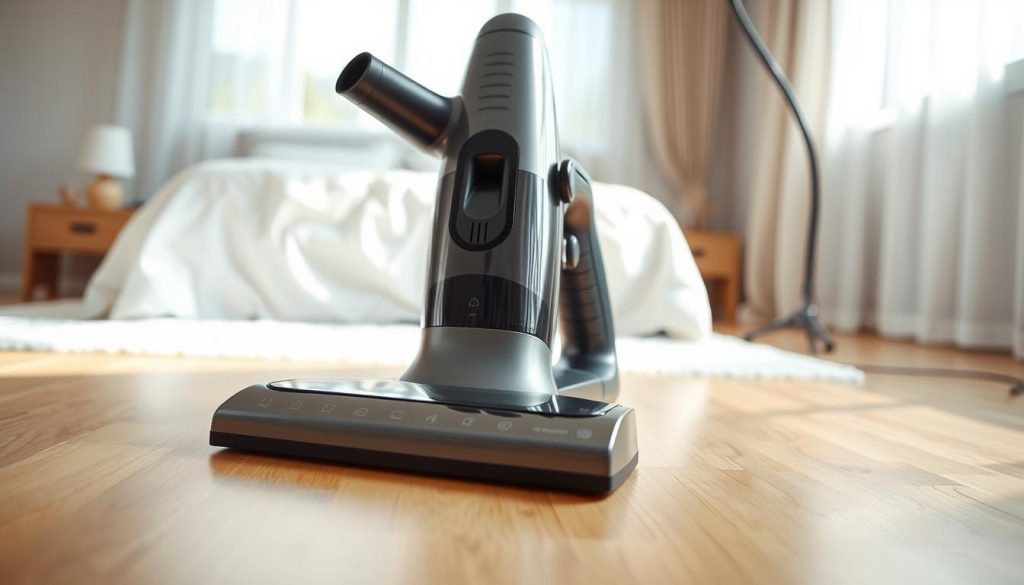
Handheld benefits and trade-offs
Handheld units give superior manoeuvrability on beds and along seams. They heat quickly and are easy to store in cupboards.
Expect a smaller water tank and frequent refills. That tank capacity trade‑off is worth it if you prioritise short, targeted sessions and quick setup.
Canister strengths
Canister machines hold a larger water tank and often include more accessories. They suit longer runs and multi‑room sessions.
The downside is storage and weight. You need extra space and may prefer wheeled models for ease of movement.
Steam mop handheld hybrids
These hybrids bridge floors and quick mattress refreshes. They offer moderate tank capacity and faster switching between floor and fabric heads.
They work well if you want one device to do both jobs without a full canister’s footprint.
Our practical Singapore checklist
- Map nearest plug points; test cord reach across queen or king beds.
- Confirm cupboard or storage corner for heavier canisters.
- Plan ventilation so treated areas dry fast to avoid mould.
- Consider how often you’ll use the unit — more frequent use favours handheld ease.
“Pick a format that fits your routine and storage — the right choice reduces interruptions and makes upkeep realistic.”
Conclusion
We recommend matching products to a clear profile: heavy-duty models for long runs, compact units for quick touch-ups, handhelds for tight seams and canisters when you want longer sessions without frequent refills.
Focus on four decision factors: controlled steam output, sensible pressure, comfortable head and handle ergonomics, plus cord range that suits your bedroom layout. Bigger tank and greater tank capacity cut refill interruptions but raise weight and storage needs.
Technique matters more than power — keep the steamer moving, avoid soaking seams and allow plenty of drying time in humid Singapore. Choose two products, check storage and plug positions, then pick the cleaner you will actually use regularly. A well‑chosen model pays off across the home, not just on the bed.

