

We introduce our range as an all-in-one solution for professional sites in Singapore. Our models handle dust, debris and spills so teams stay productive and safe. The page helps buyers choose the right machine quickly.
We explain what a wet & dry option achieves versus a typical dry-only unit. You will see clear gains in speed, hygiene and risk reduction on sites such as workshops, facilities and hospitality venues.
We outline key decision points: dust class, filtration, suction power, container size, motor options and service support. This helps you compare specs with confidence before purchase.
Buy online with support: browse models, compare features and request guidance from our team. We back Singapore operations with after-sales care so performance stays consistent over time.
Wet & dry vacuum cleaners for professional cleaning in Singapore
Our range is engineered to tackle mixed messes — from fine dust to spilled liquids — in busy sites. These machines are built for repeated daily use with durable housings, robust castors and tough cables that stand up to frequent handling.
Built for demanding environments
We design units for trades, workshops and hospitality back-of-house areas where mess types shift often. Strong mobility makes transport between floors simple. Reliable pickup of mixed waste keeps teams productive.
One machine for dust, damp dirt and spills
Versatility matters. A wet dry machine removes fine dust, binds damp grime and recovers liquids in a single workflow. That reduces tool changes, saves time and improves hygiene in fast turnaround settings.
- Professional definition: engineered for daily operation and site mobility.
- Operational simplicity: one device for solids, moist dirt and liquids.
- Robust build: housings, castors, hose and cable durability for transport and storage.
We will next break down dust classes and filtration so you can match a model to risk and application.
Why choose a wet dry vacuum for commercial spaces
Strong extraction and rapid recovery cut cleaning time and reduce risk on site. High suction power speeds pickup of heavy debris and fine dust, which means fewer repeat passes and lower labour cost.
We find suction power especially valuable where residues build up quickly — cutting, sanding or packaging areas benefit most. Faster pickup keeps production lines and entryways clear.
These machines suit indoor and outdoor work. They handle loading bays, car parks, workshop aprons and tiled lobbies without swapping tools.
Minimising downtime is a core benefit. Quick removal of spills and dust keeps foot traffic safe and production moving. That continuity protects schedules and reduces lost time.
Risk control follows naturally: reclaiming liquids prevents slips, while effective dust capture reduces airborne particles from sweeping. For best results, match dust class and filtration to the task, which we address in the next section.
Commercial vacuum cleaner wet and dry: choosing the right class for your work
Identifying the dominant mess type on site makes selecting the right model straightforward. We advise classing the task first — fine dust-heavy, mixed wet/dry, liquid-focused, or hazardous — then choosing a suitable range from there.
NT Tact systems for uninterrupted work
NT Tact models use a patented self-cleaning Tact system. Short bursts of air keep the filter clear so suction stays high during long duty cycles.
This makes NT Tact ideal where fine dust loads quickly, such as construction sites or busy workshops.
Ap class all-rounders
Ap class machines suit mixed tasks. Semi-automatic filter cleaning helps control loading while handling liquids, moist grime and medium-fine dust.
Standard class for coarse dirt and liquids
Standard class units are robust and built for daily use by contract teams. They excel at coarse debris and large liquid volumes where simple, durable performance matters.
Safety models for regulated environments
Safety vacuums target respirable and hazardous dusts such as asbestos. They offer secure containment and certified filtration, with explosion-proof variants for zone 22 where required.
- Class the job first, then pick the machine class that matches the risk and task.
- Shortlist two or three models by class, then compare motor options, container size, mobility and accessories.
- Prioritise consistent suction and suitable power for the site to protect uptime and performance.
Typical applications: from workshops to construction sites
We map common Singapore applications to machine behaviour so buyers visualise day-to-day use.
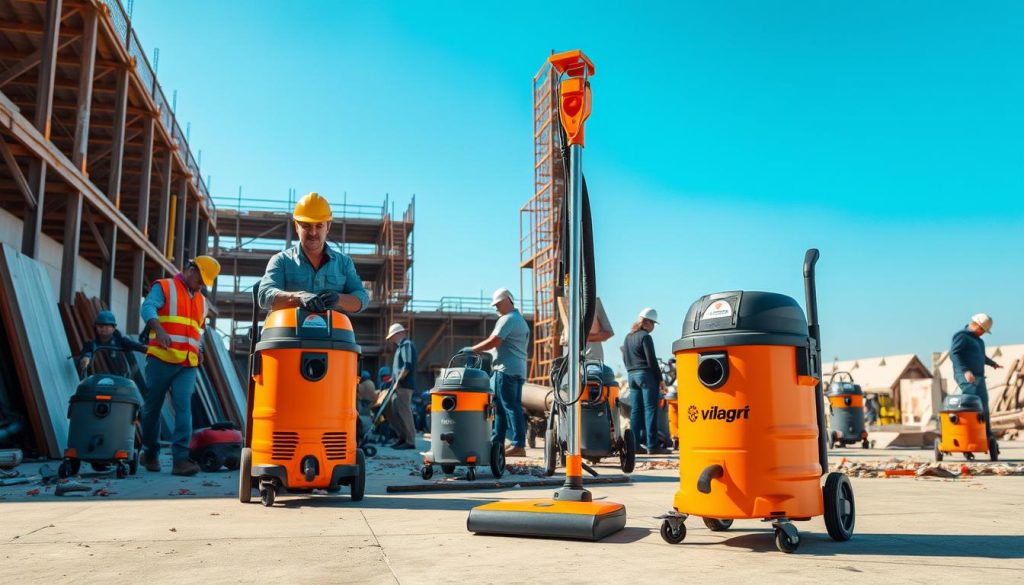
Construction dust control and on-tool extraction
On-tool extraction captures dust at source to reduce airborne spread across construction sites.
We recommend connecting power tools to a unit with a tool port and auto-start. This keeps respirable dust down and protects finishes on the floor.
Workshops and industry: fine dust, sawdust, and material residues
Workshops generate sawdust, fine particles and residues that lodge in machines. A robust unit outperforms a basic dry vacuum for these tasks.
Choose higher filtration where sanding or cutting creates very fine dust to maintain suction and reduce maintenance.
Hotels, restaurants, and building cleaning: liquid recovery and daily use
Standard class machines suit hospitality: quick liquid pick-up prevents slips and lets teams keep public areas open.
Accessory choice matters for tiles, concrete, epoxy and textured outdoor surfaces — match nozzles to the surface for best results.
- We link application choice back to dust class and filtration so buyers avoid under‑specifying for hazardous or high-volume dust.
- For examples of alternative deployments and unusual uses, see our unusual uses.
Wet pick-up performance and liquid safety features
Fast liquid recovery depends on controlled suction and built-in safeguards that stop overfill and motor flooding. We explain how systems move spills into the tank and what prevents costly damage.
How liquid suction uses bypass blower action
The system creates a bypass blower vacuum that draws water and debris through the hose into the container. Airflow carries the fluid directly to the drum so teams can clear spills quickly.
This method is reliable for rapid response. It keeps suction steady while moving liquids away from floors and walkways, improving site safety and turnaround times.
Overfill protection: float shut-off or electronic cut-off
Two common safeguards prevent motor flooding. A mechanical float rises with the liquid and blocks the suction port when the tank reaches its safe level.
Alternatively, an electronic automatic cut-off uses conductive contacts. When the fluid reaches those probes, the unit stops to protect the motor and wiring.
- Practical benefits: fewer slip hazards, faster reopening of corridors, kitchens and loading areas.
- Operational requirements: check tank level, use correct wet nozzles and switch setup when moving from dry to liquid work.
- Expectations: small spills clear fast; large volumes need larger tanks or more frequent emptying to maintain performance.
For any cleaner tasked with frequent liquid recovery, these features are essential. They protect equipment, save time and keep workplaces safe in busy Singapore sites.
Dry vacuum cleaning performance for fine dust and debris
We explain how dry-mode operation moves fine dust through a hose and into the container using a bypass blower. Airflow pulls particles along a controlled path so motors stay protected while material separates out.
Filtration and separation: cartridge, flat filters and cyclone-style settling
Filter choice matters. Cartridge and flat filters trap fine particles at different rates. Cartridge units offer large surface area for long runs. Flat filters are simple and cost-effective for coarse debris.
Cyclone-style settling uses hose-port geometry to induce rotation so heavier fragments fall into the drum before reaching the filter. That reduces filter load and extends service intervals.
Maintaining suction power when filters load with dust
Filter clogging reduces suction over time. Professional models include semi-automatic or automatic cleaning that briefly reverses airflow to dislodge dust and restore suction.
| Issue | Mitigation | Best for |
|---|---|---|
| Fine dust build-up | Cartridge filter + auto-clean | Sanding, grinding |
| Mixed coarse debris | Flat filter + cyclone settling | Workshops, loading bays |
| Frequent clogging | Semi-automatic pulse cleaning | Intermittent heavy dust loads |
Selection guidance: choose a system that matches dust type and workflow. A single dry vacuum cleaner mode works for many sites, but an all‑in‑one platform pays off where mess types change during the day.
Filter cleaning technology that keeps suction power high
Filter cleaning systems play a quiet but crucial role in keeping suction steady during long shifts.
Semi‑automatic cleaning lets operators trigger cleaning at set intervals. On AP class units the practical method is simple: press the pulse button three times quickly, ideally with the hose port closed. This restores airflow with minimal interruption and keeps suction power reliable on busy sites.
Semi‑automatic filter cleaning for controlled intervals
We use this mode when teams want manual control over maintenance cycles. It reduces unplanned stops and gives predictable performance during repetitive tasks.
Automatic cleaning and triggered air cleaning technology
Triggered Air Cleaning Technology (Tact) uses short, sensor‑led airflow reversals to dislodge dust without halting work. L class units allow interval settings (min 60s, max 15s), while M and H classes use differential pressure to select 7 / 15 / 60s or none.
Benefits: time savings, safer handling, fewer consumables
Automatic systems save time and reduce operator exposure to collected dust. They keep suction consistent, cut maintenance time and lower bag spend.
| Method | How it works | Best for |
|---|---|---|
| Semi‑automatic | User triggers pulse (press button x3 with hose port closed) | Routine site tasks; AP class use |
| Automatic / Tact | Sensor‑triggered brief airflow reversals (intervals per class) | Fine dust environments; long shifts |
| Bagless operation | No filter bag; full drum use; empty less often | Non‑hazardous waste to save consumables |
When to work without bags: bagless use maximises container volume and reduces consumable cost, but we advise using disposal bags or safety sets for hazardous dusts to meet class compliance. For model choices see our professional range.
Dust classes L, M and H for commercial vacuums
Choosing the right filtration class protects workers and ensures compliance on site. Dust class tells you the filtration performance required for different hazard levels, not just how clean an area will look.
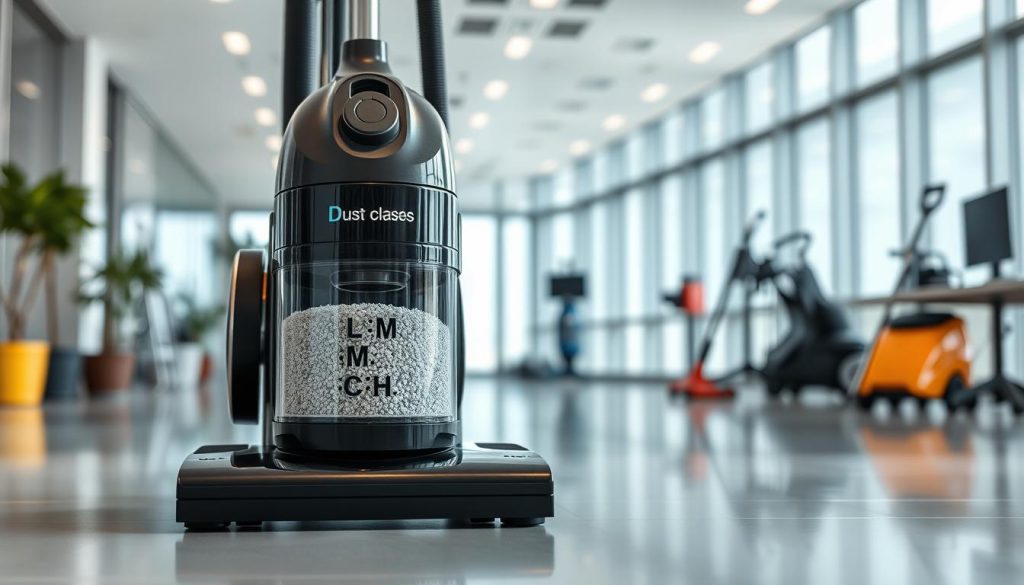
Class L — moderate-risk particles
Class L handles moderate-risk dust where permeation ≤1.0%. Typical materials include chalk, lime and plaster.
Practical note: maintenance and disposal are straightforward, but we still follow safe emptying and bag procedures.
Class M — the construction baseline
Class M limits permeation to
Class H — hazardous dust containment
Class H offers the strictest protection (
- Why classes matter: they match filtration to risk and legal requirements.
- Our advice: assess your materials and tasks first, then pick the right class — price or suction figures alone are not enough.
- Next: we explain HEPA and specialised filters so class and filter type work together for safe containment.
HEPA and specialised filters: matching filtration to your requirements
Filter selection is a practical system decision, not just a parts swap. We pair filtration to hazard level, dust fineness, wet‑to‑dry switching frequency and operating cost targets. This helps protect staff and avoid premature filter failure.
Colour-coded system and on-site signals
Quick checks save time. The colour code guides suitability: brown for wood and fibre dust, red for HEPA, black for the toughest jobs, blue for general use, green for dry, cost‑effective work.
PTFE and PES for mixed use
PTFE and PES media resist moisture and rot. They last longer where frequent wet-to-dry changeovers occur and keep performance steady on mixed tasks.
Certified H-class containment
H-class filters provide verified separation (up to 99.995% HEPA standard). For hazardous materials use disposal bags or safety filter sets to meet safe containment rules and local regulations.
Paper filters for cost-effective dry applications
Paper is sensible where only dry work occurs. If liquids are ever picked up, the paper element must be dried or replaced to avoid damage.
- Match filter type to dust class, materials and disposal method.
- Choose PTFE/PES for wet use; pick red HEPA for high‑risk tasks.
- Consider the filter, bag and class as one system to protect people and assets.
Key features to compare across vacuum cleaner models
We focus on the practical features that make one model more productive than another on site.
Motor options and continuous-operation capability: Some units offer up to three motors for higher suction. We look for thermal protection, staged start to reduce current draw, and service intervals that support long duty cycles for workshops and contract teams.
Container capacity, housings and mobility: Larger drums cut down emptying stops. Robust metal or reinforced poly housings with bumpers and handholds resist knocks. Large metal castors ease movement over ramps and debris‑strewn surfaces.
Wet-to-dry changeover and floor nozzles
Quick-change floor nozzles let crews switch from liquid pick-up to dry pick-up without tools. Wide nozzles with insert options improve coverage and speed across tiled lobbies or workshop floors.
Storage and workflow conveniences
Tool sleeves, hose and cable storage, and a dedicated accessory holder reduce loss and speed setup. A suction hose connection in the machine head can increase net container volume, improving productivity on long runs.
- Checklist approach: rank models by motor count, duty capability, tank size and mobility.
- Practical tip: prioritise reliable power delivery and easy changeovers for multi‑task sites.
Operational best practice for cleaner, safer environments
Putting extraction where the task happens prevents dust migration and protects staff health. We promote simple workflows that keep airborne particles low and make cleaning faster across Singapore sites.
Capture dust at source with tool connector sockets and auto-start
Connect tools to extractor sockets so the unit starts whenever a power tool runs. This keeps dust at the point of origin and cuts secondary spread.
Low-dust methods: damp operation and binding dust with water
Where safe, we recommend damp methods to bind particles. Lightly moistening surfaces during outdoor demolition or grinding limits airborne dust without creating excess water.
Protecting teams from respirable crystalline silica and other fine dusts
Fine dust harms long-term health. Respirable crystalline silica, asbestos and certain hardwood dusts can cause serious illness. We select dust class and filtration to match the risk and reduce exposure.
- Avoid dry sweeping; keep extraction close to the work.
- Empty containers carefully and use disposal sets for hazardous loads.
- Train cleaners in capture-at-source workflows and safe wetting methods.
| Practice | Benefit | Best for |
|---|---|---|
| Tool port + auto-start | Immediate extraction; less rework | Sanding, cutting |
| Damp binding | Reduces airborne spread | Outdoor grinding, demolition |
| Correct dust class & filters | Health protection; compliant disposal | Silica, asbestos, hardwood dusts |
Our range of commercial cleaning solutions in Singapore
We present a curated selection that aligns machine capability with typical facility needs.
Wet & dry vacuum cleaners to suit every budget and application
Our range covers tasks from fine dust capture to large liquid recovery. We list products by duty cycle, filtration class and tank size so buyers match machines to real workloads.
Examples: Allinton supplies AET (Italy) models with high suction, large capacity drums and two-bucket solid/liquid separation. Winston Engineering (Jetmaster) offers compact, robust units plus high-pressure cleaners for sites needing fast rinse and deep grime removal.
Complementary equipment for demanding sites and facilities
We advise building a system: the main unit, correct nozzles, certified filters and a disposal method. This prevents under‑specifying and cutting productivity.
| Need | Recommended product feature | Why it matters |
|---|---|---|
| Fine dust | High-filtration cartridge, Tact cleaning | Maintains suction; protects health |
| Mixed wet/dry mess | Two-bucket separation, large drum | Efficient liquid removal; less downtime |
| Rinse & deep clean | High-pressure cleaner + nozzle set | Complements suction for hard grime |
- Budget clarity: spend scales with duty, filter tech and accessories.
- Products match applications: pick by task, not price alone.
Buying online in Singapore: delivery, support, and service
We make the purchase process transparent so facilities teams know what to expect from order to first use.
Choosing the right solution with our expert guidance
We ask practical questions about dust type, switching needs, drum size, duty cycle and compliance to match requirements to suitable models.
Our advisers compare specs, suggest accessories and confirm delivery windows that fit business schedules in Singapore.
After-sales support to keep performance consistent
Planned service keeps uptime high. We supply spare parts, genuine filters, accessories and guided troubleshooting so suction and reliability stay steady.
For multi-site teams we standardise recommended models to simplify training, parts stock and routine servicing.
- Request a tailored recommendation.
- Compare shortlisted models side-by-side.
- Proceed to checkout with scheduled delivery and support.
Conclusion
In conclusion, the right all‑purpose machine streamlines cleaning where dust, spills and debris coexist. We recommend matching machine class to the dominant task, then pairing the correct filtration, accessories and service plan.
Key benefits, include faster turnaround, safer handling and sustained suction through proper filter care and operating routines. Robust build, easy mobility and quick wet/dry changeovers make the investment pay back in uptime.
Browse our wet dry vacuum options online, compare models and contact us for tailored guidance to keep performance high across Singapore sites.

