
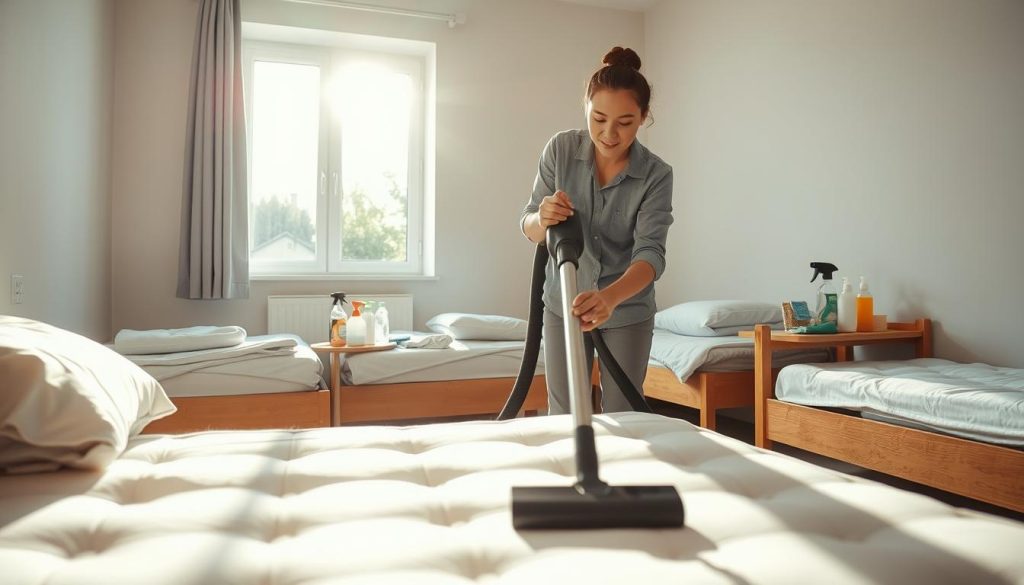
We set clear expectations for what hostel mattress cleaning means in real operations. In Singapore’s humid climate, bedding can absorb sweat, oils, dust and dead skin. This affects health, comfort and sleep quality.
Our approach is a repeatable, low‑moisture process that fits fast turnovers without compromising hygiene. We explain what teams can handle in‑house and when to call for deeper intervention.
We tie mattress hygiene to guest experience. Proper steps reduce odours, shorten drying times and protect guest confidence. We also show why ventilation and product choice matter in high humidity.
Below we preview a simple workflow from preparation to drying. We define the difference between cleaning, deodorising and sanitising so staff apply the right method for the right issue.
For practical stain advice and treatment options, see our guide on urine stain advice.
Key takeaways: repeatable steps, humidity-aware choices, correct methods, faster turnovers.
Why mattress hygiene matters in Singapore hostels
Unchecked debris and moisture turn sleep surfaces into a hotbed for allergens and germs. In warm, humid rooms we manage, dust mites and other mites thrive. These tiny organisms and trapped dust worsen breathing and allergy symptoms.
How dust mites, bacteria and allergens affect guest health and sleep
We see dust and allergens trigger itchy eyes, runny noses and disrupted sleep. For sensitive guests, this can escalate to chest tightness or asthma exacerbations.
Common contaminants in high‑turnover rooms
Typical finds include dead skin cells, sweat, body oils, crumbs and occasional bodily fluid marks. Bacteria and general germs increase when mattresses are used nightly with little airing time.
Reputation, reviews and duty of care
“Consistent checks and records protect guests and prove our standards to auditors.”
Visible stains or lingering odours damage reviews and create operational fallout. We document inspections and follow set protocols to show due care. For more detailed protocols see our mattress hygiene guidance.
| Contaminant | Primary risk | Control priority |
|---|---|---|
| Dust & dust mites | Allergic reactions, sleep disruption | Vacuuming, airing |
| Bacteria & germs | Infection risk, odour | Sanitise, low‑moisture treatments |
| Bodily fluids | Staining, odour, pathogen presence | Spot treatment, documentation |
What we prepare before cleaning the mattress
Preparation sets the stage: removing layers and staging tools prevents repeat soiling and speeds turnaround. We treat prep as part of the hygiene system, not a separate chore.
Stripping the bed: covers, pillows, protectors and toppers
We remove mattress covers, pillowcases, duvets, toppers and protectors. Items are separated by colour and care label to avoid dye transfer.
Protectors are inspected for wear and leaks; a sound protector reduces stains and moisture reaching the core.
Hot-water washing and high-heat drying for bed linens
We choose the hottest safe wash setting with detergent to lift sweat and oils. Weekly laundering of bed linen is recommended where turnover is high.
High-heat drying helps remove residue and shortens damp time before items return to service.
Sun-drying as a practical, natural disinfectant option
When terraces or lines are available, direct sunlight adds practical disinfection. Sunlight also helps remove odour and speeds evaporation.
| Step | Action | Benefit |
|---|---|---|
| Strip bed | Remove covers, pillows, toppers | Prevents recontamination |
| Sort linens | Separate by colour and fabric care | Protects fabrics, ensures effective wash |
| Wash & dry | Hot wash, high-heat dry where safe | Removes oils; reduces dampness |
| Inspect protectors | Check for wear and leakage | First line of defence |
Our hostel mattress cleaning workflow for reliable results
We follow a compact process that starts with a rapid visual check and finishes only once drying and ventilation are confirmed. This gives consistent results and reduces the chance of rework.
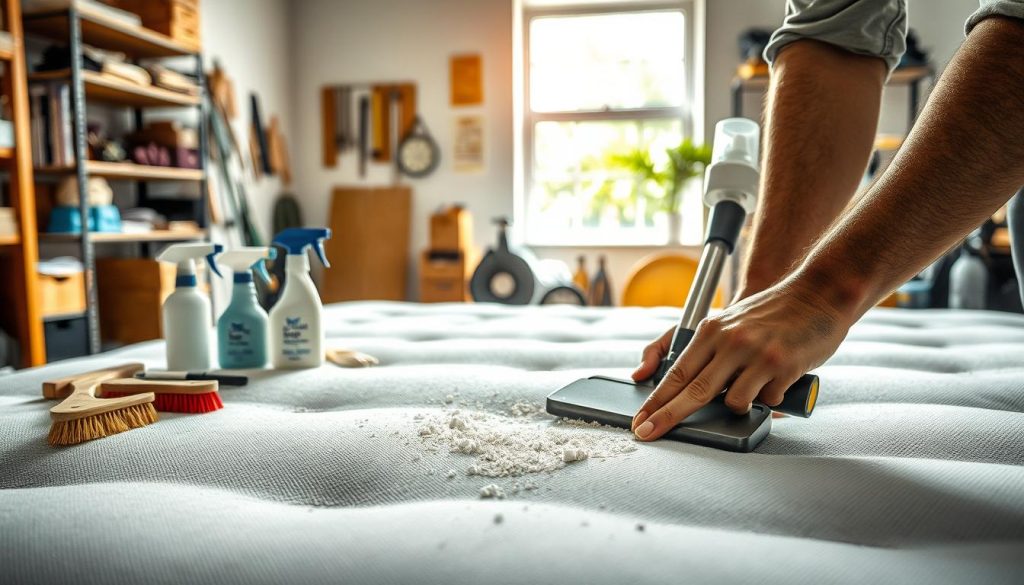
Fast visual checks for stains, odours, wear and moisture
We run a quick inspection first, noting stains, damp patches, seam wear and any signs of pest risk or replacement need.
These checks tell us whether a light treatment will suffice or if escalation is required.
Tools we use: upholstery head, crevice attachment and sprays
Our kit is standardised for speed: a vacuum with an upholstery head for broad areas and a crevice nozzle for seams.
We use low‑moisture sprays for deodorising and sanitising, applied sparingly to avoid saturation.
Protecting surrounding areas and improving airflow
We shield walls and headboards from overspray and clear floors of debris before work begins.
Windows and fans or dehumidifiers stay on where possible to speed drying and control odour.
- Inspect → dry removal → spot treat → deodorise → sanitise → dry/ventilate.
- Label spray bottles clearly to avoid product mix-ups during busy shifts.
- Document exceptions (heavy staining, persistent odour, moisture) for management review.
Vacuuming properly to remove dust, dirt and hidden allergens
We prioritise a methodical dry-pass that lifts embedded dust before any spray or spot work begins. This is our primary step to reduce allergens and visible debris in high‑turnover rooms.
Working the surface, sides and seams methodically
We use an upholstery attachment across the top and sides to avoid fabric damage while drawing out fibres. Then we switch to the crevice tool for seams and joins.
Targeting crumbs, hair and fine dust that regular turns miss
Slow, overlapping passes lift fine dust rather than just pushing it around. We set minimum time-on-bed guidelines for each size so staff do not rush and leave dirt behind.
- Vacuum sides and handles—edges trap fibres and odour sources.
- Work seams and crevices carefully to remove compacted crumbs and hair.
- Adjust suction and nozzle for different mattress types to protect quilting.
Vacuuming is not cosmetic: it reduces the load before any wet treatment and helps keep rooms fresh for guests. We finish with a quick check of corners and labels to catch what is often missed.
Spot cleaning stains without over-wetting the mattress
Small, precise treatments solve most marks without saturating foam or padding. We favour a “barely damp” rag to limit moisture that can sit under layers.
Why “barely damp” matters for memory foam and mould prevention
Memory foam traps moisture. That creates a risk of mould and boosts mite activity in humid Singapore, which affects guest health.
Warm-water dilution and gentle blotting for fresh marks
We dilute a liquid cleaner in warm water and use a clean, well-wrung rag. Blot from the outside in to keep the stain area small.
Natural stain options for tougher spots
For stubborn marks we make a lemon-juice and salt paste. Leave for 30–60 minutes, then wipe away and air-dry immediately.
“Controlled blotting protects fibres and prevents deeper residue.”
| Method | Application | Drying note |
|---|---|---|
| Warm-water dilution | Light blotting with wrung rag | Air-dry with fan; avoid covers until dry |
| Lemon & salt paste | Apply 30–60 mins, wipe clean | Ventilate well; repeat only if fabric permits |
| Professional escalation | Persistent or large stains | Refer out to avoid damage |
Deodorising with baking soda and low-moisture sprays
A light, low‑moisture deodorising routine brings quick relief from persistent odours without risking damp cores. We neutralise smells while keeping fabrics dry and ready for guests.
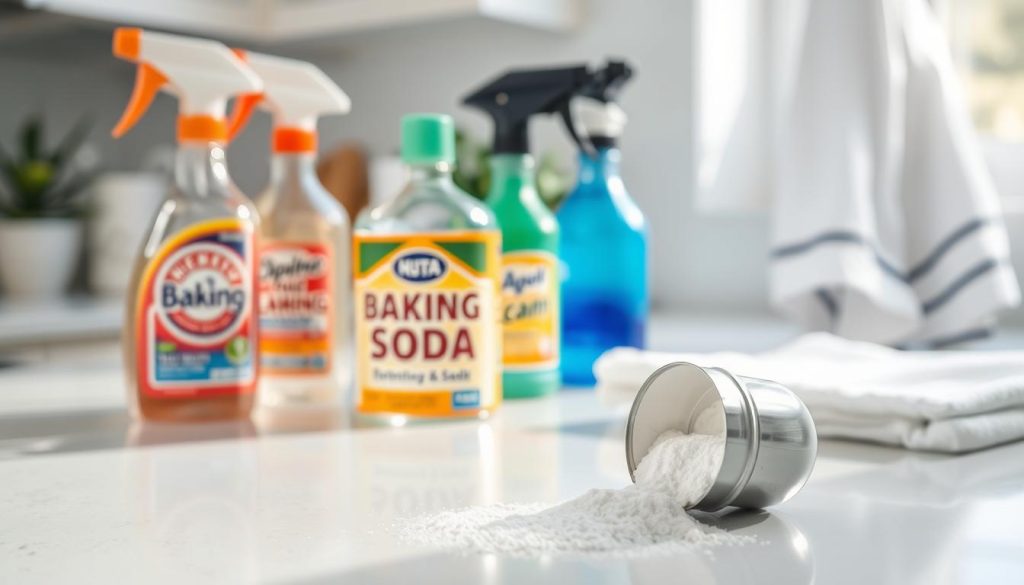
Vinegar-and-water misting: We lightly mist equal parts distilled white vinegar and water to neutralise odours without soaking the surface. After a brief rest, we open windows or run fans to ensure full air drying.
Using baking soda to absorb moisture and smells
We sprinkle baking soda evenly across the surface to absorb residual moisture and smells. For routine refreshes we leave it for several hours.
Dwell times: hours, overnight and up to 24 hours
For stronger odours we leave the soda overnight; for deep deodorising we allow up to a full day. After the chosen dwell time we vacuum thoroughly to remove all powder.
Optional essential oils and guest-friendly scents
When a subtle scent helps, we mix 10–20 drops of essential oil into the baking soda container before application. We choose mild notes and use minimal quantities to avoid triggering sensitivities.
“Better deodorising supports better sleep and removes the musty impression that harms reviews.”
| Step | Action | Timing |
|---|---|---|
| Vinegar mist | Light mist of equal parts distilled white vinegar and water | Air dry until surface feels dry (minutes to hours) |
| Baking soda | Sprinkle evenly; optional 10–20 drops essential oil mixed in | Several hours; overnight for stronger odours; up to 24 hours for deep deodorising |
| Final vacuum | Vacuum thoroughly to remove all powder and residue | Immediately after dwell time |
Disinfecting and sanitising to reduce germs and dust mites
Effective sanitisation reduces microbial load while keeping fabrics dry and guest‑ready. We treat sanitising as distinct from deodorising: the aim is to lower microbes and allergens, not just mask smells.
Antibacterial sprays: correct coverage and dry time
We apply an antibacterial spray as a light, even mist across the surface. Then we wipe with a warm, well‑wrung cloth to avoid wet patches.
Allow full dry time before remaking the bed. Sanitising is ineffective if the core stays damp and odour returns.
Steam technique and heat benefits
Handheld steam reduces dust mites and allergens by heat. We move steadily across the fabric rather than holding repeated bursts in one spot.
Avoid saturation. Excessive moisture risks mildew in Singapore’s climate and undoes the hygiene gains.
Where UV fits in modern routines
UV treatments add a targeted germ reduction step when paired with vacuuming and thorough drying. We use them as a supplementary layer, not a sole remedy.
“Sanitise, dry, verify — repeat only when fully dry.”
- Separate sanitising from deodorising; choose products with validated dwell times.
- Prefer hypoallergenic, non‑toxic options to limit guest sensitivities.
Drying and ventilation in humid conditions
Getting drying and ventilation right prevents a small damp patch from becoming a persistent problem. In Singapore’s humid environment we treat drying as non‑negotiable to protect hygiene outcomes.
Managing water use to prevent mildew and mite breeding
We minimise water everywhere we can. Low‑moisture methods reduce the risk of mildew and limit conditions that promote mites.
When we must spot-treat, we blot and use fans immediately. Excess surface wetness is never left under covers or protectors.
How long we allow for drying before making up the bed again
We use a “dry-to-touch plus buffer time” rule. Once the surface is dry to touch we add a conservative buffer—typically several hours—before remaking the bed.
Operationally, we schedule deeper work early in the day so rooms get maximum airflow before check‑in. Before bed‑making we perform a tactile and smell check to confirm the mattress is neutral and ready for service.
“Dry thoroughly, ventilate well, verify before reuse.”
Cleaning frequency, schedules and staff best practices
We set a predictable cadence of routine upkeep so teams can meet guest needs without dropping standards.
How often we act: after stays and planned deep work
Where occupancy is high we aim to treat surfaces after each stay when feasible. This quick turnover step helps control stains, odours and issues that affect guest comfort and health.
Regardless of turnover, we schedule a deeper mattress cleaning every three to six months. That interval balances practical staffing with proven hygiene gains.
Routine maintenance between deep cleans
- Daily/after-stay tasks: vacuuming, spot checks and light deodorising where needed.
- Weekly tasks: record inspections of seams, dampness and visible wear.
- Quarterly tasks: full sanitise cycle, steam or targeted treatments and supervisor sign-off.
Training, inspections and consistent standards
We train every team member on product doses, dwell times and the safe use of low‑moisture methods. Consistency reduces rework and supports guest confidence.
“Standardised checks and clear sign-off protect our guests and our reputation.”
| Interval | Primary tasks | Outcome |
|---|---|---|
| After each stay | Vacuum, spot treat, deodorise as needed | Immediate removal of visible issues; ready for next guest |
| Monthly | Inspection checklist, minor sanitise, record review | Early catch of odours, dampness and fabric wear |
| 3–6 months | Deep mattress cleaning, steam/sanitise, supervisor audit | Reduced allergen load; extended asset life |
We keep clear logs and supervisor sign‑offs. Good records back up our services when complaints escalate and help with planning extra external services during peaks.
For detailed step guidance, we link practical procedures to staff training so execution matches policy. Our operational tips include scheduling deep work on low-occupancy days and rotating rooms so drying time is never compromised.
When we choose a professional mattress cleaning service
We decide to outsource when scale, equipment or turnaround demands outstrip our team’s capacity.
Decision criteria include heavy staining, persistent odour, suspected contamination or tight dry-times that risk guest checks. When these occur, a professional service can deliver advanced equipment and validated protocols.
In-house vs outsourcing: control, expertise and equipment
We keep in-house work for quick response and flexible scheduling. This gives immediate control over routine tasks.
Outsourcing brings industrial gear, specialist techniques (steam, UV, low‑moisture systems) and consistent output at scale. The trade-off is less direct oversight and a need for clear scopes of work.
Cost considerations and what impacts pricing in Singapore
Price drivers are mattress size, stain severity, chosen method and volume. Market guidance notes single-unit professional service can command premium rates depending on these factors.
Bulk contracts often reduce per-unit cost and make periodic resets affordable across multiple rooms.
What we look for: hypoallergenic products and transparent processes
We require providers to use hypoallergenic, non‑toxic products and to document each step: vacuuming, low‑moisture stain removal, steam or UV options, and estimated drying times.
“Request product lists and after‑service care instructions so we can maintain results between visits.”
| Decision trigger | Typical provider benefit | Expected cost factor |
|---|---|---|
| Heavy staining or contamination | Industrial spot removal, lab testing if needed | Higher due to labour and materials |
| Fast turnaround needs | Commercial drying, rapid treatments | Premium for urgency |
| Large volume work | Consistent output; lower per-unit price | Discounts with scale |
Conclusion
We focus on simple steps that deliver measurable hygiene gains with minimal disruption.
Our end-to-end approach is clear: prepare linens, vacuum thoroughly, spot treat with minimal moisture, deodorise with baking soda, sanitise as needed and then dry fully before reuse.
In Singapore, controlling moisture and airflow is as important as product choice because humidity magnifies odour and mould risk. Fans, dehumidifiers and prompt drying are non-negotiable.
Consistent routines protect guest comfort and extend service life, reducing emergency room blocks and replacement costs while keeping reviews positive.
Next steps: implement a schedule, train staff to our standard, use protectors and a raised platform to limit dust beneath the bed, and call professionals when issues exceed safe in-house limits.

