

We set the buying context for Singapore households where indoor air quality, fine dust and humidity make routine cleaning feel never-ending, especially in HDB flats and compact condominiums.
This guide defines a canister-style model that uses water inside the system to trap debris and shows how it differs from bagged and bagless options. We explain who benefits most: allergy-prone families, pet owners and anyone who wants cleaner exhaust air after a session.
We outline what we will judge: performance, filtration effectiveness, daily handling and cost of ownership. Our aim is a shortlist based on measurable criteria, not marketing claims.
We also preview trade-offs: the benefits of water-based filtration versus added weight, the need to empty dirty water, and the extra storage space required. By the end, we will know which specifications matter for our home and budget.
How water filtration vacuums work and why they suit Singapore homes
This section explains in plain terms how a wet-trap system captures debris and why urban flats often notice fresher indoor air after use.
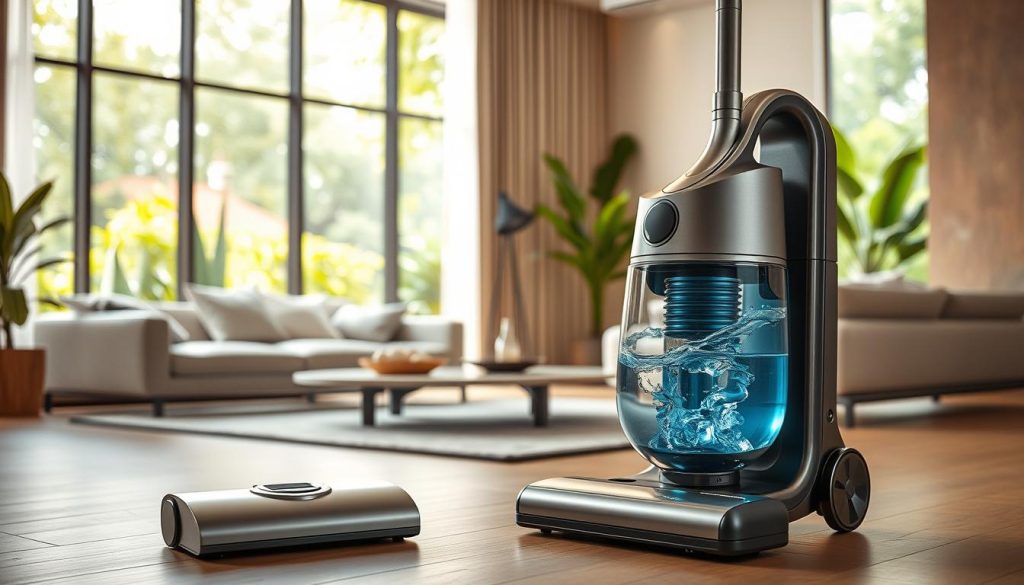
Water as a natural trap
Suction draws air and dust into a rotating liquid bath where particles become wet and heavy. The debris then stays in the bath rather than being re‑released into the room.
Multi-stage protection
After the liquid stage, most machines add secondary layers to polish exhaust air. A wet-compatible HEPA stage catches microscopic particles and any residual droplets.
Allergy-centred advantages
We see two practical wins for allergy sufferers: less airborne dust during operation and far smaller dust clouds when emptying. Allergens are removed with the trapped debris instead of building up in a bag or bin.
What “clean air” claims really mean
Manufacturers quote capture percentages and micron ratings. We look for stated HEPA class and particle-capture numbers so we can compare models fairly.
| Stage | Role | Expected result |
|---|---|---|
| Liquid bath | Bulk debris capture | Less re‑entrainment of dust into room air |
| HEPA stage | Microscopic particle safety net | Higher exhaust cleanliness; captures pollen and fine particles |
| Motor protection | Protects internals from droplets | Longer machine life and stable suction |
For an easy primer on types and practical buying cues, see our guide to vacuum cleaner basics.
Choosing a water filter vacuum cleaner: what to compare before you buy
We focus on practical checks so your next purchase works in a typical Singapore home. Start by testing how suction performs on tiles, vinyl and thin rugs rather than relying on wattage alone.
Suction and power efficiency
Measure pickup on real floors: a low-rated power machine can still deliver strong suction if the design channels airflow well.
Power efficiency means steady pickup with modest input power, which keeps running costs down while removing embedded dirt.
Tank capacity and handling
More liquid capacity often gives better primary capture but adds weight and bulk. For flats with stairs, a smaller compartment is easier to carry.
Check how simple it is to empty and rinse. Quick-cleaning routines prevent lingering odours in humid climates.
Filtration hardware and protection
Look for a HEPA-class stage and parts that tolerate wet conditions. A dedicated motor-protection layer helps the machine last.
“Practical usability beats headline specs: if you won’t use it daily, its performance is irrelevant.”
| Spec | Why it matters | Target for flats |
|---|---|---|
| Suction design | Real pickup on floors | High airflow, measured pickup |
| Tank size | Filtration vs weight | 1–3 L for balance |
| Operating radius | Ease of movement | 8–12 m |
- Right floor head for hard floors
- Crevice and upholstery tools for corners and sofas
- Parking position for quick stops
Real product benchmarks we can use when shopping in Singapore
We use a concrete, local model to turn specs into meaningful shopping cues for small flats and condos.
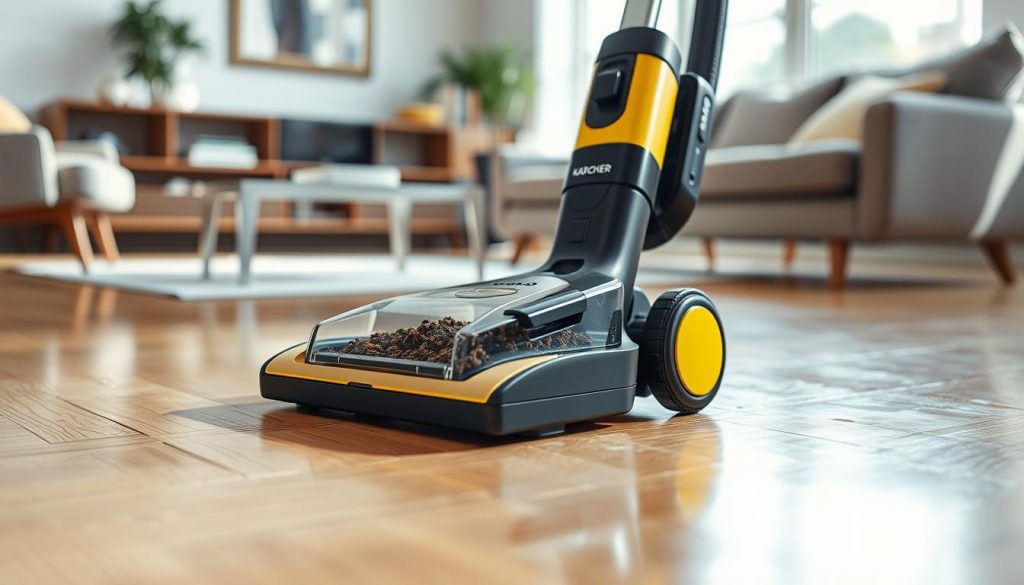
Kärcher DS6: key specs for quick comparison
Overview: the DS6 is a compact canister with a 650 W rated input and an energy-efficient motor marketed as equivalent to a 1,400 W unit.
| Spec | Value | What it means at home |
|---|---|---|
| Rated input power | 650 W | Good balance of power and running cost for flats |
| Water volume | 2 L | Enough capture without excessive weight for stairs |
| HEPA | HEPA 13; up to 99.95% exhaust capture | Cleaner exhaust air; useful for allergy-prone households |
| Operating radius / weight | 10.2 m / 7.5 kg | Long reach and portable for multi-room cleaning |
Ownership cues: automatic cable rewind, accessory compartment and FoamStop defoamer reduce fuss and protect the machine. Included tools (floor head, crevice and upholstery nozzles) help remove embedded dirt and particles from sofas and floors.
For a shopping checklist and one-stop bundle options, consider our recommended local supplier page: order timing and bundle offers.
Conclusion
We give a simple decision path so readers can match a model to their flat or house.
Choose a water-based model when you want noticeably cleaner exhaust air, a more contained emptying routine and you accept the extra rinsing that upkeep brings.
Prioritise suction stability, realistic handling weight with a full tank and the quality of the final filter stage. These checks decide real-world performance.
For Singapore homes, smaller flats often favour operating radius and storage. Larger homes may value tank size and accessory coverage. Allergy-focused households should pick HEPA-rated exhaust claims.
Compare specs side-by-side using a benchmark like the DS6. Match what matters to your layout and habits, and pick the best-value model among comparable vacuum cleaners.

