

We provide practical, clinic-friendly solutions for premises with high patient flow and strict hygiene expectations. Our team helps clinics, medical offices and nearby support sites get fast, clear recommendations and outcomes they can trust.
We outline a simple journey: assessment → recommendation → supply → installation → monitoring → maintenance. Many units are plug & play and can be installed in about ten minutes, so disruption to opening hours and staff workflows is minimal.
Our on-demand options include on-site audit and initial training from Airinspace. We focus on reducing exposure to airborne particles while supporting everyday comfort and continuity. We do not make medical claims; instead we emphasise measurable clean air outcomes and technical topics to follow, such as HEPA grades and UV-C choices.
For facilities seeking integrated HVAC approaches and 24-hour reliability, see our partner guidance on centralised controls and ERV-based filtration in this short guide: LG healthcare HVAC solutions.
Air quality risks around hospitals and healthcare facilities in Singapore
High patient volumes and rapid turnover around medical complexes create distinct challenges for indoor air control. We focus on practical risk factors that affect staff, patients and visitors in clinic clusters and adjoining premises.
High-traffic waiting areas and consultation rooms as airborne transmission hotspots
Waiting rooms, receptions and small consultation rooms concentrate people for long periods. Coughing, sneezing, speaking and close-proximity examinations can all raise the level of infectious particles in shared spaces.
- High people density and frequent turnover increase exposure to bacteria and viruses.
- Procedures such as throat checks can generate extra aerosols in a single room.
- “Clean-looking” interiors give a false sense of safety when ventilation is limited.
Why enclosed, poorly ventilated rooms can raise infection risk for patients and staff
Enclosed spaces with stagnant zones reduce dilution of contaminants. Over long shifts, staff face cumulative exposure that affects comfort and overall health.
When upgrades to central ventilation are constrained, mechanical filtration and supplementary systems provide a practical layer of protection for clinical and support areas.
What our air purifier service near hospital includes
We begin with a concise site inspection to match technical choices to each room’s real use. This ensures recommendations are practical and easy to approve.
On-site assessment and room-by-room recommendations
We review room size, occupancy patterns and typical activities to produce clear, room-specific notes and a recommended system for procurement teams.
Selection, supply and quick installation
We select suitable products for reception, consultation and treatment areas. Installation is plug-and-play and typically completed in about 10 minutes to avoid disruption.
Monitoring, maintenance and on-demand support
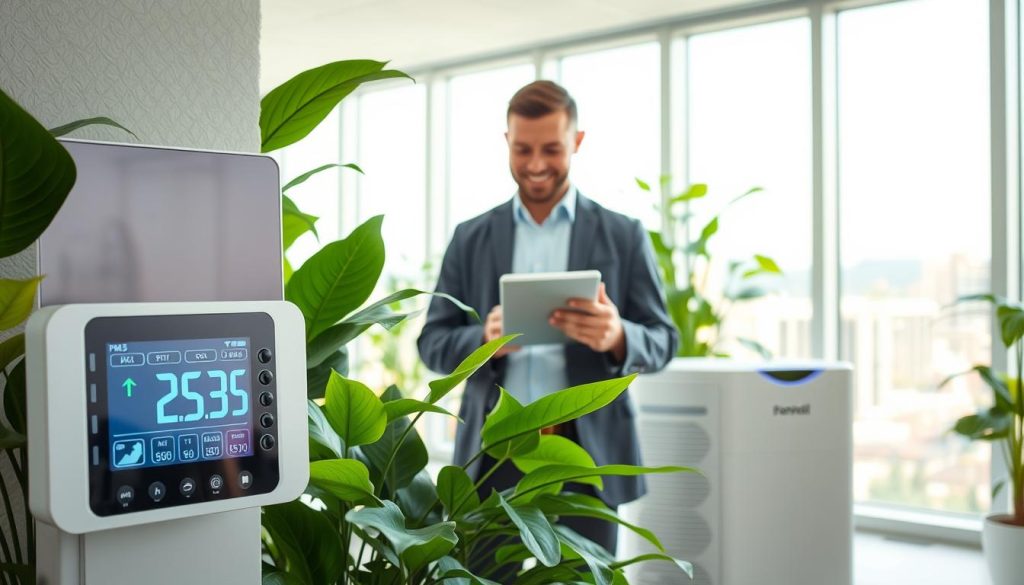
Our team offers professional air monitoring options using sensors and particle counters to track trends over time.
We provide scheduled maintenance, automated filter change alerts and on-demand interventions such as audits, initial training and airborne surface disinfection.
“Our deliverables include assessment notes, a recommended system per room and a maintenance schedule for quick approvals.”
| Deliverable | Purpose | Typical turnaround |
|---|---|---|
| Assessment notes | Room-by-room recommendations | 24–48 hours |
| Recommended system | Performance matched to use | 2–3 days |
| Maintenance schedule | Filter planning and change alerts | Custom, ongoing |
For medical office guidance and tailored products, see our dedicated page at medical office solutions.
Hospital-grade filtration and why we recommend H13/H14 HEPA
Hospital-grade in practice means selecting proven mechanical filtration and sizing systems by performance metrics rather than trusting marketing labels.
The French Public Health Council recommends H13 or H14 HEPA mechanical filters for medical practices. We follow that guidance when specifying equipment for clinic clusters and adjoining spaces.
Mechanical filtration that suppresses viruses and bacteria with H14 performance
H14 HEPA performance is stated by Airinspace to suppress 99.995% of viruses and bacteria in the air. We report this figure as a measured performance parameter, not a clinical claim.
Capturing fine particles, aerosols, and dust linked to indoor pollutants
HEPA filters capture fine dust, aerosol-sized particles and common indoor pollutants that build up in enclosed rooms.
Why turnover matters: we size systems to achieve at least five air renewals per hour in busy waiting areas and consultation rooms to reduce airborne load and improve comfort.
- Proof-based selection: performance testing and correct sizing.
- Practical outcomes: reduced particulate levels and clearer environmental quality.
- Next steps: activated carbon and enclosed UV-C can complement HEPA where odours or surface disinfection needs arise.
For guidance on complementary cleaning systems, see our partner page on premium solutions: Lura premium air-cleaning systems.
UV-C air sterilisation options for clinics and rooms near hospitals
Combining HEPA, activated carbon and enclosed UV-C treatment gives clinics a measurable way to reduce microbial load in enclosed spaces.
How the combined workflow operates
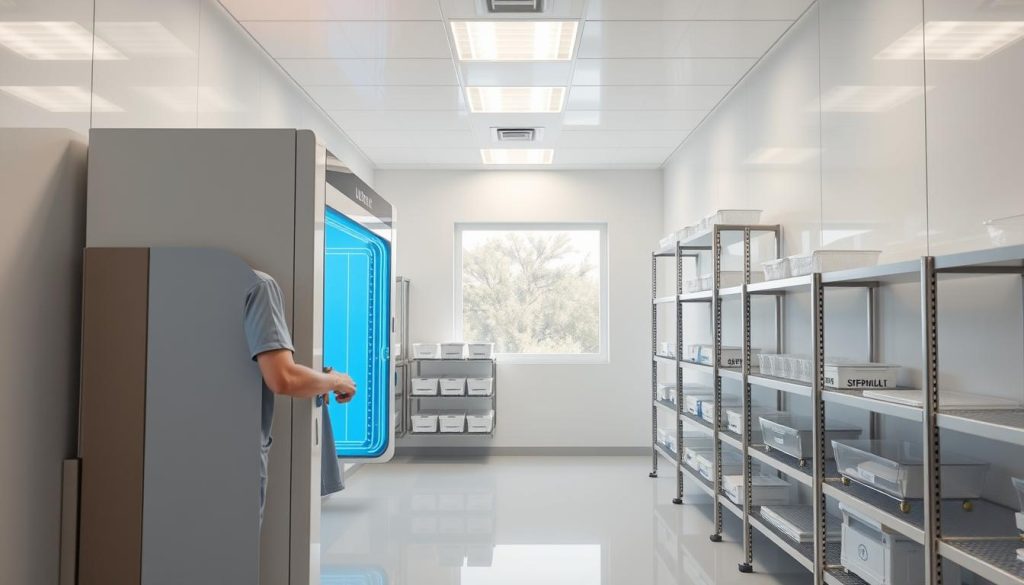
First, HEPA captures particles and allergens from the room. Then activated carbon reduces gases and unpleasant scent.
Enclosed UV-C at 254 nm acts inside a sealed chamber to inactivate microbes before sterile air is reintroduced. This layered approach gives robust, evidence-based results without relying on a single technology.
Safe continuous operation and compliance
Enclosed UV-C designs allow continuous use around people because the lamp works inside a sealed path. These systems produce no ozone and no toxic by-products when specified and installed correctly.
Where UV-capable units fit best
- Reception and waiting areas — higher traffic and turnover.
- Consultation and treatment rooms — sensitive occupancy and close contact.
- Staff pantries and storage/dispensary — stale zones where mould and allergens may build up and scent control is needed.
We view UV-capable products as complementary tools. They support routine cleaning and good ventilation practice, but do not replace surface cleaning or standard infection control protocols.
Targeted pollutant control for cleaner indoor air in medical environments
We focus on identifiable pollutant sources so operators can take practical steps fast. Matching technology to the pollutant profile prevents over-specifying equipment and keeps budgets sensible.
VOCs and chemical particles from regular disinfecting
Frequent cleaning and disinfection can release volatile compounds and tiny chemical particles. These irritants cause stuffiness and can worsen staff and patient comfort during long shifts.
Activated carbon stages help reduce odours and gaseous by-products from routine cleaning. We pair carbon with mechanical filtration and ventilation adjustments to limit exposure.
Dust and dust-mite sources in soft furnishings
Soft textiles such as curtains, rugs and fabric chairs trap dust and mites. High dust load raises allergen counts and can aggravate allergies in sensitive patients and children.
Regular laundering, vacuuming with HEPA-equipped extractors and replacing worn fabrics are simple, effective controls we recommend.
Mould spores, bacteria and other airborne allergens
Mould thrives in humid corners, storage nooks and older finishes. Spores and microbes add to the allergen burden and affect overall health.
Enclosed UV-C modules inside combined systems can inactivate spores and bacteria before treated air returns to the room. We stress that UV complements, not replaces, good housekeeping and moisture control.
“We match technology to the pollutant profile rather than suggesting a one-size-fits-all approach.”
- We map common pollutant sources and recommend realistic controls.
- Our solutions combine carbon stages, filtration and targeted UV where needed.
- Outcome: less stuffiness, fewer irritants and clearer environmental quality for patients and staff.
Maintenance and servicing plans designed for healthcare operations
We design upkeep to fit clinic timetables and to minimise disruption. Predictable schedules and rapid turnarounds keep units operating during working hours so staff need not rearrange shifts.
Fast filter changes and long-life options
Our teams can complete a filter change in minutes using guided workflows and change alerts from the monitoring system.
This reduces downtime and avoids performance drop-offs from overdue replacements.
Typical lifespans and replacement scheduling
HEPA and carbon stages commonly last 6–12 months depending on occupancy and pollutant load.
We confirm schedules with usage data so replacements match real conditions and extend overall life.
Quiet, mobile units with safe mechanical design
Units are low-noise, easy to move for reconfiguration and built without exposed UV lamps, removing overheating risks.
| Item | Typical interval | Benefit |
|---|---|---|
| HEPA filter | 6–12 months | Maintains capture efficiency |
| Carbon stage | 6–12 months | Controls odour and VOCs |
| Machine check | Annual | Extends machine life beyond 8 years |
| Change alerts & monitoring | Real-time | Fewer emergency call-outs; clearer budgeting |
“Consistent maintenance reduces unexpected faults and lowers total cost of ownership.”
Choosing the right air purifier system for each room, budget, and use case
Choosing the right unit depends on room size, how people use the space and the noise you can tolerate.
Small rooms and confined spaces versus large waiting rooms and consultation rooms
We size every product by room volume and typical occupancy. A compact option works well for small consult rooms and short-stay spaces.
For large waiting areas we specify higher-flow systems to achieve at least five renewals per hour. This reduces cumulative exposure while keeping comfort high.
Filter-based solutions versus filterless, silent options
Filter-based systems pair HEPA capture with carbon stages for dust, VOCs and mould control.
Filterless, silent models suit noise-sensitive rooms such as counselling suites or recovery areas. They use low power and near-silent operation where quiet matters more than high airflow.
Performance targets and practical trade-offs
We balance budget against performance. Higher-grade filters and greater flow cost more but deliver measurable outcomes in busy zones.
For staff areas, homes of caregivers, and spaces with children or pets we recommend products sized for occupancy and pollutant load rather than one-size-fits-all choices.
“We size equipment by volume and turnover so it works effectively without creating draughts or noise disruption.”
| Space type | Recommended approach | Target renewals/hr |
|---|---|---|
| Small consultation room | Compact HEPA model, low noise | 5 |
| Large waiting room | High-flow HEPA + carbon, monitored | 5–8 |
| Staff pantry / short-stay | Silent filterless or low-noise unit | 3–5 |
Conclusion
Practical interventions that fit clinic routines make measurable improvements without major disruption. We present a clear business case: better comfort, a stronger hygiene posture and greater confidence for staff and patients.
Our offer is straightforward — assessment, supply, installation, monitoring and maintenance — delivered as practical solutions, not one-off products. We specify H13/H14 HEPA, optional carbon for scent and enclosed UV-C where it suits room use.
Installation can take about ten minutes. Scheduled upkeep and filter planning across months and years keep performance steady. Contact our experts for an on-site assessment and a room-by-room plan tailored to your use and budget, so you get better indoor air quality and cleaner, more comfortable spaces.

